
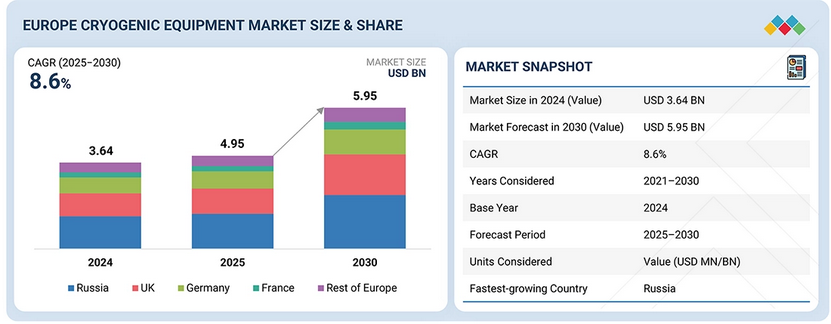
The Europe cryogenic equipment market is projected to reach USD 3.94 billion in 2025 and USD 5.95 billion by 2030, exhibiting a CAGR of 8.6% during the forecast period. The regional market is driven by considerable investments in hydrogen economy development, LNG infrastructure expansion, and energy transition projects. The growing use of industrial gases in chemicals, metallurgy, electronics, and transportation boosts the demand for cryogenic storage and transit systems. Stringent emission reduction rules hasten the use of cleaner fuels, while modernisation of gas handling infrastructure and improvements in cryogenic technology lead to long-term market expansion across Europe.
Europe Cryogenic Equipment Market Size & Forecast:
- Market Size Available for Years: 2020–2030
- 2025 Market Size: USD 3.94 billion
- 2030 Projected Market Size: USD 5.95 billion
- CAGR (2025–2030): 8.6%
Download PDF Brochure @ https://www.marketsandmarkets.com/pdfdownloadNew.asp?id=98058307
Growing investments in innovative manufacturing industries, including semiconductors, electronics, and specialty materials, all of which need ultra-low temperature settings for precise processes, drive the Europe cryogenic equipment market. The need for cryogenic propulsion testing, fuel management, and storage systems grows due to the expansion of aerospace, space research, and satellite programs. Furthermore, a consistent requirement for cryogenic cooling and containment solutions is increasing in physics, material science, and superconducting research activities in European labs. The increasing emphasis on carbon capture, utilization, and storage (CCUS), which uses cryogenic technology for gas separation and liquefaction, is another crucial factor. Demand is also being supported by the production of batteries, the recovery of rare gases, and metal refining applications.
By equipment, the tanks segment is likely to grow at a considerable rate in the Europe cryogenic equipment market between 2025 and 2030. Cryogenic storage tanks are crucial for various applications, such as LNG storage, industrial gas handling, hydrogen projects, and large-scale manufacturing facilities. The tanks section of the Europe cryogenic equipment market is the largest. These tanks are necessary in large quantities for transportation and stationary infrastructure, and they are valuable, long-lived assets. Additionally, there is a steady need for new tanks and the replacement of outdated storage systems throughout Europe due to continuous expenditures in gas storage terminals, distribution hubs, and industrial facilities.
Based on cryogen, the LNG segment is projected to exhibit the highest CAGR in the Europe cryogenic equipment market during the forecast period. The segmental growth can be attributed to the increased dependence of Europe on LNG imports to diversify its energy supply and reduce its overreliance on pipeline gas. Growth of LNG terminals, regasification, and small-scale LNG infrastructure also drives the demand for cryogenic equipment. Besides, in the forecast period, the utilisation of LNG in heavy-duty cars, decentralised power generation, and sea transportation will hasten equipment requirements.
Speak to Analyst @ https://www.marketsandmarkets.com/speaktoanalystNew.asp?id=735
The Europe cryogenic equipment market is influenced by the growth of LNG import terminals, energy source diversification, and decarbonization policies. Growth is also available in strong industrial gas demand and the deployment of the hydrogen strategy. Companies such as Sulzer and Wessington Cryogenic can tap the opportunity by concentrating on high-efficiency cryogenic storage, regasification systems, and hydrogen-ready solutions. To further penetrate the market, collaboration on European-funded clean energy initiatives and providing retrofit services to the existing infrastructure can be done. The focus on sustainability with products that have lower emissions, high automation, and the extension of after-sales services and local networks of services corresponds to the trends in regulations, and reliability and customer loyalty are improved.