
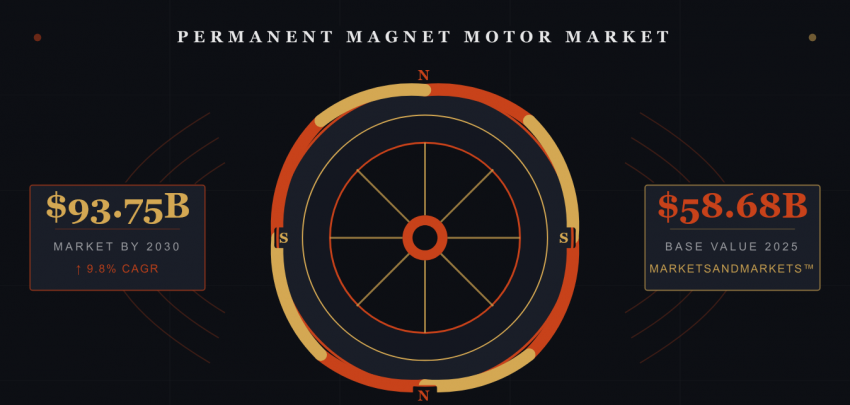
According to new research from MarketsandMarkets™, permanent magnet motor market is on course to leap from an estimated $58.68 billion in 2025 to a remarkable $93.75 billion by 2030, expanding at a robust CAGR of 9.8%.
These motors — which use permanent magnets rather than electromagnets to generate their magnetic fields — are not new inventions. But a confluence of falling rare-earth material costs, breakthroughs in motor control software, and surging demand from EV manufacturers has catapulted them to the center of the global energy transition conversation.
Permanent magnet motors offer superior torque profiles, higher power density, and a more compact design than conventional alternatives — making them the preferred choice wherever efficiency and precision matter most.
Download PDF Brochure @ https://www.marketsandmarkets.com/pdfdownloadNew.asp?id=218887711
Why This Motor? Why Now?
The answer lies in what these motors do better than the alternatives. Conventional induction motors are workhorses — reliable, cheap, and proven. But permanent magnet motors operate at significantly higher efficiencies, particularly at partial loads, and they deliver exceptional torque-to-weight ratios. In an era where every watt saved translates directly to a longer EV driving range or a lower industrial energy bill, that difference is decisive.
Three parallel trends are accelerating adoption simultaneously. First, the EV revolution has created enormous demand: automakers require motors that maximize range without adding weight or bulk to their drivetrains. Second, industrial automation — from robotics to HVAC systems — increasingly demands precision control and low energy consumption. Third, supportive government policies around the world are nudging manufacturers away from older, less efficient motor technologies through both incentives and mandates.
A Look at the Key Segments
By Motor Type
Permanent Magnet AC (PMAC)
The dominant segment. Preferred in EVs, industrial automation, and HVAC for their superior efficiency and performance in variable-speed applications. Declining rare-earth costs are closing the price gap with older motor types.
Permanent Magnet DC (PMDC)
Widely used in smaller consumer electronics and appliances. Simpler drive electronics make them attractive for cost-sensitive applications requiring moderate performance.
Brushless DC (BLDC)
Popular in robotics, drones, and precision industrial tools. Combines the efficiency of AC motors with the controllability of DC, requiring no brushes — reducing maintenance significantly.
Industrial & Commercial End-Use
The largest end-user segment, spanning factory automation, compressors, pumps, and conveyors. Energy savings at scale drive rapid payback periods and strong ROI justifications.
The Asia Pacific Edge
Asia Pacific: The World’s Fastest-Growing Market
Rapid industrialization, a booming electric vehicle manufacturing base, and strong government backing in China, Japan, India, and South Korea make Asia Pacific the undisputed growth leader. The region’s high concentration of motor manufacturers and parts suppliers further accelerates production capacity and drives down costs — creating a self-reinforcing cycle of innovation and adoption.
China alone accounts for a significant share of the global EV market — and each new EV sold typically contains one or more permanent magnet motors. Japan’s industrial automation sector and India’s ambitious manufacturing expansion plans compound this regional advantage. For global motor suppliers, the message is clear: Asia Pacific is where the growth is.
Make an Inquiry @ https://www.marketsandmarkets.com/Enquiry_Before_BuyingNew.asp?id=218887711
Major Players Shaping the Market
| Company | Headquarters | Strategic Focus |
|---|---|---|
| NIDEC Corporation | Japan | EV Drivetrains |
| ABB | Switzerland | Industrial Automation |
| Siemens | Germany | Smart Manufacturing |
| Wolong Electric Group | China | Asia Pacific Growth |
| WEG | Brazil | Energy Efficiency |
Key competitive strategies among these players include targeted acquisitions to expand product portfolios, new product launches aimed at emerging EV segments, and strategic partnerships with automakers and automation integrators. Innovation in magnet materials and motor control electronics is also a central battleground.