

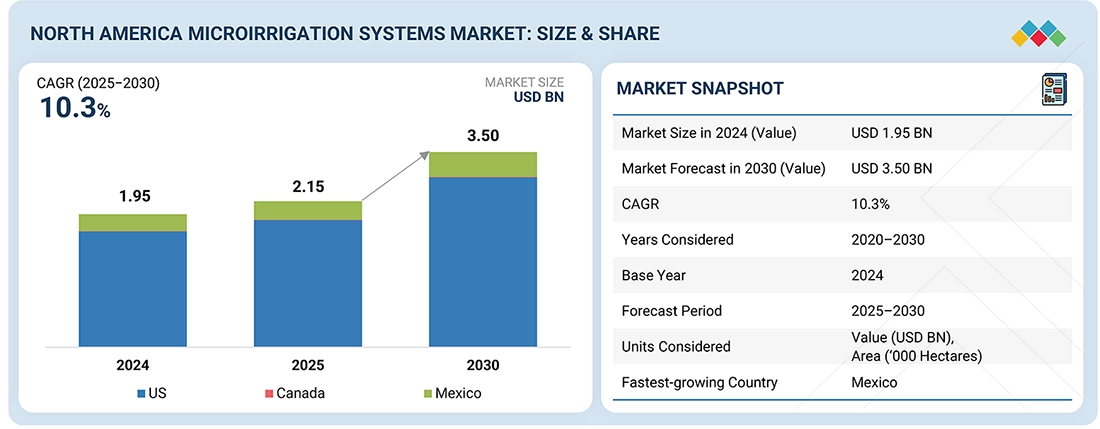
The North America microirrigation systems market is witnessing robust expansion, driven by rising water scarcity, climate variability, and the modernization of agricultural practices. This North America Microirrigation Systems Market Growth trajectory reflects strong structural shifts in farming economics and resource management. The market is valued at USD 2.15 billion in 2025 and is projected to reach USD 3.50 billion by 2030, growing at a CAGR of 10.3% from 2025 to 2030.
Once considered a niche water-saving solution, microirrigation has now become a core component of modern farm infrastructure. Today’s agricultural operations prioritize precision farming, water efficiency, nutrient optimization, and risk mitigation, making microirrigation systems essential for sustainable crop production.
Transformation of Modern Farming Through Microirrigation
The North America Microirrigation Systems Industry is undergoing a structural transformation as farms increasingly redesign operations around predictability, consistent crop output, and resource efficiency. Climate change, groundwater depletion, and regulatory pressure have intensified uncertainty in traditional irrigation methods.
Microirrigation systems enable plant-level water delivery, allowing growers to customize irrigation based on:
- Crop growth stages
- Soil composition
- Weather conditions
- Regional water availability
- These systems are especially valuable in:
- Regions with strict groundwater regulations
- Areas affected by prolonged drought
- Farms transitioning away from flood and conventional sprinkler irrigation
As outdated irrigation models threaten farm profitability and long-term viability, growers are actively investing in modern microirrigation technologies to safeguard productivity and sustainability.
Micro-Sprinkler Systems: Fastest-Growing Segment
By type, the micro-sprinkler segment is projected to be the fastest-growing segment during the forecast period, surpassing traditional drip irrigation growth rates.
Key Growth Drivers:
- Wider and more uniform wetting patterns
- High adaptability across crop types
- Suitability for orchards, vineyards, nurseries, and plantations
- Partial canopy coverage and frost protection capabilities
- Strong performance in sandy and uneven soils
Micro-sprinkler systems also support advanced applications such as
- Fertigation
- Chemigation
- Crop cooling
- Frost protection
Technological innovations—such as pressure-regulated emitters, clog-resistant nozzles, low-flow designs, and automation compatibility—have significantly improved reliability, reduced maintenance costs, and enhanced system longevity.
Although drip irrigation remains dominant in installed acreage, micro-sprinkler systems are expected to record the highest growth rate due to rising high-value crop cultivation, climate volatility, and demand for flexible irrigation solutions.
Download PDF Brochure: https://www.marketsandmarkets.com/pdfdownloadNew.asp?id=63889674
Farmers Dominate Market Demand
By end user, the farmers segment is projected to account for the largest market share throughout the forecast period.
Microirrigation adoption is strongest among growers of permanent and high-value crops, where precision irrigation directly influences:
- Yield consistency
- Crop quality
- Profitability
- Water-use efficiency
Drip and micro-sprinkler systems are no longer viewed as optional upgrades but as core production infrastructure.
A well-established ecosystem of dealers, installers, financing partners, and technical service providers further accelerates adoption by offering:
- Localized system design
- Installation services
- Financing solutions
- Long-term technical support
- Retrofit and expansion programs
While non-farm applications such as landscaping, municipal projects, and industrial irrigation are growing, agriculture continues to dominate market value due to scale, regulatory pressure, and ongoing system upgrades.
United States Leads the Regional Market
The United States is projected to hold the largest market share in North America. Chronic droughts and water shortages have intensified irrigation challenges across multiple agricultural regions.
Historical water supply constraints, declining groundwater availability, and stricter water conservation policies are forcing farmers to adopt high-efficiency irrigation systems to maintain economic viability.
Key Growth States:
California—Market leader due to:
- Large irrigated farmland area
- High concentration of high-value crops (almonds, pistachios, grapes, vegetables)
- Stringent water-use regulations
- Arizona
- Nevada
- Texas
- Washington
These regions benefit from strong demand for water-efficient irrigation due to arid climates and rising pressure to maximize agricultural water productivity.
Request Sample Pages: https://www.marketsandmarkets.com/requestsampleNew.asp?id=63889674
Technology, Policy & Sustainability Driving Market Expansion
Market growth is further supported by:
- Automated irrigation management systems
- IoT-based irrigation monitoring
- Smart fertigation technologies
- Advanced drip and micro-sprinkler engineering
- Climate-adaptive irrigation designs
In addition, federal and state government initiatives promoting:
- Water conservation
- Cost-sharing programs
- Sustainable farming practices
- Climate-resilient agriculture
are accelerating system adoption across North America.
Leading North America Microirrigation Systems Companies:
- Nelson Irrigation (US)
- Rain Bird Corporation (US)
- The Toro Company (US)
- Lindsay Corporation (US)
- Valmont Industries (US)
- HUNTER INDUSTRIES (US)
- T-L Irrigation (US)
- DRIPWORKS (US)
- Netafim (Israel)
Market Outlook
With increasing climate uncertainty, regulatory pressure, and water scarcity, microirrigation systems are becoming strategic infrastructure investments rather than optional technologies. The integration of smart irrigation, automation, and precision farming will continue to reshape agricultural water management.
As innovation accelerates and adoption expands, North America Microirrigation Systems Companies are scaling investments in R&D, smart irrigation platforms, and digital agriculture ecosystems to meet rising demand. As a result, North America is positioned to remain the global leader in the microirrigation systems market, supported by technological innovation, policy backing, and strong farmer-driven demand.