

The food nanoencapsulation market is witnessing rapid expansion and is projected to grow from USD 991.4 million in 2025 to USD 1,856.8 million by 2030, registering a strong Compound Annual Growth Rate (CAGR) of 13.4% during the forecast period.
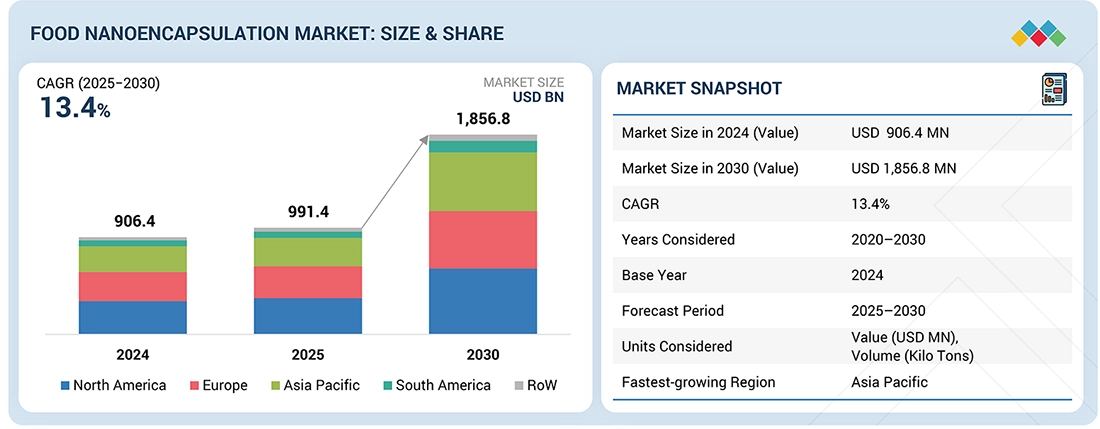
This growth is driven by increasing adoption of advanced encapsulation technologies that operate at the nanoscale to improve ingredient performance, stability, and bioavailability. Food and nutrition manufacturers are increasingly using nanoencapsulation technology to protect sensitive food ingredients and enhance their functional efficiency at the molecular level.
Nanoencapsulation enables the safe and effective delivery of vitamins, minerals, omega-3 fatty acids, probiotics, flavors, antioxidants, and bioactive compounds, making it a critical innovation in modern food processing and functional nutrition.
What Is Food Nanoencapsulation?
Food nanoencapsulation is an advanced delivery system that encloses active ingredients within nanoscale carriers to protect them from environmental stressors such as:
- Heat
- Moisture
- Oxygen
- Light
- Processing conditions
At the nanoscale, encapsulated ingredients show improved stability, enhanced bioavailability, controlled release, and better functional performance across multiple food matrices. This makes nanoencapsulation highly valuable in applications such as:
- Functional foods
- Dietary supplements
- Infant nutrition
- Medical and clinical nutrition
- Fortified beverages
- Dairy products
Food Nanoencapsulation Market Growth Drivers:
Rising Demand for Functional and Fortified Foods: The global shift toward preventive healthcare, wellness nutrition, and immunity-boosting foods is significantly boosting demand for nanoencapsulation solutions in food and nutrition industries.
Growth of Clean-Label Nutrition: Consumers increasingly prefer clean-label, natural, and health-focused products, driving manufacturers to adopt advanced delivery systems that improve performance without synthetic additives.
Technological Advancements
Innovations in:
- Nanoemulsions
- Lipid-based carriers
- Polymeric nanoparticles
- Biopolymer coatings
are improving scalability, processing efficiency, and commercial feasibility, enabling large-scale adoption across the food industry.
Regulatory Support and Industry Standardization
Improved regulatory clarity around nano-ingredients and food safety frameworks is accelerating commercialization and industry adoption.
Download PDF Brochure: https://www.marketsandmarkets.com/pdfdownloadNew.asp?id=51067411
By Encapsulation Technique: Nanoemulsification Dominates
Nanoemulsification holds the largest market share in the food nanoencapsulation market due to its:
- High processing flexibility
- Excellent compatibility with liquid food systems
- Ability to improve delivery of lipophilic ingredients
- Enhanced bioavailability and stability
Nanoemulsification forms nano-sized droplets (typically <200 nm) that enable efficient delivery of:
- Omega-3 fatty acids
- Fat-soluble vitamins
- Flavors
- Antioxidants
- Bioactive compounds
Its advantages include:
- Controlled release functionality
- Oxidation resistance
- Heat and light protection
- Sensory preservation
- Commercial scalability using high-pressure homogenization and ultrasonic emulsification systems
This makes nanoemulsification the most commercially viable nanotechnology platform in food nanoencapsulation.
By Core Material: Vitamins & Minerals Lead the Market
The vitamins and minerals segment accounts for the largest market share due to rising global demand for nutrient-enriched and fortified foods.
Nanoencapsulation improves:
- Nutrient stability
- Bioavailability
- Taste masking
- Dispersion uniformity
- Shelf life
Applications include:
- Functional foods
- Dairy products
- Dietary supplements
- Infant nutrition
- Clinical nutrition products
Drivers include:
- Preventive healthcare awareness
- Global micronutrient deficiency concerns
- Clean-label fortification trends
- Government-supported food fortification programs
Request Sample Pages: https://www.marketsandmarkets.com/requestsampleNew.asp?id=51067411
By Region: North America Leads the Market
North America dominates the global food nanoencapsulation market due to:
- Advanced food technology infrastructure
- Strong regulatory compliance frameworks
- High consumer adoption of functional foods
- Mature nutraceutical and dietary supplement industries
The region shows strong adoption in:
- Functional foods
- Infant nutrition
- Medical nutrition
- Dietary supplements
Nanoencapsulation in North America supports controlled nutrient release, bioavailability enhancement, product stability, and formulation performance, positioning the region as a global innovation leader.
Competitive Landscape
The food nanoencapsulation market is supported by an integrated ecosystem of:
- Global ingredient suppliers
- Food technology providers
- Specialty chemical companies
- Nutrition solution developers
Industry players are investing heavily in:
- Research & development
- Pilot-scale nanoencapsulation systems
- Advanced formulation platforms
- Customized delivery technologies
- Scalable manufacturing solutions
This innovation-driven environment continues to accelerate market growth and commercialization.
Future Outlook
The future of the food nanoencapsulation market is defined by:
- Growth in functional nutrition
- Expansion of preventive healthcare foods
- Rising demand for bioavailable nutrients
- Technological maturation
- Regulatory acceptance
- Industrial-scale deployment
Nanoencapsulation is emerging as a core enabling technology in next-generation food systems, offering tailored nutritional solutions while maintaining product quality, safety, stability, and shelf life.
As global nutrition demands become more personalized and performance-driven, food nanoencapsulation will remain central to the evolution of modern food processing and advanced nutrition delivery systems.