

The global feed vitamins market is projected to grow from USD 1.85 billion in 2025 to USD 2.45 billion by 2030, registering a Compound Annual Growth Rate (CAGR) of 5.7% during the forecast period. This consistent expansion reflects the increasing prioritization of animal health, nutrition, and performance optimization across livestock and poultry production systems worldwide.
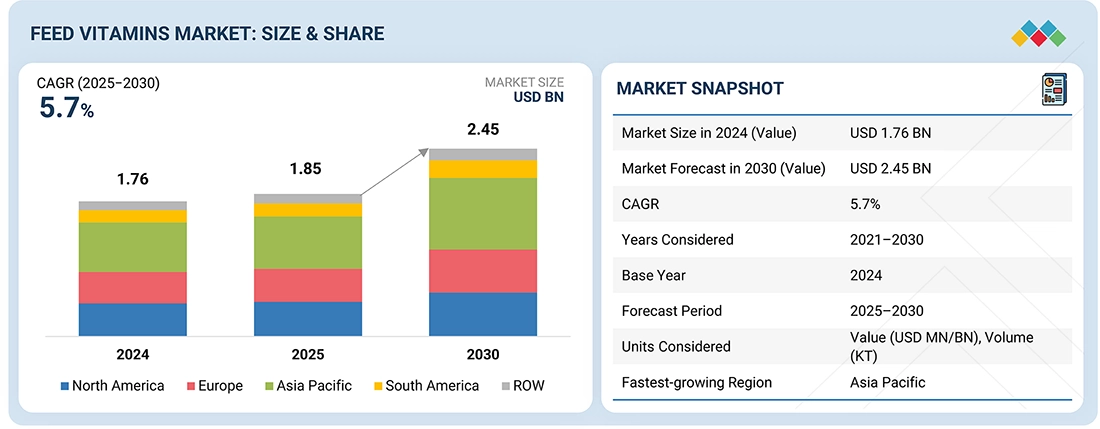
Livestock and poultry producers are increasingly focused on improving growth performance, feed intake, immunity, and overall animal well-being. As animal farming becomes more structured and scaled, the use of vitamin-enriched feed formulations is expanding rapidly across commercial operations. Feed vitamins play a critical role in:
- Enhancing metabolic processes
- Strengthening immune response
- Reducing physiological stress
- Supporting reproduction
- Improving feed conversion efficiency
These functional benefits position vitamins as a core nutritional component rather than a supplementary input in modern livestock and aquaculture feeding systems.
Major feed-producing regions, including North America, Europe, Asia Pacific, and Latin America, are witnessing rising demand for balanced, standardized, and reliable vitamin formulations. Producers are shifting toward safe, effective, and performance-oriented nutrition strategies, reinforcing the long-term growth trajectory of the global feed vitamins market.
Download PDF Brochure: https://www.marketsandmarkets.com/pdfdownloadNew.asp?id=255903634
Asia Pacific: The Fastest-Growing Regional Market
The Asia Pacific region is emerging as the fastest-growing market in the global feed vitamins industry during the forecast period. This growth is driven by rapid expansion in poultry, swine, and aquaculture farming, supported by rising demand for meat, eggs, and seafood.
Countries such as China, India, Vietnam, Thailand, and Indonesia are expanding animal production capacities to meet growing domestic consumption and export demand.
Key structural drivers in the region include:
- Transition from smallholder farming to commercial and integrated production systems
- Expansion of large feed mills and integrated livestock operations
- Greater emphasis on productivity, disease prevention, and feed efficiency
Feed vitamins are now being incorporated as a standard nutritional input, not as an optional additive. Their role in preventing nutrient deficiencies, supporting immunity, and stabilizing productivity makes them essential in modern feed formulations. This structural transformation in animal production systems is driving faster regional growth compared to other global markets.
Water-Soluble Vitamins Segment: Fastest-Growing Product Category
The water-soluble vitamins segment is expected to be the fastest-growing segment in the global feed vitamins market.
Key vitamins in this category—such as B-complex vitamins and vitamin C—play a critical role in:
- Energy metabolism
- Stress management
- Immune function
- Growth performance
Their widespread application across poultry, swine, ruminants, and aquaculture species supports consistent demand.
Growth is further supported by intensive farming practices, where animals face higher metabolic stress, disease exposure, and productivity pressure. Water-soluble vitamins are:
- Easily absorbed
- Flexible in application (feed and drinking water)
- Commonly used during heat stress, disease recovery, vaccination periods, and growth phases
This combination of biological importance, operational flexibility, and routine usage is driving accelerated growth of this segment globally.
Request Sample Pages: https://www.marketsandmarkets.com/requestsampleNew.asp?id=255903634
Dry Feed Additives: The Fastest-Growing Form Segment
The dry form of feed vitamins is the fastest-growing formulation segment in the market, driven by its operational and logistical advantages.
Key growth drivers include:
- High stability against moisture and temperature
- Longer shelf life
- Compatibility with large-scale feed manufacturing systems
- Ease of blending into premixes and compound feeds
- Uniform nutrient distribution
- Reduced processing losses
Commercial feed producers increasingly prefer dry formulations due to their processing efficiency, storage stability, and scalability, making them ideal for industrial feed production and integrated livestock operations. These advantages are accelerating the adoption of dry vitamins globally.
Leading Feed Vitamins Companies:
The global feed vitamins market is supported by strong participation from major nutrition and feed solution providers. Key players profiled in the market include:
- Adisseo (France)
- ADM (US)
- BASF SE (Germany)
- dsm-firmenich (Switzerland)
- Nutreco (Netherlands)
These companies are focused on innovation in vitamin formulations, premix solutions, stability technologies, and bioavailability optimization, strengthening the foundation of the global feed vitamins value chain.
Future Outlook
The global feed vitamins market is transitioning from supplement-based nutrition to systematic, performance-driven feeding strategies. With rising protein demand, structured farming systems, and intensifying production environments, vitamins are becoming strategic nutritional inputs rather than basic additives.
Key long-term growth themes include:
- Expansion of commercial livestock farming
- Growth of aquaculture production
- Increasing demand for safe, standardized nutrition
- Rising focus on animal welfare and health resilience
- Adoption of precision nutrition strategies
As producers seek consistent output, lower health risks, and higher productivity, the role of feed vitamins will continue to strengthen—positioning the market for stable and sustained growth through 2030 and beyond.