
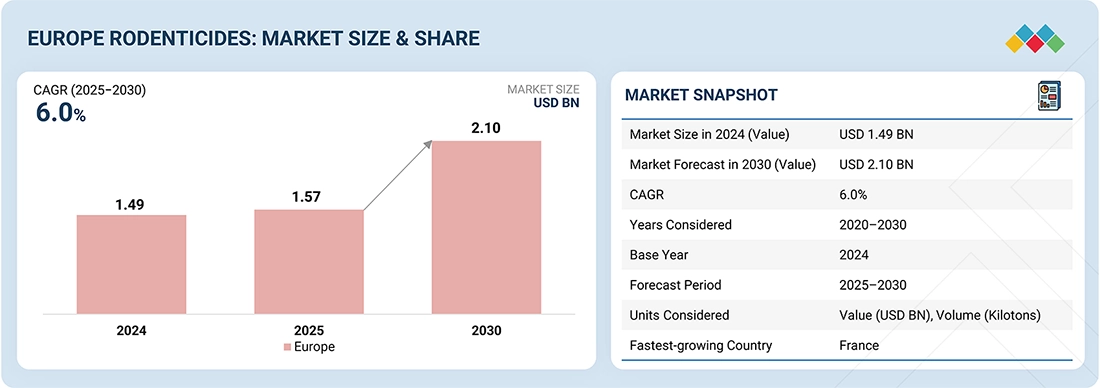
The Europe rodenticides market is on a steady growth trajectory, projected to expand from USD 1.57 billion in 2025 to USD 2.10 billion by 2030, registering a Compound Annual Growth Rate (CAGR) of 6.0% during the forecast period. This expansion clearly reflects the rising Europe rodenticides market size and the strengthening structural importance of rodent control across urban, industrial, and commercial ecosystems.
This positive outlook is driven by rapid urbanization, logistics sector expansion, regulatory evolution, and technological innovation in pest management systems—positioning the European rodenticides industry as a critical component of public health, food safety, and infrastructure protection.
Market Drivers Fueling Europe Rodenticides Market Growth
Multiple macroeconomic and sector-specific forces are accelerating Europe rodenticides market growth across the region:
- Urban redevelopment and smart city investments are increasing the deployment of advanced, integrated pest control systems.
- Expansion of e-commerce logistics and warehousing networks has intensified the need for scalable, reliable rodent control to protect packaged goods, food stocks, and infrastructure assets.
- Automation of service contracts with digital compliance reporting and monitoring platforms is transforming pest control into a data-driven operational service.
- Rising insurance and liability regulations for property risk mitigation are making pest control protocols mandatory across commercial and industrial facilities.
Together, these drivers are shifting rodenticides from standalone products into essential components of integrated pest management (IPM) ecosystems across Europe.
Download PDF Brochure: https://www.marketsandmarkets.com/pdfdownloadNew.asp?id=5630245
Anticoagulants Segment Dominates the Chemical Rodenticides Market
The anticoagulants segment continues to hold a dominant share within the chemical rodenticides category in Europe due to:
- High efficacy and reliability
- User-friendly application methods
- Broad adoption across agricultural, commercial, and municipal sectors
- Ability to manage both small and large rodent populations
- Delayed action that prevents bait shyness and ensures population-level control
First- and second-generation anticoagulants such as bromadiolone, brodifacoum, difenacoum, and flocoumafen remain widely deployed in high-risk environments, including food storage facilities, processing plants, logistics hubs, and transportation infrastructure.
Despite increasing regulatory scrutiny, anticoagulants continue to dominate due to their proven performance, historical trust, cost efficiency, and strong market availability, supported by ongoing investments in compliant and safer formulations.
Mechanical Rodent Control Gaining Strategic Importance
The mechanical segment represents a significant and fast-growing share of the European rodenticides market, driven by:
- Stricter regulatory controls on chemical rodenticides
- Rising animal welfare standards
- Demand for non-toxic and environmentally sustainable alternatives
Solutions such as snap traps, electronic traps, multi-catch traps, and smart trapping systems are seeing strong adoption across food plants, logistics centers, commercial buildings, and municipal infrastructure.
Smart mechanical technologies featuring remote monitoring, automated alerts, and real-time analytics are transforming mechanical rodent control into a scalable, data-integrated, compliance-friendly solution. As sustainability and ESG compliance become core business priorities, mechanical control methods are emerging as long-term strategic alternatives across Europe.
Request Sample Pages: https://www.marketsandmarkets.com/requestsampleNew.asp?id=5630245
Germany Leads the European Rodenticides Market
Germany holds a dominant position in the European rodenticides market due to its:
- Strong industrial and manufacturing base
- Integrated agricultural infrastructure
- High demand from food processing, logistics, warehousing, and public sector facilities
- Dense urban environments in Berlin, Hamburg, and Munich, where rodent pressure is structurally high
The country benefits from advanced regulatory frameworks, strict hygiene standards, mature professional pest management ecosystems, and well-developed distribution networks. The rapid adoption of digital monitoring platforms and smart pest control systems further strengthens Germany’s leadership role in the regional market.
Competitive Landscape: Leading Europe Rodenticides Companies
The market is characterized by innovation, regulatory compliance, and integrated service models. Key European rodenticide companies shaping the competitive landscape include:
- BASF SE (Germany)
- Rentokil Initial plc (UK)
- Syngenta (Switzerland)
- Rollins, Inc. (US)
- Ecolab (US)
- PelGar International (UK)
- Impex Europa S.L. (Spain)
- Futura GmbH (Germany)
- Anticimex (Sweden)
- Pelsis Group (UK)
- Environmental Science U.S. LLC (US)
- Liphatech, Inc. (US)
- Colkim srl (Italy)
- Bell Labs (US)
These organizations are actively investing in sustainable formulations, smart pest control technologies, digital monitoring platforms, and regulatory-compliant solutions, strengthening their long-term market positioning across Europe.