
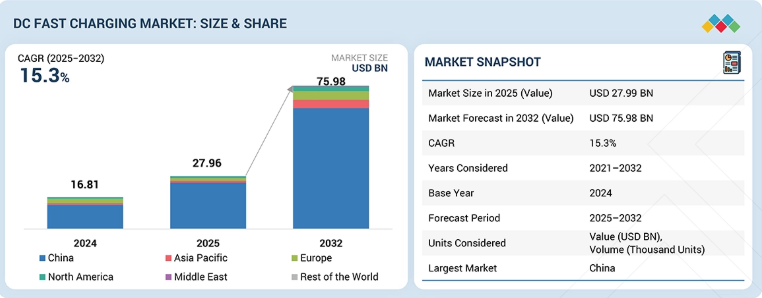
The global DC charging market is expected to grow from USD 27.99 billion in 2025 to USD 75.98 billion in 2032 at a CAGR of 15.3%. The expansion of the DC charging market is closely linked to the structural shift in electric mobility toward higher-energy vehicles and increased reliance on public infrastructure. As EV adoption moves beyond early adopters into the mainstream market and commercial sectors, dependable high-power charging becomes crucial for long-distance travel and fleet growth. The rising popularity of large battery SUVs, pickup trucks, and electric buses is increasing energy demand per session, requiring robust, high-capacity charging systems. In response, infrastructure providers are installing modular DC charging stations capable of supporting higher power levels and adapting to evolving connector standards. Improvements in power conversion and grid interface technologies are further enabling efficient, high-density charging across urban and intercity networks.
Expansion of Urban Charging Networks Accelerating Growth of Public DC Fast Charging
Public charging is projected to be the fastest-growing application segment, driven by expanding highway networks, urban charging hubs, and rising EV adoption among private users without home charging access. Governments and utilities are prioritizing the installation of high-power DC chargers in high-traffic areas to improve accessibility and reduce range anxiety. Growth is supported by deploying multi-bay fast charging stations designed for high vehicle throughput and short dwell times. In April 2025, Tritium announced the expansion of its scalable DC fast charging systems for large public hub installations. In August 2025, Kempower reported additional deliveries of modular high-power chargers for public charging networks across Europe.
Download PDF Brochure @ https://www.marketsandmarkets.com/pdfdownloadNew.asp?id=146469315
Advancement of 800V Architectures Accelerating Growth of Ultra-Fast Charging Segment
Ultra-fast charging is expected to be the fastest-growing segment, driven by the increasing deployment of systems rated above 350 kW to support high-voltage passenger EVs and emerging heavy-duty platforms. Expansion of corridor-based charging hubs and high-throughput urban sites is accelerating demand for higher-output DC infrastructure. Growth is further supported by the shift toward 800 V battery architectures requiring compatible ultra-high-power chargers. In May 2025, Tritium launched its TRI FLEX ultra-scaling architecture designed to support multi-dispenser configurations with high power output for large hub installations. In October 2025, Alpitronic expanded its Hypercharger portfolio with higher-capacity configurations exceeding 300 kW for corridor and fleet applications.
Rising EV Penetration and Public Infrastructure Targets Driving Regional Market Dominance
China is expected to become the largest regional market for DC fast charging, driven by the highest global EV sales and extensive public infrastructure goals. Deployment of high-power DC systems above 150 kW continues in urban areas and intercity corridors, supported by robust domestic manufacturing and standardized national protocols. In March 2025, BYD announced the expansion of its integrated charging and energy solutions portfolio within China to support higher-power vehicle platforms. In July 2025, Star Charge reported further deployments of high-power DC charging stations across major metropolitan and highway networks.
Key Players
Major players in the DC charging market include Tesla Supercharger (USA), ABB Ltd. (Switzerland), Siemens AG (Germany), BYD Company Ltd. (China), and Delta Electronics (Taiwan). These companies provide various DC charging solutions and have robust global distribution networks. They are also actively launching new products and partnering with other companies to expand their market presence.
Request Free Sample Report @ https://www.marketsandmarkets.com/requestsampleNew.asp?id=146469315