

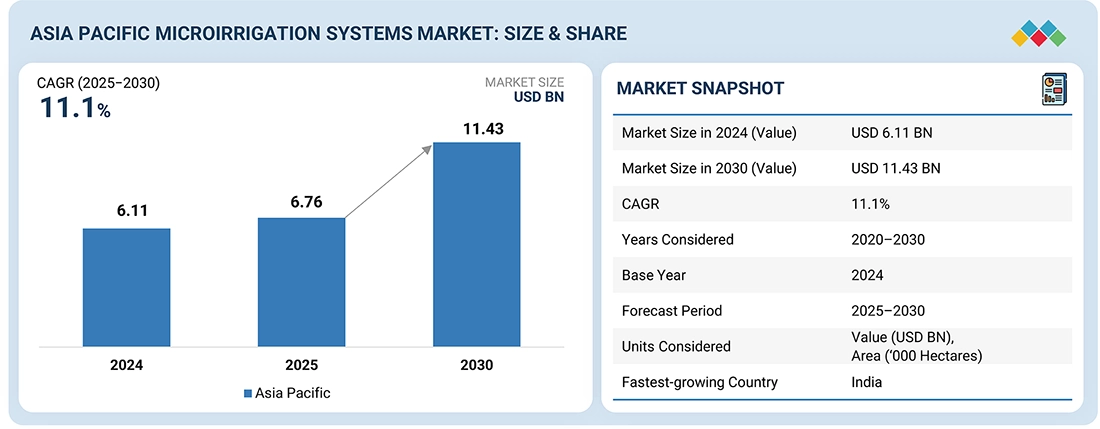
The Asia Pacific Microirrigation Systems Market is poised for substantial growth, projected to expand from USD 6.76 billion in 2025 to USD 11.43 billion by 2030, registering a robust CAGR of 11.1%.
Microirrigation is no longer just a productivity-enhancing solution—it has become a critical agricultural infrastructure across the Asia Pacific region. With increasing water scarcity, climate variability, and regulatory pressure on groundwater usage, farmers are shifting toward precision irrigation technologies to ensure sustainable crop production.
Why Microirrigation is Gaining Momentum in Asia Pacific
- Rising Water Scarcity and Climate Change
Erratic rainfall patterns and declining groundwater levels are compelling farmers to adopt water-efficient irrigation systems. Microirrigation enables:
- Precise water application
- Reduced wastage
- Improved crop yield stability
This transition is especially vital in drought-prone and water-stressed regions.
- Shift Toward Sustainable Farming Practices
Farmers are increasingly aligning irrigation strategies with:
- Long-term risk management
- Cost optimization
- Sustainable agriculture goals
Microirrigation systems, including drip irrigation and microsprinklers, are becoming essential tools for achieving these objectives.
- Growth in High-Value Crop Cultivation
Orchards, plantations, and horticulture farms are leading adoption due to the need for:
- Plant-level irrigation precision
- Efficient fertigation and chemigation
- Enhanced crop quality and yield consistency
Market Dynamics: Evolving Business Models
Manufacturers and suppliers are transforming their go-to-market strategies by focusing on:
- Dealer-led agronomic advisory services
- Modular irrigation system designs
- Flexible financing options
- After-sales and service-based engagement models
This approach supports both smallholder farmers and large commercial farms, accelerating technology adoption across the region.
Download PDF Brochure: https://www.marketsandmarkets.com/pdfdownloadNew.asp?id=40679376
Segment Analysis
By Type: Microsprinklers to Witness Fastest Growth
The microsprinklers segment is expected to grow at the fastest rate during the forecast period.
Key Advantages:
- Wider and more uniform water distribution
- Adaptability across diverse soil types and terrains
- Ideal for orchards, nurseries, and plantations
- Supports microclimate control and partial canopy irrigation
Technological Advancements:
- Pressure-compensated emitters
- Clog-resistant nozzles
- Low-flow system designs
These innovations enhance reliability and performance, making microsprinklers highly suitable for hot and variable climatic conditions across Asia Pacific.
By End User: Farmers Dominate the Market
The farmers segment accounted for the largest market share in 2024 and continues to lead demand.
Key Drivers:
- Direct impact on yield reliability and farm income
- Increasing adoption in high-value crops such as fruits and vegetables
- Access to:
- Installation services
- Agronomic advisory support
- Financing solutions
Countries like India, China, Southeast Asia, and Australia are witnessing strong farmer adoption, driven by the transition from traditional flood irrigation to efficient microirrigation systems.
Request Sample Pages: https://www.marketsandmarkets.com/requestsampleNew.asp?id=40679376
By Country: China Leads the Regional Market
China holds the largest share in the Asia Pacific microirrigation systems market.
Key Growth Factors:
- High dependence on irrigation for agricultural productivity
- Increasing water scarcity and groundwater depletion
- Frequent droughts in northern and western regions
Major Agricultural Regions:
- Xinjiang
- Inner Mongolia
- Hebei
- Shandong
- Henan
- Gansu
Farmers in these regions are rapidly adopting drip and microsprinkler systems to:
- Combat arid conditions
- Address soil salinization
- Ensure consistent crop yields
Government Support:
China’s dominance is further reinforced by:
- Water conservation policies
- Irrigation modernization programs
- Subsidies for efficient irrigation technologies
Additionally, the integration of automation, fertigation systems, and digital monitoring solutions is accelerating adoption, particularly among commercial farms and greenhouse operators.
Leading Asia Pacific Microirrigation Systems Companies:
The Asia Pacific microirrigation systems market features a mix of global leaders and regional players focusing on innovation and expansion.
Key Companies:
- Netafim
- The Toro Company
- Rivulis
- Rain Bird Corporation
- Mahindra EPC
Notable Regional and SME Players:
- Drip Irrigation Technology Solutions (DRTS)
- Kothari Agritech Private Limited
- Harvel Agua India Private Limited
- Hubei Plenterrain Irrigation Equipment Ltd
- Ripple Aquaplast Ltd
- Metro Irrigation
These companies are focusing on product innovation, distribution network expansion, and localized solutions to strengthen their market position.
Future Outlook
The Asia Pacific microirrigation systems market is set for strong growth, driven by:
- Increasing climate risks and water scarcity
- Rising demand for high-efficiency irrigation systems
- Government initiatives promoting sustainable agriculture
- Expansion of high-value crop cultivation
As agriculture in the region becomes more data-driven and resource-efficient, microirrigation will continue to evolve from a supportive tool to a core component of modern farming systems.