
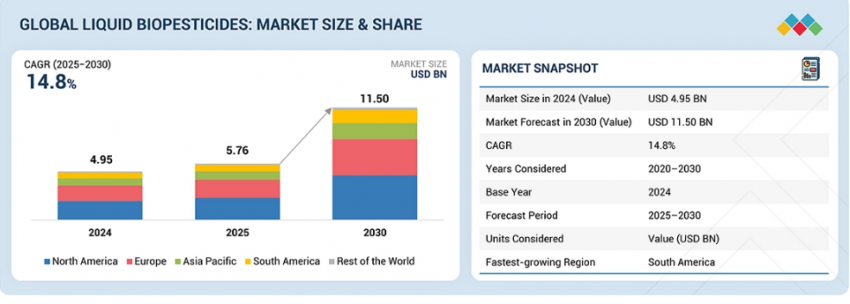
The global liquid biopesticides market is entering a high-growth phase as agriculture steadily shifts toward safer, sustainable crop protection solutions. According to industry projections, the market is expected to grow from USD 5.76 billion in 2025 to USD 11.50 billion by 2030, registering a robust CAGR of 14.8% during the forecast period.
This growth reflects a broader transformation in global farming practices—one driven by food safety concerns, environmental responsibility, and evolving regulatory frameworks.
What’s Driving Market Expansion?
Several structural factors are accelerating demand for liquid biopesticides worldwide. Farmers and agribusinesses are responding to rising consumer expectations for residue-free food while navigating tighter regulations on synthetic pesticides. At the same time, integrated pest management programs are gaining traction, positioning biopesticides as essential tools rather than niche alternatives.
Request Personalized Data Insights for Your Business Goals
The expansion of organic farming acreage, supportive government policies for sustainable agriculture, and continuous advancements in microbial fermentation technologies are further strengthening market momentum. Liquid formulations, in particular, are preferred for their ease of application, improved crop coverage, and seamless compatibility with modern spraying equipment—making them a practical choice across diverse farming systems.
Biofungicides Lead the Type Segment
Within the type segment, biofungicides hold a significant share of the liquid biopesticides industry. Fungal diseases such as powdery mildew, downy mildew, and Fusarium remain major threats to high-value crops, especially fruits, vegetables, and greenhouse-grown produce.
Liquid biofungicides offer rapid action, uniform distribution, and both preventive and curative benefits. Their effectiveness against soil-borne and foliar pathogens, combined with strong compatibility with IPM strategies, has helped reduce reliance on chemical fungicides. As growers focus on long-term disease management and crop quality, biofungicides continue to secure a strong foothold in the market.
Soil Treatment Dominates Mode of Application
Soil treatment represents a major share of the mode of application segment in the liquid biopesticides market. This approach directly targets soil-borne pathogens, nematodes, and root diseases that affect early crop development and overall yield.
Liquid biopesticides used in soil drenching, seedbed treatment, and root-zone applications support effective microbial colonization and provide long-term protection. These benefits align well with organic and regenerative farming practices that prioritize soil health, nutrient uptake, and early-stage crop resilience. As a result, soil treatment applications are widely adopted across horticulture, row crops, and protected cultivation systems.
Europe Holds a Strong Regional Position
Europe accounts for a significant share of the global liquid biopesticides market, supported by stringent regulations on chemical pesticide use and a strong regional push toward sustainable agriculture. The widespread adoption of organic and residue-free farming practices has created a favorable environment for biological crop protection solutions.
Government incentives, subsidies for biological inputs, and a strong focus on environmental protection continue to accelerate market adoption. In addition, Europe benefits from the presence of leading biopesticide manufacturers, active R&D ecosystems, and well-established integrated pest management programs across key agricultural economies.
Competitive Landscape and Industry Outlook
The market features a diverse mix of global and regional players actively investing in product innovation, microbial research, and formulation advancements. Companies such as BASF SE, BioFirst Group, Syngenta, Koppert, Novonesis Group, Bayer AG, Bioceres Crop Solutions, UPL, Andermatt Biocontrol, Corteva, Rovensa Next, DE SANGOSSE Group, Certis Belchim, and Seipasa are shaping the competitive landscape through strategic expansions and portfolio diversification.
Looking ahead, liquid biopesticides are expected to play an increasingly central role in sustainable crop protection. As regulatory pressure intensifies and growers prioritize productivity alongside environmental stewardship, the market is well-positioned for continued expansion through 2030 and beyond.
Make an Inquiry to Address your Specific Business Needs
Frequently Asked Questions
- What are liquid biopesticides?
Liquid biopesticides are biological crop protection products formulated in liquid form and derived from natural sources such as microorganisms or biochemical compounds. They are used to control pests, diseases, and nematodes while minimizing environmental impact and chemical residues.
- Why is the liquid biopesticides market growing rapidly?
The market is growing due to increasing demand for residue-free food, stricter regulations on chemical pesticides, rising adoption of organic farming, and wider use of integrated pest management programs. Liquid formulations are also preferred because they are easy to apply and compatible with modern spraying equipment.
- Which segment holds a major share in the liquid biopesticides market?
The biofungicides segment holds a significant share, as fungal diseases pose major threats to high-value crops such as fruits, vegetables, and greenhouse produce. Liquid biofungicides offer effective prevention and control of soil-borne and foliar pathogens.
- Why is soil treatment an important mode of application?
Soil treatment plays a key role because it targets soil-borne pathogens, nematodes, and root diseases that affect crop establishment and yield. Liquid biopesticides applied through soil drenching or root-zone treatment support better microbial activity and long-term crop protection.
- Which region dominates the liquid biopesticides market?
Europe holds a significant share of the global liquid biopesticides market due to strict pesticide regulations, strong support for sustainable agriculture, and widespread adoption of organic and residue-free farming practices.
- What types of crops benefit most from liquid biopesticides?
Liquid biopesticides are widely used in cereals and grains, oilseeds and pulses, fruits and vegetables, and greenhouse crops. They are particularly effective in high-value and export-oriented crops where residue compliance is critical.