
According to MarketsandMarkets, the biopesticides market is projected to reach USD 15.66 billion by 2029, up from USD 7.72 billion in 2024, growing at a CAGR of 15.2% during the forecast period in terms of value. This rapid expansion reflects long-term biopesticides market trends driven by sustainable agriculture practices, rising consumer preference for organic food, and tightening regulations on synthetic chemical pesticides.
Governments and regulatory bodies worldwide are strengthening controls on conventional agrochemicals due to environmental and health concerns. In 2023, the U.S. Environmental Protection Agency updated its FIFRA regulations, introducing a more comprehensive assessment of environmental and health risks associated with chemical pesticides. These updates emphasize minimizing pesticide residue risks in food and reinforce compliance with the Food Quality Protection Act, raising safety benchmarks for synthetic products.
Similarly, the European Union has taken decisive action by banning several key active ingredients. In June 2022, the EU proposed reducing chemical pesticide usage by 50% by 2030. Such regulatory developments continue to accelerate the transition toward biological alternatives in agricultural production.
Driver: Increasing Demand for Organic Food
The rising demand for organic food remains a major driver of market growth, as consumers increasingly prioritize health, food safety, and environmentally responsible farming practices.
Organic farming prohibits the use of synthetic pesticides and fertilizers, creating a natural reliance on biopesticides derived from microorganisms, plant extracts, and other organic sources. Increased awareness of the health and environmental impacts of chemical residues has further strengthened this shift.
According to the Organic Trade Association’s 2023 Organic Industry Survey, organic food sales in the United States surpassed USD 60 billion in 2022, while total organic sales, including non-food items, reached USD 67.6 billion. This sustained growth in organic farming has increased the need for effective pest management solutions that comply with certification standards.
Unlock Business Growth with Custom Data Tailored for You
Opportunity: Integration of Biopesticides in Precision Agriculture
Precision agriculture presents a key opportunity by enhancing the efficiency and effectiveness of pest management practices. Technologies such as drones, GPS-guided equipment, and sensor-based systems allow targeted application of biopesticides at precise locations and optimal timings.
This approach reduces waste, minimizes environmental impact, and lowers input costs for farmers. Data-driven insights from digital farming platforms further support tailored crop protection strategies aligned with sustainability goals.
Government incentives, research funding, and public–private partnerships continue to support innovation in precision agriculture. As adoption of advanced farming practices increases globally, this integration is expected to positively shape the biopesticides market outlook over the coming years.
North America to Dominate the Biopesticides Market During the Forecast Period
North America is expected to hold the largest share of the global market due to strong regulatory frameworks, widespread adoption of organic farming, and increasing demand for sustainable agriculture.
In the United States and Canada, stringent regulations on chemical pesticide usage—particularly in food production—have accelerated adoption of biological alternatives. Government subsidies, grants, and sustainability initiatives further support this transition.
The region also benefits from strong research and development capabilities, especially in the United States, where leading agricultural companies continue to invest in advanced biopesticide formulations. Well-established distribution networks ensure broad product availability, reinforcing North America’s leadership position.
Cereals and Grains to Hold a Significant Market Share
Cereals and grains represent a significant share of the market due to their critical role in meeting global food demand. Rising population levels and increasing consumption of staple crops have intensified the need for improved yields and effective pest management.
According to FAO reports, global cereal utilization for 2023/24 is expected to increase compared to previous years, with higher global stocks forecast by 2024. This underscores the importance of sustainable crop protection solutions, positioning biopesticides as a key component of yield optimization strategies.
Seed Treatment to Grow at the Highest Rate by Mode of Application
Seed treatment is projected to grow at the highest rate within the mode of application segment. Biopesticide-based seed treatments provide early-stage crop protection, reducing dependence on chemical pesticides during later growth phases.
Growing concerns about soil health, environmental sustainability, and pesticide residues have accelerated adoption of biological seed treatments. These solutions offer targeted pest control, support healthy crop establishment, and contribute to improved yield outcomes.
Competitive Landscape
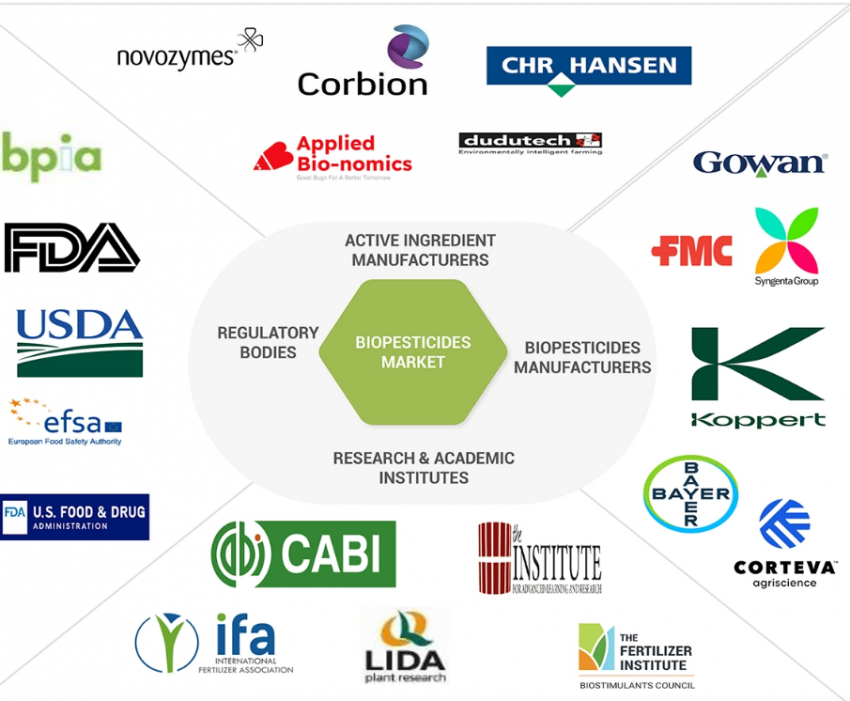
The market features a mix of multinational agrochemical companies and specialized biological solution providers. Key players include BASF SE, Bayer AG, Syngenta Group, UPL, Corteva, FMC Corporation, Nufarm, Sumitomo Chemical Co., Ltd., Certis USA L.L.C., Bioceres Crop Solutions, Novonesis Group, Koppert, Biobest Group NV, Gowan Company, and Lallemand Inc.
These companies continue to invest in innovation, partnerships, and capacity expansion to strengthen their positions within the global biopesticides market report landscape.
Recent Developments in the Biopesticides Market
- In May 2024, Bioceres Crop Solutions Corp received approval from Brazil’s Ministry of Agriculture and Livestock for three new bio-insecticidal and bio-nematocidal solutions derived from its proprietary Burkholderia platform.
- In May 2024, FMC Corporation partnered with Optibrium to accelerate the discovery of novel crop protection technologies, including biopesticides, using machine learning and artificial intelligence.
- In April 2024, Bayer entered into an agreement with AlphaBio Control to develop a new biological insecticide for arable crops, strengthening its sustainable crop protection portfolio.
- In March 2024, BASF invested in a new fermentation plant for biological and biotechnology-based crop protection products at its Ludwigshafen site, with operations expected to begin in the second half of 2025.
- In December 2023, Syngenta launched CERTANO, its first biological product for sugarcane production, offering both nematode control and biofungicidal action.
Frequently Asked Questions (FAQs)
- What are biopesticides?
Biopesticides are pest control products derived from natural sources such as microorganisms, plants, minerals, and organic compounds. They are used to manage pests while minimizing environmental and health impacts compared to synthetic chemical pesticides.
- What is driving the growth of the biopesticides market?
Market growth is driven by increasing demand for organic food, stricter regulations on chemical pesticides, and rising awareness of sustainable farming practices. Government policies and environmental safety standards are accelerating adoption worldwide.
- Why are governments promoting the use of biopesticides?
Governments are promoting biopesticides to reduce chemical residue in food, protect biodiversity, and minimize environmental pollution. Updated regulatory frameworks in regions such as North America and Europe encourage safer and more sustainable crop protection solutions.
- How does organic farming influence biopesticide demand?
Organic farming prohibits the use of synthetic pesticides, making biopesticides essential for pest and disease control. As organic food consumption increases, farmers rely more on biological crop protection methods to meet certification standards.
- What role does precision agriculture play in biopesticide adoption?
Precision agriculture enables targeted and efficient application of biopesticides using technologies such as drones, sensors, and GPS-guided equipment. This approach reduces waste, lowers costs, and improves pest control effectiveness.
- Which region leads the global biopesticides market?
North America leads the global market due to strong regulatory support, high adoption of organic farming, and significant investments in research and development for biological crop protection products.