
Introduction
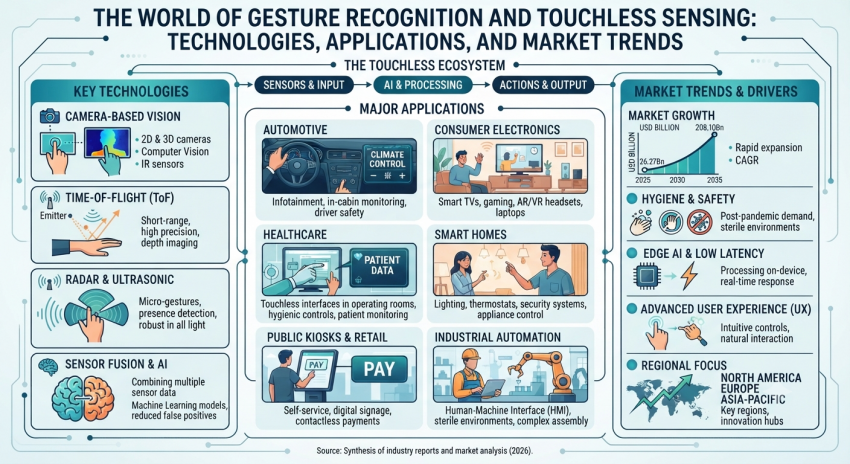
The North America Gesture Recognition and Touchless Sensing Market is witnessing significant growth as industries increasingly adopt advanced human-machine interaction technologies. Gesture recognition and touchless sensing enable users to operate electronic devices, machines, and digital systems without relying on traditional physical interfaces. These technologies use human movements, including hand, finger, head, and body gestures, to facilitate seamless communication between humans and machines.
The increasing demand for contactless interfaces across consumer electronics, automotive, healthcare, retail, and industrial applications is creating new opportunities for market participants. Growing investments in artificial intelligence (AI), machine learning, computer vision, radar-based sensing, and advanced sensor technologies are further improving the accuracy and functionality of gesture recognition systems.
According to MarketsandMarkets, the North America gesture recognition and touchless sensing market is projected to grow from USD 9.65 billion in 2025 to USD 25.94 billion by 2030, registering a compound annual growth rate (CAGR) of 21.9% during the forecast period. Increasing digitalization, demand for improved user experiences, and the adoption of connected technologies are expected to support market expansion.
Increasing Demand for Touchless Technologies Across North America
The growing adoption of digital technologies across North America is creating strong demand for touchless sensing and gesture recognition solutions. Businesses are increasingly integrating contactless interfaces into their operations to improve convenience, operational efficiency, hygiene, and workplace safety.
Traditional physical interfaces, including buttons, switches, and touchscreens, are gradually being complemented by advanced sensing technologies. Gesture recognition enables users to interact with electronic devices through predefined movements, while touchless sensing allows systems to detect proximity, movement, and biometric characteristics without requiring physical contact.
In consumer electronics, manufacturers are integrating gesture-based controls into smartphones, wearable devices, smart televisions, and immersive computing platforms. These applications enable more natural interactions and improve accessibility for users.
The automotive industry is another important area of adoption. Automakers are introducing gesture-based infotainment controls and advanced in-cabin sensing technologies to improve driver convenience and reduce unnecessary physical interactions while driving.
Similarly, healthcare organizations are exploring touchless interfaces for medical equipment, patient interaction, and hands-free applications. These technologies support improved hygiene and more convenient interaction in clinical environments.
Download PDF brochure – https://www.marketsandmarkets.com/pdfdownloadNew.asp?id=13491584
Artificial Intelligence and Advanced Sensors Transforming Gesture Recognition
Artificial intelligence and advanced sensing technologies are playing an important role in improving gesture recognition capabilities. AI-powered algorithms can interpret human movements, identify gestures, and support real-time interaction between users and electronic devices.
Computer vision, depth-sensing cameras, radar-based motion detection, and time-of-flight sensors are supporting the development of more accurate and responsive gesture recognition systems.
The integration of machine learning algorithms allows devices to recognize different movement patterns and improve interaction accuracy. These developments are expanding the application of touchless technologies across connected vehicles, smart homes, healthcare facilities, and commercial environments.
Edge processing is also becoming increasingly important because it enables devices to process sensor information locally. This can improve responsiveness while reducing dependence on cloud-based processing. Local processing can also support privacy-focused applications where sensitive information requires careful handling.
The combination of AI software, advanced sensors, and connected devices is expected to create new opportunities for technology providers across North America.
Major Growth Drivers of the North America Gesture Recognition and Touchless Sensing Market
Rising Demand for Contactless Retail and Self-Service Solutions
The increasing adoption of self-service technologies across retail and commercial environments is supporting market growth. Retailers are implementing interactive kiosks, contactless ordering systems, and touchless navigation interfaces to improve customer convenience.
Gesture recognition lets customers navigate digital displays and access information through hand movements without touching the screen. These solutions can improve customer engagement while supporting faster interactions at checkout counters and service locations.
Quick-service restaurants are also exploring touchless ordering systems to improve service efficiency and simplify customer interactions. Integrating gesture-based menu navigation with digital ordering platforms creates opportunities for technology providers and system integrators.
Growing Adoption of Smart Home and Building Automation
The expansion of smart home technologies is creating additional demand for gesture recognition and proximity sensing solutions. Consumers are increasingly adopting connected lighting systems, smart appliances, automated security solutions, and intelligent home environments.
Touchless sensing allows users to operate lighting, entertainment systems, and other connected devices without using conventional switches or remote controls. Gesture-based interfaces can also improve accessibility and convenience in residential environments.
Commercial buildings are adopting touchless access control, biometric authentication, and automated building management systems. These applications are supporting the development of connected and intelligent infrastructure across North America.
Increasing Integration of Gesture Controls in Automotive Applications
The automotive industry is emerging as an important growth opportunity for gesture recognition and touchless sensing technologies. Automakers are integrating advanced human-machine interfaces into connected vehicles and electric vehicles to improve driver convenience and passenger experiences.
Gesture-based controls can support infotainment navigation, audio adjustment, and selected vehicle functions. These systems can reduce the need for drivers to interact directly with physical controls, although their effectiveness depends on interface design and safe implementation.
Advanced radar sensors, cameras, and proximity detection systems are also supporting in-cabin monitoring applications. These technologies can contribute to driver attention monitoring and child presence detection.
The increasing development of software-defined vehicles and connected automotive platforms is expected to accelerate the adoption of advanced sensing technologies.
Key Commercial Applications Across Industries
Consumer Electronics
Consumer electronics is expected to remain an important industry for gesture recognition adoption in North America. Smartphones, wearable devices, gaming systems, and spatial computing platforms are increasingly incorporating advanced interaction technologies.
Manufacturers are developing devices that recognize hand movements, facial characteristics, and eye movements to provide more intuitive user experiences. These applications are expanding the role of gesture recognition beyond conventional touchscreen interfaces.
Healthcare
Healthcare organizations are exploring touchless sensing solutions to support hands-free medical equipment operation, patient interaction, and digital healthcare applications.
Gesture-based interfaces can allow medical professionals to interact with digital information without touching shared equipment. This can support hygiene practices and improve workflow convenience in clinical environments.
The integration of mixed reality platforms and advanced sensing technologies is also creating opportunities for medical training, simulation, and hands-free guidance.
Automotive
Automotive manufacturers are increasingly focusing on advanced human-machine interfaces to improve vehicle interaction. Gesture recognition can enable drivers and passengers to operate selected infotainment functions through natural movements.
Touchless sensing can also support cabin monitoring and proximity-based applications. The expansion of electric and connected vehicles is expected to create additional opportunities for automotive sensor manufacturers and technology providers.
Retail and Commercial Infrastructure
Retailers, airports, financial institutions, and public facilities are adopting contactless technologies to improve customer experiences and operational efficiency.
Touchless biometric equipment can support identity verification and access control, while gesture-enabled digital displays can provide interactive navigation and information services.
These applications are expanding the addressable market for touchless sensing solutions across commercial and public-sector environments.
Company Use Cases Driving Market Innovation
Leading technology companies are developing gesture recognition and touchless sensing solutions for consumer electronics, automotive, healthcare, smart homes, and enterprise applications. Their innovations are supporting the commercialization of advanced human-machine interfaces across North America.
Apple: Advancing Natural User Interfaces and Spatial Computing
Apple Inc.
Apple has integrated gesture recognition and touchless sensing into its consumer electronics ecosystem. Face ID supports biometric authentication across iPhone and iPad devices, while Apple Watch supports gesture-based interactions. Vision Pro extends these capabilities through spatial computing, hand tracking, and eye-gaze interactions.
These technologies improve authentication, privacy, accessibility, and user convenience. Natural hand movements and eye tracking also enable more immersive augmented and virtual reality experiences, creating new opportunities for advanced human-machine interaction.
Microsoft: Expanding Enterprise and Mixed Reality Applications
Microsoft Corporation
Microsoft has developed gesture recognition capabilities through technologies such as Azure Kinect DK and HoloLens. These platforms support enterprise applications, including hands-free medical guidance, industrial equipment interaction, and gesture-based collaboration.
The technology supports workplace productivity, hands-free interaction, and mixed reality training. Healthcare professionals and industrial workers can benefit from interfaces that reduce the need to physically interact with shared equipment.
Microchip Technology: Enabling Touchless Automotive and Smart Home Controls
Microchip Technology Inc.
Microchip Technology provides sensor and semiconductor solutions that support gesture recognition and touchless sensing applications. Its technologies can enable mid-air gesture controls in automotive infotainment systems, touchless light switches, smart home devices, and consumer electronics.
These solutions improve convenience by reducing dependence on physical buttons and switches. Automotive gesture interfaces can also support intuitive interactions and help reduce driver distraction when appropriately designed.
Google: Developing Radar-Based Gesture Recognition
Google LLC
Google has explored radar-based motion sensing through Project Soli, enabling gesture interactions in compatible devices. Applications include touchless music controls, call management, alarm snoozing, and motion-based interactions.
Radar-based sensing can enable hands-free device operation without relying exclusively on camera-based interfaces. These capabilities support accessibility, convenience, and smart home automation through proximity and motion detection.
OMNIVISION: Improving Sensing Capabilities Through Radar and ToF Technologies
OMNIVISION
OMNIVISION provides advanced sensing technologies, including image sensors and solutions supporting automotive cabin monitoring, smart retail displays, and industrial applications. The use cases supplied include 60 GHz radar sensors and time-of-flight (ToF) sensing.
These technologies can support driver monitoring, child presence detection, interactive retail displays, and human-machine collaboration. Advanced sensing capabilities also help improve system reliability under different lighting and environmental conditions.
Together, these companies demonstrate how advanced sensing hardware, AI software, and natural interaction technologies are expanding the commercial applications of gesture recognition and touchless sensing across North America.
Market Segmentation and Emerging Opportunities
Touchless Technology Expected to Lead the Technology Segment
Touchless technology is expected to lead the North America gesture recognition and touchless sensing market during the forecast period. Increasing demand for contact-free interfaces across consumer electronics, automotive, healthcare, and commercial infrastructure is supporting its adoption.
Businesses are increasingly implementing touchless solutions to improve user convenience and operational efficiency. The growing availability of advanced cameras, proximity sensors, and radar-based technologies is also supporting the development of more sophisticated systems.
Online Gesture Recognition to Witness Rapid Growth
The online gesture recognition segment is expected to register the fastest growth rate. Online gesture recognition enables systems to identify and process movements in real time, making it suitable for connected devices and interactive applications.
Advancements in AI algorithms and real-time data processing are improving the responsiveness of these systems. Increasing adoption across smart applications, connected vehicles, and consumer electronics is expected to create additional growth opportunities.
Consumer Electronics to Maintain Market Dominance
The consumer electronics segment is expected to dominate the gesture recognition industry. Smartphones, smart televisions, gaming devices, and wearable products are increasingly incorporating natural user interfaces.
Consumers are showing growing interest in convenient and intuitive device interactions. The integration of voice assistants, AI-powered applications, and advanced sensing technologies is further supporting the development of gesture-enabled products.
Touchless Biometric Equipment to Lead Product Adoption
Touchless biometric equipment is expected to dominate the touchless sensing product segment. The increasing need for secure and contact-free identity verification is encouraging adoption across airports, government facilities, offices, and financial institutions.
Facial recognition and other biometric technologies can support authentication and access control without requiring conventional physical interaction. Growing investments in digital security infrastructure are creating additional opportunities for solution providers.
Automotive to Register the Fastest Industry Growth
The automotive industry is expected to register the fastest CAGR in the North America touchless sensing market. Automakers are increasingly integrating advanced sensing technologies into connected vehicles and electric vehicles.
Gesture-based infotainment controls, driver monitoring, and cabin sensing are emerging as important applications. The growing emphasis on vehicle safety, convenience, and advanced digital interfaces is expected to accelerate technology adoption.
Regional Analysis of the North America Market
United States
The United States is expected to dominate the North America gesture recognition and touchless sensing market. The country’s established technology ecosystem, strong presence of leading technology companies, and investments in AI and advanced sensing solutions are supporting market expansion.
Adoption across consumer electronics, automotive, healthcare, and commercial infrastructure is creating opportunities for technology manufacturers and service providers. The growing integration of smart devices and connected technologies is further strengthening demand for advanced human-machine interfaces.
Canada
Canada is expected to record strong growth in the gesture recognition and touchless sensing market. Increasing adoption across healthcare, smart buildings, and public infrastructure is supporting demand for contactless technologies.
The country’s focus on digital transformation, artificial intelligence, and research and development is encouraging innovation in sensing technologies. The adoption of gesture-based solutions across medical equipment, gaming, and connected environments is also contributing to market expansion.
Mexico
Mexico is witnessing increasing adoption of gesture recognition and touchless sensing technologies across consumer electronics, automotive manufacturing, healthcare, and smart home applications.
The country’s expanding automotive manufacturing sector is creating opportunities for advanced human-machine interfaces and in-vehicle sensing solutions. Increasing investments in digital technologies and industrial automation are expected to support market development.
Challenges Affecting Market Adoption
Privacy and Data Security Concerns
Privacy and data security remain important considerations for camera-based gesture recognition systems. These technologies may process visual information and biometric data, creating concerns about data collection, storage, and usage.
Organizations must address these concerns through appropriate security measures, transparent data practices, and responsible technology implementation. Privacy-focused processing and secure system architectures can support greater user confidence.
High Implementation and Integration Costs
Advanced gesture recognition systems require specialized sensors, processing hardware, software algorithms, and system integration. These requirements can increase implementation costs for businesses.
Small and medium-sized organizations may face difficulties adopting sophisticated sensing solutions because of initial investment requirements. Cost optimization, hardware innovation, and scalable software platforms will be important for wider commercialization.
Lack of Standardization
The absence of consistent standards across gesture recognition technologies and platforms can create interoperability challenges. Different hardware configurations and software environments may affect compatibility between devices.
Greater standardization and improved integration capabilities will be important for supporting large-scale adoption across multiple industries.
Future Outlook for the North America Gesture Recognition and Touchless Sensing Market
The future of the North America gesture recognition and touchless sensing market will be shaped by advancements in AI, machine learning, computer vision, radar sensing, and connected technologies.
Automotive manufacturers are expected to explore more advanced in-cabin interaction systems, while consumer electronics companies continue developing natural user interfaces for smartphones, wearables, and spatial computing devices.
Healthcare providers and commercial organizations are also expected to increase their use of touchless interfaces for authentication, equipment operation, and customer interaction. Meanwhile, the expansion of smart buildings and connected infrastructure will create additional opportunities for proximity sensing and gesture-enabled automation.
Companies investing in advanced sensor development, AI-powered software, and integrated human-machine interfaces are likely to strengthen their competitive positions. Partnerships between semiconductor manufacturers, technology providers, automotive companies, and system integrators will also support market commercialization.
With the market projected to reach USD 25.94 billion by 2030, North America represents an important growth opportunity for companies developing next-generation interaction technologies.
Conclusion
The North America gesture recognition and touchless sensing market is entering a period of significant expansion as industries move toward more intuitive, contactless, and intelligent interaction systems. Increasing adoption across consumer electronics, automotive, healthcare, retail, and smart infrastructure is creating new commercial opportunities.
Companies such as Apple, Microsoft, Microchip Technology, Google, and OMNIVISION are contributing to market innovation through biometric authentication, radar-based sensing, advanced imaging, mixed reality, and gesture-enabled interfaces.
Although privacy concerns, implementation costs, and interoperability challenges remain important considerations, continued advancements in AI and sensing technologies are expected to improve system performance and expand application areas.
The combination of digital transformation, connected devices, and demand for natural human-machine interaction is expected to remain a major contributor to the growth of the North America gesture recognition and touchless sensing market through 2030.