
The Humanoid Robot Market Growth Analysis highlights how technological innovation, rising labor shortages, and increasing investments in robotics are reshaping the global automation landscape. Unlike conventional industrial robots designed for specific repetitive tasks, humanoid robots can operate in human-centric environments and perform multiple activities using human-like structures, sensors, and intelligent control systems.
As businesses explore flexible automation solutions, humanoid robots are gaining attention as a potential solution for labor-intensive and repetitive operations. Continuous improvements in robotic actuators, artificial intelligence, battery technology, and sensor integration are expected to strengthen their commercial potential.
Understanding the Humanoid Robot Market
Humanoid robots are robots designed with a human-like appearance and capabilities. They generally feature a head, torso, arms, and legs, allowing them to interact with objects and navigate environments originally designed for people. Depending on their applications, humanoid robots may be fully autonomous, semi-autonomous, or remotely controlled.
The Humanoid Robot Market Growth Analysis reflects the growing transition from traditional automation toward intelligent, adaptable robotic systems. These robots combine hardware and software technologies to understand their surroundings, process information, make decisions, and execute physical tasks.
Key technologies supporting humanoid robot development include:
-
Artificial Intelligence: Enables robots to understand instructions, recognize objects, and make decisions.
-
Computer Vision: Helps robots identify objects, interpret surroundings, and navigate complex environments.
-
Advanced Actuators: Support precise movement and human-like mobility.
-
Sensors: Enable robots to detect pressure, movement, distance, temperature, and environmental changes.
-
Machine Learning: Improves performance through data-driven learning and continuous optimization.
-
Motion Control Systems: Coordinate robotic movements, balance, and physical interactions.
The integration of these technologies is making humanoid robots more intelligent, adaptable, and suitable for real-world applications.
Download PDF Brochure @ https://www.marketsandmarkets.com/pdfdownloadNew.asp?id=99567653
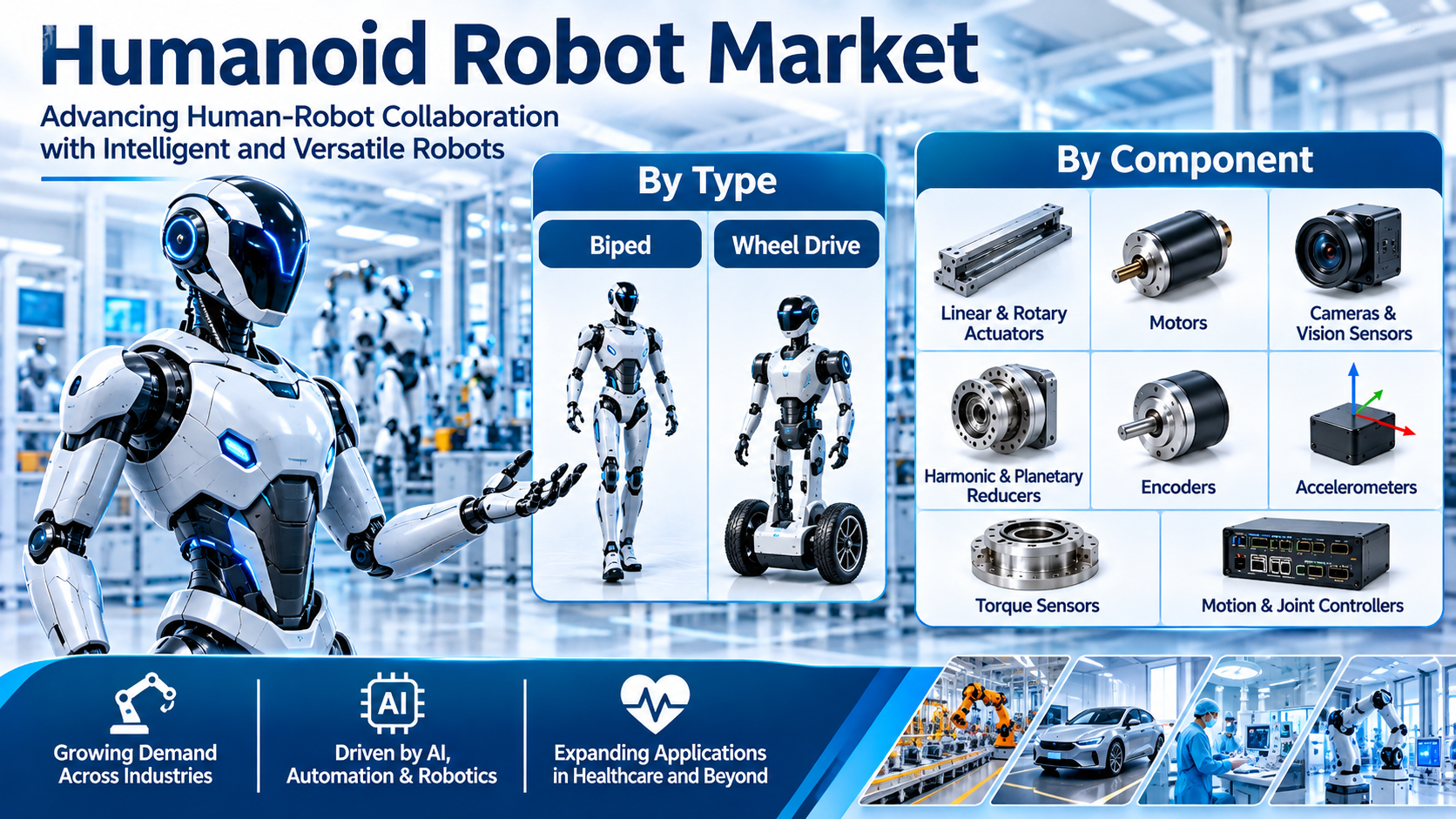
Top 10 Key Takeaways
-
The global humanoid robot market is projected to reach USD 50.27 billion by 2035.
-
The market is expected to grow at a CAGR of 28.1% from 2026 to 2035.
-
Artificial intelligence and physical AI are improving robotic intelligence and autonomy.
-
Biped humanoid robots are expected to register the highest growth.
-
Hardware is expected to hold the largest market share.
-
Manufacturing is anticipated to be the fastest-growing application.
-
Asia Pacific is expected to lead the global market.
-
Robotics-as-a-Service models are creating new deployment opportunities.
-
Healthcare and logistics are emerging as important application areas.
-
Unitree Robotics, AGIBOT, UBTECH, Figure AI, Tesla, and Boston Dynamics are among the key industry participants.
Key Growth Drivers Transforming the Humanoid Robot Market
1. Increasing Demand for Industrial Automation
Manufacturing industries are increasingly adopting automation to improve production efficiency, reduce operational costs, and maintain consistent product quality. Humanoid robots offer an opportunity to automate activities that traditionally require human workers, particularly in facilities designed around human movement and interaction.
These robots can potentially support material handling, component assembly, machine operation, inspection, and warehouse activities. Their human-like structure allows them to work with existing equipment and infrastructure without requiring extensive modifications to industrial environments.
As manufacturers seek flexible automation solutions, industrial applications are expected to become an important contributor to the Humanoid Robot Market Growth Analysis.
2. Rising Labor Shortages Across Industries
Labor shortages and increasing workforce costs are encouraging businesses to explore alternative solutions for repetitive, physically demanding, and potentially hazardous tasks. Humanoid robots can help organizations address certain workforce challenges by supporting activities that require continuous operation and consistent execution.
Industries such as logistics, manufacturing, construction, and warehousing are exploring humanoid robotics to improve workforce productivity. These systems can complement human employees by performing repetitive activities while allowing workers to focus on supervision, decision-making, and complex operations.
3. Advancements in Artificial Intelligence
Artificial intelligence is one of the most important technologies supporting humanoid robot development. AI-powered systems enable robots to interpret visual information, understand natural language instructions, recognize objects, and respond to changing environments.
The emergence of generative AI and large language models is further expanding human-robot interaction capabilities. Robots can increasingly process complex instructions and coordinate multiple tasks through intelligent software platforms.
AI-driven improvements in perception, planning, and autonomous decision-making are strengthening the long-term growth opportunities identified in the Humanoid Robot Market Growth Analysis.
4. Growing Investments in Robotics Research and Development
Technology companies, robotics manufacturers, and research institutions are increasing investments in humanoid robotics. These investments are supporting the development of advanced robotic hardware, AI algorithms, lightweight materials, and more efficient energy systems.
Strategic partnerships between semiconductor companies, AI developers, and robotics manufacturers are also accelerating innovation. Access to high-performance processors, advanced computing platforms, and sophisticated simulation technologies is helping developers improve robot performance and reduce development timelines.
Major Trends Shaping the Humanoid Robot Market
1. Shift Toward Physical AI and Intelligent Robotics
Physical AI is emerging as a major trend in humanoid robotics. It combines artificial intelligence with physical systems, enabling robots to understand real-world environments and perform physical activities rather than simply processing digital information.
Robot foundation models are helping humanoid robots improve object recognition, movement planning, task execution, and environmental understanding. Simulation-based training also allows developers to test robotic movements and improve performance before deploying robots in real-world environments.
This combination of physical AI, foundation models, and simulation technologies is expected to accelerate the commercialization of humanoid robots across industrial and commercial applications.
2. Increasing Adoption of Biped Humanoid Robots
Biped humanoid robots are designed with two legs, allowing them to move through environments developed for human beings. Their ability to navigate stairs, walk through narrow spaces, and interact with existing infrastructure makes them suitable for several applications.
These robots are gaining attention in manufacturing, logistics, healthcare, and service environments. Their mobility and human-like structure can support activities such as material transportation, inspection, assembly assistance, and facility operations.
The biped segment is expected to register the highest growth rate in the humanoid robot market during the forecast period, supported by increasing demand for robots capable of performing tasks in human-centric environments.
3. Integration of Advanced Sensors and Actuators
Sensors and actuators are essential components that determine the mobility, accuracy, and operational performance of humanoid robots. Advanced cameras, vision sensors, accelerometers, torque sensors, encoders, and motion controllers help robots understand their surroundings and coordinate movements.
Linear and rotary actuators enable precise joint movements, while harmonic and planetary reducers support controlled motion and mechanical efficiency. Improvements in these components are helping manufacturers develop robots with better balance, dexterity, and object-manipulation capabilities.
The growing demand for high-performance robotic components is creating opportunities for hardware manufacturers and technology providers.
4. Expansion of Robotics-as-a-Service Models
High initial investment remains a significant barrier to humanoid robot adoption. Developing, purchasing, integrating, and maintaining advanced robotic systems can require substantial capital expenditure.
Robotics-as-a-Service (RaaS) is emerging as an alternative deployment model that allows businesses to access robotic capabilities through subscription-based or service-based arrangements. This approach can reduce upfront costs and provide access to software upgrades, maintenance, monitoring, and technical support.
RaaS models are particularly relevant for businesses exploring humanoid robotics without making large initial investments. Fleet-management platforms can also help organizations monitor multiple robots, optimize performance, and coordinate operations.
5. Growing Focus on Human-Robot Collaboration
Humanoid robots are increasingly being developed to work alongside human employees rather than operate independently in isolated environments. Human-robot collaboration can support repetitive, physically demanding, and potentially hazardous activities.
Advanced safety sensors, intelligent navigation, collision detection, and motion-control technologies help robots operate more effectively around people. These capabilities are important for applications in manufacturing plants, warehouses, hospitals, and commercial facilities.
As collaborative robotics technologies improve, humanoid robots could become valuable assistants in workplaces where flexibility and human interaction are essential.
Humanoid Robot Market Segmentation Analysis
The Humanoid Robot Market Growth Analysis covers different market segments based on type, offering, application, and region. Each segment contributes to the industry’s development by addressing specific automation requirements.
By Type: Biped, Wheel Drive, and Torso & Stationary
-
Biped Humanoid Robots: These robots use two legs to move through human-designed environments. They are suitable for applications requiring advanced mobility, navigation, and physical interaction.
-
Wheel-Drive Humanoid Robots: These systems use wheels for movement and are generally suitable for environments where stable and efficient navigation is more important than walking capabilities.
-
Torso & Stationary Humanoid Robots: These robots are designed for applications that require upper-body movement, object manipulation, communication, and interaction without full-body mobility.
Biped humanoid robots are expected to experience the highest growth, supported by their potential to perform tasks in environments designed for human workers.
By Offering: Hardware, Software, and Services
The hardware segment is expected to account for the largest market share in 2026. This is primarily attributed to the significant contribution of physical components such as actuators, motors, cameras, vision sensors, controllers, encoders, and power systems.
The software segment is also gaining importance as manufacturers invest in AI-based perception, motion planning, manipulation software, robot foundation models, and fleet-management platforms. Software improvements are essential for enhancing autonomy and enabling robots to perform complex tasks.
The services segment includes system integration, installation, maintenance, technical support, and deployment-related services. Increasing commercial adoption is expected to create additional opportunities for service providers.
By Application: Manufacturing, Warehousing, Healthcare, and More
Manufacturing is expected to register the highest growth rate among applications during the forecast period. Humanoid robots can support assembly operations, machine tending, material handling, inspection, and repetitive production activities.
Warehousing and distribution centers represent another important application area. Humanoid robots can potentially support picking, sorting, inventory movement, and goods transportation, helping businesses improve fulfillment efficiency.
Other significant applications include:
-
Healthcare: Patient assistance, rehabilitation support, hospital logistics, and elderly care.
-
Education: Interactive learning, robotics research, programming, and educational demonstrations.
-
Hospitality and Entertainment: Guest engagement, reception, information services, and interactive experiences.
-
Personal Assistance and Caregiving: Daily living assistance, routine support, and communication.
The expansion of these applications is creating new commercial opportunities and strengthening the long-term Humanoid Robot Market Growth Analysis.
Regional Outlook: Asia Pacific Leads Humanoid Robotics Expansion
Asia Pacific is expected to account for the largest share and register the highest CAGR in the global humanoid robot market during the forecast period. Strong robotics manufacturing ecosystems, government initiatives, growing automation investments, and increasing commercialization activities are supporting regional growth.
China, Japan, and South Korea are among the important markets driving humanoid robotics development. China benefits from an expanding domestic robotics supply chain and investments in embodied intelligence. Japan has an established robotics industry, while South Korea is advancing AI, automation, and intelligent manufacturing technologies.
North America is also an important market, supported by robotics startups, AI innovation, industrial automation, and investments in advanced computing technologies. The presence of companies developing general-purpose humanoid robots is contributing to product innovation and commercialization.
Europe is witnessing opportunities through investments in advanced manufacturing, industrial automation, robotics research, and autonomous systems. Increasing interest in intelligent manufacturing and collaborative automation is expected to support regional adoption.
These regional developments demonstrate how different innovation ecosystems are contributing to the global Humanoid Robot Market Growth Analysis.
Challenges Restricting Humanoid Robot Market Growth
Despite strong growth potential, several challenges could affect the widespread adoption of humanoid robots.
1. High Development and Deployment Costs
Humanoid robots require advanced hardware, sophisticated software, high-performance processors, sensors, actuators, and battery systems. These technologies increase manufacturing and deployment costs.
Continuous research and development investments are also necessary to improve robot mobility, intelligence, and reliability. High costs can limit adoption among small and medium-sized enterprises.
2. Safety and Reliability Concerns
Humanoid robots are designed to operate in environments where people work and interact. Ensuring safe movement, accurate object handling, collision avoidance, and reliable emergency responses is essential.
Manufacturers must continue improving safety mechanisms and control systems before humanoid robots can achieve widespread deployment in workplaces and public environments.
3. Performance Limitations in Complex Environments
Although humanoid robots are becoming more intelligent, performing consistently in unpredictable environments remains challenging. Variations in lighting, obstacles, object shapes, and workplace conditions can affect robot performance.
Improving autonomous navigation, real-time decision-making, and physical manipulation will be important for overcoming these limitations.
Competitive Landscape: Leading Companies in the Humanoid Robot Market
The competitive landscape includes established robotics manufacturers, technology companies, and emerging startups investing in advanced humanoid platforms. Companies are focusing on AI integration, robotic mobility, advanced sensors, and commercial deployment strategies to strengthen their market positions.
Some of the major companies shaping the industry include:
1. Unitree Robotics – Focuses on bipedal humanoid platforms, mobility, and robotics development.
2. AGIBOT Innovation – Develops humanoid robots for industrial and commercial applications.
3. UBTECH Robotics – Focuses on humanoid robots and intelligent automation solutions.
4. Leju Robotics – Develops humanoid robots for research, education, and industrial applications.
5. EngineAI – Focuses on advanced humanoid robot development.
6. Fourier – Develops humanoid and rehabilitation robotics.
7. Figure AI – Develops general-purpose humanoid robots for real-world applications.
8. Agility Robotics – Develops humanoid robots for logistics and industrial environments.
9. Tesla – Develops the Optimus humanoid robot platform.
10. Boston Dynamics – Develops advanced robotic systems and humanoid robotics technologies.
Future Opportunities in the Humanoid Robot Market
The future of humanoid robotics will be shaped by the convergence of artificial intelligence, advanced computing, automation, and intelligent mechanical systems. As these technologies mature, humanoid robots are expected to move beyond experimental demonstrations and become increasingly integrated into commercial operations.
Several opportunities are likely to influence future industry development.
AI-Powered Autonomous Operations: Improvements in generative AI, machine learning, and robot foundation models will enable humanoid robots to understand complex instructions and perform multiple activities with greater autonomy.
Healthcare and Elderly Care: Aging populations and workforce shortages are creating opportunities for robots that can assist with patient support, rehabilitation, hospital logistics, and daily living activities.
Smart Manufacturing: Manufacturers are exploring humanoid robots to automate repetitive production tasks and improve operational flexibility without completely redesigning existing facilities.
Warehouse Automation: Growing e-commerce activity and demand for faster fulfillment are creating opportunities for humanoid robots in material handling, sorting, and inventory operations.
Simulation and Digital Twins: Virtual environments and digital twin technologies will help developers train robots, test movements, and improve task execution before physical deployment.
Robotics-as-a-Service: Subscription-based deployment models can make advanced robotic technologies more accessible to businesses by reducing upfront investment requirements.
These opportunities are expected to support the continued expansion of the Humanoid Robot Market Growth Analysis and accelerate the transition toward intelligent, human-centric automation.
The Humanoid Robot Market Growth Analysis highlights the growing importance of intelligent robotics in transforming industrial and commercial operations. Advancements in artificial intelligence, physical AI, computer vision, sensors, actuators, and motion-control technologies are improving the capabilities of humanoid robots and expanding their potential applications.
Manufacturing and warehousing are expected to remain important growth areas, while healthcare, education, hospitality, and personal assistance offer additional opportunities. Asia Pacific is positioned to play a leading role in market expansion through its strong robotics manufacturing ecosystem and increasing investments in automation.
FAQs
Q1. What is the projected size of the humanoid robot market by 2035?
The global humanoid robot market is projected to reach USD 50.27 billion by 2035, growing from USD 5.41 billion in 2026.
Q2. What is the expected CAGR of the humanoid robot market?
The humanoid robot market is expected to register a CAGR of 28.1% during the forecast period from 2026 to 2035.
Q3. Which region is expected to dominate the humanoid robot market?
Asia Pacific is expected to account for the largest market share and register the highest CAGR, driven by robotics innovation, industrial automation, and investments in AI technologies.
Q4. Which segment is expected to grow fastest in the humanoid robot market?
The biped humanoid robot segment is expected to register the highest growth rate, supported by increasing demand for robots capable of operating in human-centric environments.
Q5. Who are the key players in the humanoid robot market?
Major companies include Unitree Robotics, AGIBOT Innovation, UBTECH Robotics, Leju Robotics, EngineAI, Fourier, Figure AI, Agility Robotics, Tesla, and Boston Dynamics.