
The global construction industry is experiencing significant transformation as infrastructure development, urbanization, and smart construction technologies continue to expand. Increasing investments in residential buildings, commercial infrastructure, roads, highways, and industrial facilities are creating demand for advanced measurement and leveling equipment. Rotary laser exterior leveling tools are becoming essential instruments for contractors, surveyors, and construction professionals seeking higher accuracy, productivity, and efficiency in outdoor construction projects. The rotary laser exterior leveling tool market is projected to reach USD 0.79 billion by 2032, up from USD 0.58 billion in 2026, at a 5.4% CAGR over the forecast period.
The Rotary Laser Exterior Leveling Tool Market Analysis highlights the growing adoption of precision leveling technologies across construction and civil engineering applications. These tools use a rotating 360-degree laser beam to establish accurate horizontal, vertical, or sloped reference planes over long distances. They are widely used in site grading, foundation layout, excavation, drainage installation, road construction, landscaping, and concrete formwork.
According to MarketsandMarkets, the global rotary laser exterior leveling tool market is projected to grow from USD 0.58 billion in 2026 to USD 0.79 billion by 2032, registering a compound annual growth rate (CAGR) of 5.4% during the forecast period.
Growing investments in infrastructure development, increasing demand for construction accuracy, and the adoption of digital construction equipment are supporting market expansion. Furthermore, advancements in self-leveling technology, dual-slope functionality, green laser beams, and Bluetooth connectivity are transforming the capabilities of modern rotary laser systems.
Download PDF Brochure @ https://www.marketsandmarkets.com/pdfdownloadNew.asp?id=238458526
Rising Construction Activities Drive Market Growth
Increasing residential and commercial construction activities represent a major factor supporting the rotary laser exterior leveling tool industry. Rapid urbanization, population growth, and expanding infrastructure requirements are encouraging governments and private developers to invest in large-scale construction projects.
Modern construction projects require accurate measurement and alignment to maintain structural quality and meet engineering specifications. Traditional leveling methods can involve extensive manual measurements, increasing the possibility of errors, labor requirements, and project delays.
Rotary laser exterior leveling tools address these challenges by providing consistent reference levels across large construction sites. Contractors can use these systems to perform foundation alignment, land grading, concrete leveling, excavation, and drainage installation with improved precision.
The Rotary Laser Exterior Leveling Tool Market Analysis indicates that increasing investments in residential developments, commercial complexes, industrial facilities, and transportation infrastructure will continue supporting demand for professional leveling equipment.
As construction companies focus on reducing rework and improving project execution, rotary laser systems are becoming important tools for modern construction workflows.
Growing Adoption of Precision Construction Technologies
Precision construction is becoming increasingly important as infrastructure projects become more complex and construction companies seek to improve operational efficiency.
Rotary laser systems provide accurate leveling references over extended distances, enabling construction professionals to maintain consistent elevations across different sections of a project. These tools are particularly valuable in road construction, site preparation, excavation, landscaping, and large commercial developments.
The adoption of precision leveling equipment also helps reduce dependence on manual measurement processes. By providing accurate reference points, rotary lasers can minimize measurement inconsistencies and improve coordination between construction teams.
Advanced systems equipped with automatic self-leveling capabilities further simplify equipment setup and operation. These features reduce manual adjustments and help contractors complete repetitive leveling activities more efficiently.
The growing emphasis on construction quality, productivity, and cost optimization is expected to strengthen demand for advanced rotary laser exterior leveling tools.
Dual-Slope Rotary Lasers Gain Momentum
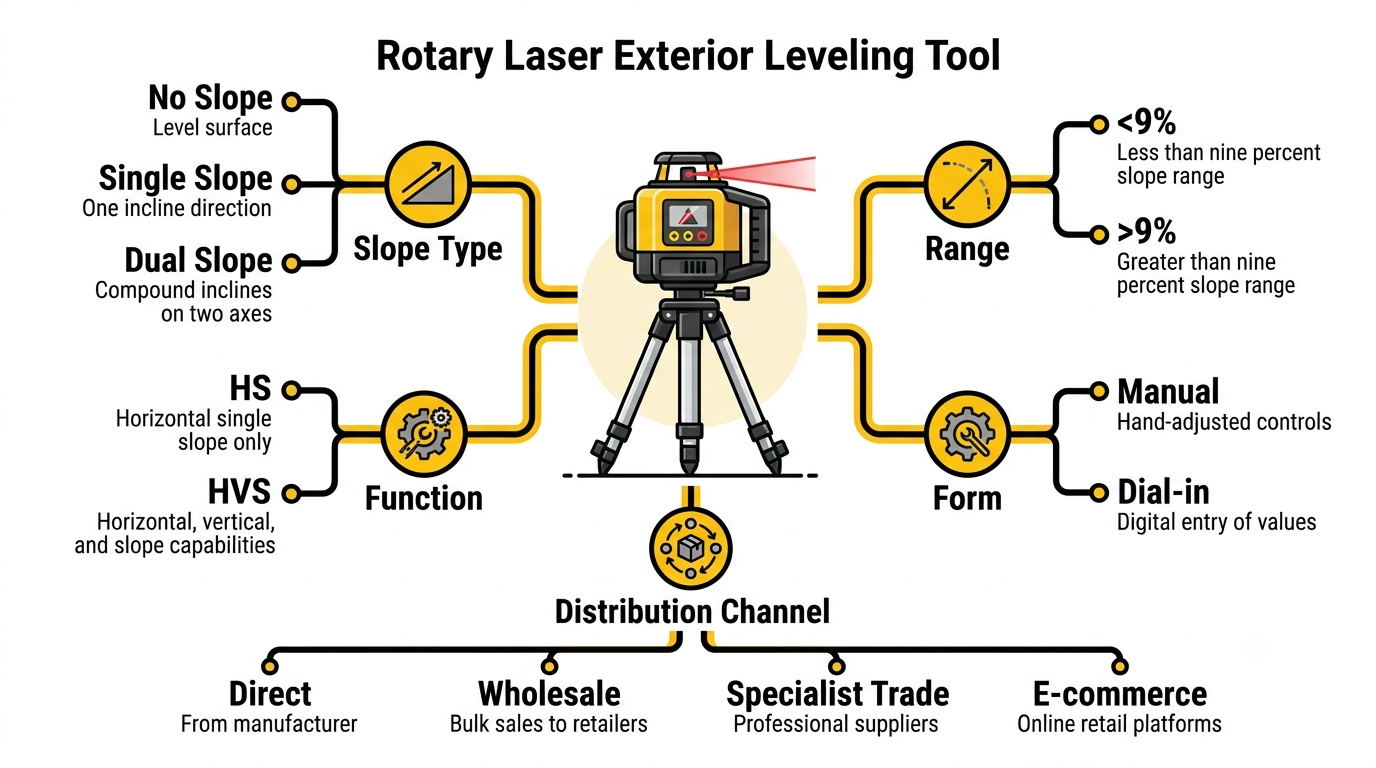
Dual-slope rotary lasers are emerging as an important technology segment in the market. These systems allow users to independently configure slope settings along two axes, making them suitable for complex outdoor construction and grading applications.
Unlike conventional horizontal leveling systems, dual-slope rotary lasers support precise slope control across different directions. This functionality is particularly useful for road construction, drainage systems, airport runways, site grading, and large commercial infrastructure projects.
According to MarketsandMarkets, the dual-slope segment is expected to register the highest CAGR of 9.1% during the forecast period.
The growing adoption of dual-slope systems is driven by their ability to reduce manual adjustments, improve grading accuracy, and support more efficient construction workflows.
As infrastructure projects increasingly require precise elevation and slope management, demand for dual-slope rotary laser solutions is expected to increase.
Dial-In Slope Technology Transforms Leveling Operations
Another important development shaping the Rotary Laser Exterior Leveling Tool Market Analysis is the growing adoption of dial-in slope technology.
Traditional manual slope adjustment methods require operators to make physical adjustments to achieve the desired grading angle. Dial-in slope technology simplifies this process by allowing users to digitally enter specific slope values into the equipment.
This capability improves setup efficiency, reduces manual intervention, and supports accurate slope management across construction sites.
Dial-in slope systems are particularly useful in road construction, drainage installation, foundation preparation, landscaping, and large commercial projects where precise slope control is essential.
According to MarketsandMarkets, the dial-in slope segment is projected to register the highest CAGR of 10.1% during the forecast period.
The increasing demand for automated construction equipment and productivity-enhancing technologies is expected to accelerate the adoption of digitally controlled slope adjustment systems.
Green-Beam Technology Improves Outdoor Visibility
Laser visibility is an important performance factor in exterior leveling applications. Construction professionals often operate rotary laser equipment in outdoor environments with bright sunlight and changing weather conditions.
Green-beam technology is gaining popularity because green laser beams are generally more visible to the human eye than comparable red beams under similar conditions. This can improve usability and help operators identify reference lines more easily.
Manufacturers are incorporating green laser technology into advanced rotary laser systems to improve visibility and support outdoor construction applications.
The integration of green beams with high-performance receivers also enables accurate measurements over long distances, including applications involving large construction sites and infrastructure projects.
The development of high-visibility laser systems is expected to create opportunities for manufacturers focusing on advanced professional construction equipment.
Bluetooth Connectivity and Digital Construction Integration
Digitalization is transforming construction equipment by enabling connectivity, remote operation, and improved coordination between different project activities.
Modern rotary laser exterior leveling tools increasingly incorporate Bluetooth connectivity, digital receivers, and mobile application support. These features allow operators to manage selected equipment functions remotely and simplify leveling operations.
Connected systems can improve communication between equipment and construction teams while supporting more efficient workflows.
Integration with digital construction platforms, building information modeling (BIM), and machine control technologies is another emerging opportunity. Rotary laser reference systems can support automated grading equipment and connected construction machinery, reducing the need for repeated manual measurements.
The Rotary Laser Exterior Leveling Tool Market Analysis highlights the growing importance of connected equipment and digital construction workflows in improving productivity and measurement accuracy.
As construction companies adopt smart infrastructure technologies, demand for connected rotary laser systems is expected to increase.
General Construction Remains a Major Application Segment
General construction is projected to account for the largest share of the rotary laser exterior leveling tool market during the forecast period.
These tools are widely used for site layout, foundation work, grading, concrete formwork, and structural alignment. Their ability to establish accurate reference planes across large areas makes them valuable for residential, commercial, and industrial construction projects.
The increasing development of housing communities, commercial buildings, warehouses, industrial facilities, and mixed-use projects is supporting demand from this application segment.
Rotary laser systems help contractors maintain consistent elevations, improve foundation preparation, and reduce measurement errors during construction.
Other important applications include framing and layouts, ceiling installation, concrete formwork, and excavation. These applications are also benefiting from the increasing adoption of precision measurement equipment.
E-Commerce and Direct Sales Transform Distribution Channels
Distribution strategies are evolving as construction equipment manufacturers expand their digital sales channels and strengthen relationships with professional contractors.
Manufacturer-direct sales and webstores are expected to capture the largest share of the rotary laser exterior leveling tool market by distribution channel. Direct purchasing allows manufacturers to provide customized equipment configurations, technical support, warranty services, and product training.
E-commerce is also becoming an important distribution channel as contractors increasingly use online platforms to compare product specifications, evaluate prices, and purchase construction equipment.
According to MarketsandMarkets, the e-commerce segment is expected to register a CAGR of approximately 6.7% during the forecast period.
The growing adoption of digital procurement platforms is improving product accessibility and enabling manufacturers to reach customers across different geographic markets.
Equipment rental companies and specialist construction tool distributors also play an important role by providing access to professional leveling systems for contractors with varying project requirements.
Asia Pacific Emerges as a Key Growth Region
Asia Pacific is expected to lead the rotary laser exterior leveling tool market, accounting for approximately 40% of the market value in 2026.
The region’s growth is supported by rapid urbanization, expanding residential and commercial construction, infrastructure modernization, and increasing investments in smart city projects.
China, India, Indonesia, and other Southeast Asian countries are witnessing significant construction activity. Government initiatives focused on housing development, transportation infrastructure, industrial expansion, and urban redevelopment are creating demand for advanced construction equipment.
India is becoming an important growth market due to investments in highways, airports, residential developments, commercial infrastructure, and industrial corridors. The increasing adoption of modern construction practices is encouraging contractors to use precision leveling technologies.
China continues to support regional demand through large-scale infrastructure and commercial construction projects. Japan and other developed markets are also adopting advanced construction equipment to improve productivity and operational accuracy.
The Rotary Laser Exterior Leveling Tool Market Analysis indicates that increasing construction activity and the growing availability of professional leveling equipment will strengthen Asia Pacific’s position in the global market.
Competitive Landscape and Key Market Players
The rotary laser exterior leveling tool market includes established construction equipment manufacturers and specialized measurement technology providers. Competition is primarily based on product accuracy, working range, slope functionality, durability, connectivity, pricing, and distribution capabilities.
Major companies operating in the market include:
- Robert Bosch GmbH
- Hilti Group
- Johnson Level & Tool
- Leica Geosystems
- Topcon Corporation
- Milwaukee Tool
- Makita Corporation
- Trimble Inc.
- Stabila
- Stanley Black & Decker
- Laserliner
These companies are focusing on product innovation, advanced laser technology, digital connectivity, and improvements in equipment durability.
Bosch offers professional rotary laser systems with advanced leveling and connectivity features. Hilti is strengthening its product portfolio through automated leveling and digital slope control capabilities. Leica Geosystems and Topcon are focusing on precision measurement and construction positioning technologies.
Makita and Milwaukee Tool are expanding cordless construction equipment portfolios, supporting greater mobility and flexibility on outdoor job sites.
Strategic partnerships, product launches, distribution expansion, and integration with digital construction technologies are expected to remain important competitive strategies.
Challenges Affecting Market Growth
Despite growing demand, the rotary laser exterior leveling tool market faces several challenges that may influence adoption.
High initial equipment costs remain a major restraint, particularly for small and medium-sized contractors. Advanced systems equipped with dual-slope functionality, green-beam technology, extended working ranges, Bluetooth connectivity, and rugged protective designs can be significantly more expensive than conventional leveling tools.
Price sensitivity among contractors in developing markets may limit the adoption of premium equipment.
Maintenance and calibration requirements also influence purchasing decisions. Professional rotary laser systems require proper handling, periodic calibration, and operator training to maintain measurement accuracy.
Another challenge is competition from low-cost manufacturers offering more affordable alternatives. Established companies must continue investing in product innovation, performance improvements, and customer support to maintain their competitive positions.
Addressing these challenges through cost-effective product development, rental models, and improved service networks will be important for expanding market adoption.
Future Outlook: Smart Construction Technologies Shape Market Opportunities
The future of the rotary laser exterior leveling tool industry will be influenced by increasing construction activity, infrastructure modernization, and the adoption of digital construction technologies.
Innovations in self-leveling capabilities, dual-slope technology, green laser beams, Bluetooth connectivity, and automated machine control are expected to improve equipment functionality and operational efficiency.
The integration of rotary laser systems with BIM platforms, digital construction workflows, and connected machinery will create additional opportunities for manufacturers and technology providers.
The market is projected to grow from USD 0.58 billion in 2026 to USD 0.79 billion by 2032, reflecting steady demand for precision leveling equipment across construction and infrastructure applications.
Overall, the Rotary Laser Exterior Leveling Tool Market Analysis highlights the increasing importance of accurate measurement, automation, and connected construction equipment. Companies investing in advanced laser technologies, digital integration, and cost-effective product solutions will be well positioned to benefit from emerging opportunities.
As the construction industry moves toward smarter and more productive project execution, rotary laser exterior leveling tools will continue to play an important role in improving accuracy, reducing rework, and supporting the development of modern infrastructure.
FAQs:
Q1. What is the market size of the Rotary Laser Exterior Leveling Tool Market?
The Rotary Laser Exterior Leveling Tool Market is projected to grow from USD 0.58 billion in 2026 to USD 0.79 billion by 2032, registering a CAGR of 5.4% during the forecast period.
Q2. What are the key factors driving the Rotary Laser Exterior Leveling Tool Market?
The market is driven by increasing residential and commercial construction, infrastructure development, and growing demand for accurate leveling, grading, and alignment in construction projects.
Q3. Which segment is expected to grow fastest in the Rotary Laser Exterior Leveling Tool Market?
The dial-in slope segment is expected to register the highest growth, with a projected CAGR of 10.1%, driven by demand for precise slope adjustments in construction and land-leveling applications.
Q4. Which region is expected to lead the Rotary Laser Exterior Leveling Tool Market?
Asia Pacific is expected to account for approximately 40% of the market in 2026, supported by rapid urbanization, infrastructure investments, and expanding construction activities.
Q5. Who are the key players in the Rotary Laser Exterior Leveling Tool Market?
Key companies operating in the market include Robert Bosch GmbH, Hilti, Johnson Level & Tool, Leica Geosystems, Topcon, Milwaukee Tool, Makita, Trimble, Stabila, and Stanley Black & Decker.