
The global power sector is undergoing a profound transformation. Utilities face mounting pressure to integrate distributed energy resources (DERs), accommodate bidirectional power flows, and maintain reliability amid rapidly growing demand from data centers and electrification initiatives. At the heart of this transformation lies the digital substation—a fundamental shift from conventional hardwired architectures to flexible, interoperable, and data-driven systems built on the IEC 61850 standard.
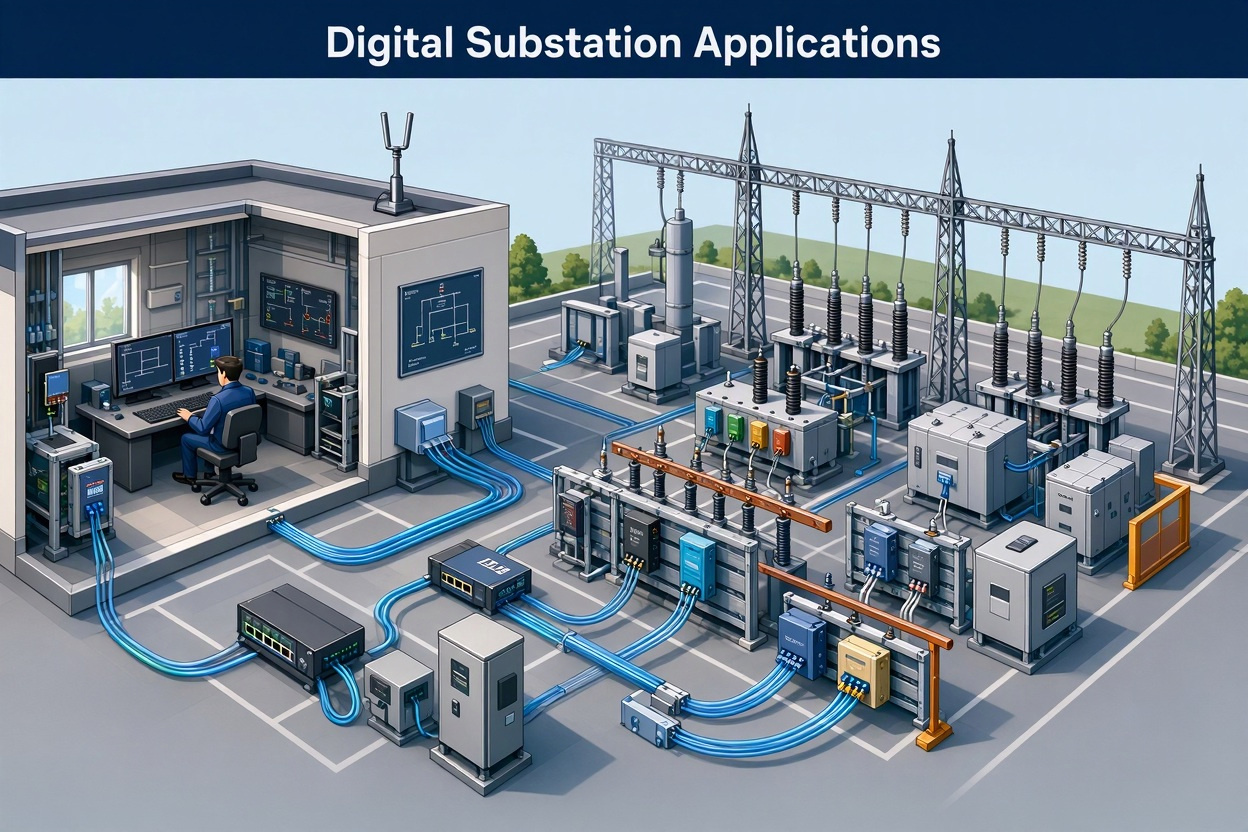
Digital substation applications extend far beyond simple equipment upgrades. They encompass a comprehensive ecosystem of technologies, architectures, and operational strategies that collectively enhance grid resilience, reduce lifecycle costs, and enable the intelligent monitoring and control required for future smart grids. From process bus implementations that eliminate miles of copper wiring to edge computing platforms that enable predictive maintenance, the applications of digital substation technology are reshaping how utilities design, operate, and maintain critical infrastructure.
According to Marketsandmarkets, the global digital substation market size is projected to grow from USD 15.62 billion in 2026 to USD 23.39 billion by 2032, growing at a CAGR of 7.0 from 2026 to 2032.
Download PDF Brochure @ https://www.marketsandmarkets.com/pdfdownloadNew.asp?id=43227003
This comprehensive guide examines the diverse applications of digital substations, exploring the technical foundations, practical implementations, and measurable benefits that utilities worldwide are realizing through digital transformation.
Understanding the Core Architecture of Digital Substation Applications
The foundation of any digital substation application rests on a three-level, two-network architecture defined by the IEC 61850 standard. This framework divides substation functionality into process, bay, and station levels, interconnected through station bus and process bus communication networks.
At the process level, primary equipment such as circuit breakers, current transformers (CTs), and voltage transformers (VTs) interface with intelligent electronic devices (IEDs) through merging units (MUs). These merging units digitize analog measurements and publish sampled values (SV) according to IEC 61850-9-2, replacing traditional hardwired copper connections with fiber-optic Ethernet communications. The bay level houses protection and control IEDs that subscribe to these digital data streams, executing protection algorithms and control logic. At the station level, human-machine interface (HMI) systems, gateways, and engineering workstations provide operators with situational awareness and system-wide coordination capabilities.
This architecture enables digital substation applications to achieve unprecedented flexibility. Protection and control functions become software-configurable rather than hardware-dependent, allowing utilities to adapt schemes without physical rewiring. The separation of data acquisition from processing means that a single merging unit can feed multiple IEDs simultaneously, reducing equipment count and panel space requirements. Furthermore, the standardized data models ensure interoperability between devices from different manufacturers, preventing vendor lock-in and enabling competitive procurement strategies.
The process bus represents perhaps the most transformative element of digital substation applications. By replacing point-to-point copper wiring with a shared Ethernet network, utilities dramatically reduce installation complexity and material costs.
Process Bus Technology: The Backbone of Modern Digital Substation Applications
Process bus technology constitutes the most visible and impactful application of digital substation principles. By digitizing measurements at the source and transmitting them via IEC 61850-9-2 sampled values, process bus implementations eliminate the extensive copper cabling that characterizes conventional substations.
The benefits of process bus applications extend across the entire project lifecycle. During engineering and design phases, the reduction in physical connections simplifies documentation and reduces the potential for wiring errors. Construction becomes faster and less labor-intensive, particularly in greenfield installations where the absence of legacy infrastructure allows full optimization of digital architecture. Commissioning activities benefit from the ability to test protection functions using digital test sets that inject sampled values directly into the network, eliminating the need for physical test injections at primary equipment terminals.
Operational advantages emerge as well. Digital signals are immune to electromagnetic interference that can affect analog copper circuits, improving measurement accuracy and protection reliability. The ability to monitor communication network health provides early warning of degradation before protection functions are compromised. Furthermore, the standardized nature of sampled values enables interoperability testing and validation frameworks that ensure consistent behavior across multi-vendor environments.
Davao Light and Power Company in the Philippines represents a notable adopter of process bus technology among distribution utilities. Motivated by significant electricity demand growth and renewable generation penetration, the utility determined that digital substations with process bus technology could reduce both CAPEX and OPEX while maintaining network reliability. Their implementation strategy emphasized careful planning around engineering processes, organizational impact, long-term stability, and whole-of-life benefits before committing to the technology transition.
IEC 61850 and Interoperability: Enabling Seamless Digital Substation Applications
The IEC 61850 standard series provides the foundational communication framework that makes digital substation applications practical and scalable. This international standard defines data models, communication protocols, and configuration languages that enable devices from different manufacturers to interoperate seamlessly within a unified automation system.
IEC 61850-8-1 specifies the Generic Object-Oriented Substation Event (GOOSE) protocol for time-critical messages such as protection trips and interlocking signals. GOOSE messages are published on the station bus and subscribed to by multiple IEDs simultaneously, enabling distributed protection schemes without dedicated hardwired connections between devices. The protocol’s peer-to-peer nature supports applications such as busbar protection, breaker failure protection, and zone interlocking that require deterministic, low-latency communication.
IEC 61850-9-2 defines the sampled values protocol for transmitting digitized current and voltage measurements from merging units to protection and metering IEDs. This standard ensures that measurement data maintains the accuracy and time synchronization required for protection functions, with sample rates typically ranging from 4,800 to 14,400 samples per second depending on application requirements. The protocol supports both stand-alone merging units (SAMUs) that retrofit conventional instrument transformers and native digital instrument transformers with integrated digital outputs.
Beyond these core protocols, the IEC 61850 series continues to evolve to address emerging digital substation applications. IEC 61850-7-420 provides a generic model for integrating distributed energy resources into the grid, enabling standardized communication between DER management systems and substation automation platforms. Work on IEC 61850-6-2 aims to automate HMI configuration through standardized configuration languages, potentially reducing engineering effort from weeks to minutes for smaller substations. These ongoing developments ensure that the standard remains relevant as grid requirements evolve.
Real-World Digital Substation Applications: Case Studies and Implementations
Examining actual deployments provides valuable insight into how digital substation applications deliver value across different contexts and geographies.
Iceland’s National Transmission System
Landsnet, which operates over 3,000 kilometers of transmission lines and approximately 70 substations in Iceland, initiated its digital substation program in 2019. The utility commissioned six digital substations in its initial rollout, gaining experience that informed subsequent deployments. Challenges encountered included initial knowledge gaps and unclear requirements, but each project contributed to organizational learning and process refinement. The Icelandic experience demonstrates that digital substation adoption is as much an organizational transformation as a technical one, requiring investment in training and change management alongside equipment procurement.
Indonesia’s Bekasi Digital Substation
The Bekasi Digital Substation represents Indonesia’s largest digital substation deployment, featuring a 27-bay configuration that integrates conventional primary equipment with digital technology through merging units. This brownfield approach demonstrates that utilities need not replace existing primary equipment to realize digital substation benefits. The project achieved measurable improvements in operational efficiency and maintenance safety, with the 75% reduction in test preparation time and 50% reduction in panel counts providing compelling evidence of value. Technical lessons learned included the importance of validating digital signals post-migration to prevent misconfigurations and the need for robust validation frameworks aligned with IEC 61850-8-1.
Türkiye’s First Digital Substation Pilot
Turkish Electricity Transmission Corporation (TEİAŞ) collaborated with Hitachi Energy on Türkiye’s first digital substation pilot, implementing process bus technology on a parallel feeder’s control and protection bay. This approach enabled direct comparison between digital and conventional systems operating side by side, providing real-world performance data to inform future rollout decisions. The pilot demonstrates the value of phased, evidence-based approaches to digital substation adoption, allowing utilities to validate benefits and refine designs before committing to large-scale deployment.
Finland’s Edge Computing Pilot
A Finnish pilot project explored centralized services for remote digital substations using edge computing and virtualization technology. The system gathers sampled values and GOOSE status information from substations and processes data at an edge server connected to cloud services. Use cases include anomaly detection, fault forecasting, and congestion management, with the generic architecture enabling addition of other smart grid functionalities. This application illustrates how digital substations serve as data sources for advanced analytics and grid optimization, extending value beyond the substation fence.
Advanced Applications: Edge Computing, Digital Twins, and AI Integration
As digital substations mature, advanced digital substation applications are emerging that leverage the data-rich environment to enable capabilities impossible with conventional architectures.
Edge computing represents a natural extension of digital substation data availability. By deploying computational resources at or near the substation, utilities can process sampled values and GOOSE data locally to detect anomalies, forecast equipment health, and optimize local operations without the latency and bandwidth constraints of centralized cloud processing. This architecture supports applications such as adaptive protection settings, real-time thermal monitoring of primary equipment, and local voltage optimization that respond dynamically to changing conditions.
Digital twin technology offers another powerful application. A digital twin is a virtual representation of a physical substation that mirrors its real-time state and behavior. Andrea Bonetti of Megger demonstrated a personal digital twin at IEC 61850 Week, illustrating how virtual representations enable testing anywhere and anytime without geographical barriers. Digital twins support training in safe environments, remote commissioning and troubleshooting, and predictive simulation of equipment behavior under various scenarios. For digital substation applications, digital twins provide a sandbox for validating configuration changes before deployment to physical systems, reducing risk and downtime.
Artificial intelligence and machine learning applications are increasingly relevant as substation data volumes grow. A proposed four-layer monitoring and coordination framework for ultra-high voltage digital substations in Xinjiang integrates perception, edge computing, intelligent analysis, and collaborative decision-making layers. The intelligent analysis layer employs machine learning models to calculate health indices, forecast loads, and optimize operations. Such applications transform digital substations from passive data sources into active participants in grid management, capable of autonomous response to emerging conditions.
Measurable Benefits and ROI of Digital Substation Applications
The business case for digital substation applications rests on quantifiable improvements across capital expenditure, operational expenditure, reliability, and safety.
Capital Expenditure Reductions: The most immediate and measurable benefit is the reduction in materials and labor costs. Eliminating copper control cables reduces material expenses and the associated installation labor. Smaller panel counts reduce building size requirements, lowering construction costs. The Bekasi project’s 50% reduction in panel counts directly translates to smaller control buildings and reduced real estate requirements. Engineering costs decrease as standardized configurations replace custom designs, and commissioning timelines shorten through digital testing capabilities.
Operational Expenditure Savings: Digital substations reduce ongoing maintenance costs through improved monitoring and diagnostics. The ability to monitor communication network health and equipment condition enables condition-based maintenance rather than scheduled maintenance, optimizing resource deployment. Remote diagnostic capabilities reduce site visits for troubleshooting. Automated testing using digital test sets and digital twins reduces the time and personnel required for routine verification.
Reliability Improvements: Digital communication is immune to electromagnetic interference that can cause maloperation of analog circuits. Redundant network architectures with zero recovery time, as specified in IEC 62439-3, ensure high availability of protection and control functions. The ability to monitor system health in real-time enables proactive intervention before failures occur. Standardized data models and interoperability testing reduce the risk of configuration errors that can lead to protection failures.
Safety Enhancements: Digital substations improve personnel safety by removing high-voltage copper connections from the control room environment. Fiber-optic cables carry only low-power light signals, eliminating electrical hazards. The reduction in physical testing requirements at primary equipment terminals means fewer personnel exposed to high-voltage environments during commissioning and maintenance. Digital twins enable training and procedure development without any physical risk.
Challenges and Considerations in Digital Substation Implementation
Despite compelling benefits, digital substation applications present challenges that utilities must address for successful implementation.
Technical complexity increases with digital architectures. Protection engineers must understand network communication, time synchronization, and cyber security in addition to traditional power system protection. The skills required for designing, configuring, and troubleshooting digital substations differ significantly from conventional systems, necessitating investment in training and potentially new organizational roles.
Interoperability, while a core promise of IEC 61850, requires careful validation in practice. Multi-vendor environments can reveal subtle differences in how devices implement the standard, leading to communication failures or unexpected behavior. Robust testing frameworks and validation procedures are essential before deployment. Utilities should participate in interoperability testing events and demand conformance certificates from equipment suppliers.
Cyber security becomes a critical concern as substations become network-connected. Digital substations introduce attack surfaces that do not exist in hardwired systems. Utilities must implement defense-in-depth strategies including network segmentation, access controls, intrusion detection, and security monitoring. The benefits of connectivity must be balanced against the risks, with appropriate security controls applied at every layer of the architecture.
Organizational change management is often underestimated. Digital substations change workflows across engineering, construction, commissioning, operations, and maintenance. Staff at all levels require training and support to adapt to new tools and processes. Early engagement of operations and maintenance personnel in design decisions helps ensure that digital substation applications meet practical needs and gain organizational acceptance.
Future Directions for Digital Substation Applications
The trajectory of digital substation applications points toward increasingly autonomous, data-driven, and interconnected systems.
Standardization continues to evolve, with IEC 61850-6-2 promising automated HMI configuration that could dramatically reduce engineering effort. Enhanced data models for DER integration will support the growing penetration of renewable generation and storage. Work on cyber security standards for substation automation will provide frameworks for addressing evolving threats.
Integration with grid-edge intelligence will expand. Digital substations will serve as anchors for distributed energy resource management, coordinating solar, storage, and electric vehicle charging within their service areas. Edge computing platforms will host applications that optimize local grid conditions while participating in broader system-level coordination through connections to distribution management systems and market platforms.
Artificial intelligence and machine learning will become embedded in substation operations. Predictive maintenance algorithms will anticipate equipment failures before they occur. Anomaly detection will identify cyber intrusions and physical faults with greater accuracy. Autonomous protection and control schemes will adapt to changing grid conditions in real-time, maintaining reliability as system complexity increases.
The convergence of operational and information technology will continue, requiring utilities to develop integrated architectures that span from primary equipment sensors to enterprise analytics platforms. Digital substations represent a critical node in this convergence, providing both the data foundation and the control capabilities for the intelligent grid of the future.
Frequently Asked Questions (FAQs)
What is a digital substation?
A digital substation is a power system facility that uses digital communication technology, primarily based on the IEC 61850 standard, to replace conventional hardwired connections between primary equipment and protection, control, and monitoring systems. This architecture enables greater flexibility, interoperability, and data availability compared to traditional substations.
What are the primary applications of digital substation technology?
Key digital substation applications include process bus implementations for digitized measurements, station bus architectures for protection and control communication, centralized protection and control schemes, edge computing for local analytics, digital twin development for testing and training, and integration platforms for distributed energy resources and smart grid functions.
What are the benefits of digital substation applications?
Benefits include reduced capital costs through elimination of copper wiring and smaller panel counts, lower operational expenses through condition-based maintenance and remote diagnostics, improved reliability through interference-immune digital communications and network redundancy, enhanced safety by removing high-voltage circuits from control rooms, and greater flexibility for future upgrades and grid integration.
What is the IEC 61850 standard and why is it important for digital substations?
IEC 61850 is the international standard for communication networks and systems in substations. It defines data models, communication protocols (including GOOSE and Sampled Values), and configuration languages that enable interoperability between devices from different manufacturers. This standard is foundational to digital substation applications, ensuring that equipment can communicate and function together regardless of vendor.
What is a process bus in a digital substation?
A process bus is a communication network that connects merging units at the process level (near primary equipment) to protection and control IEDs at the bay level. It carries digitized current and voltage measurements according to IEC 61850-9-2, replacing traditional point-to-point copper wiring. Process bus implementations significantly reduce cabling, simplify testing, and improve measurement accuracy.
How do digital substations improve reliability?
Digital substations improve reliability through several mechanisms: fiber-optic communications are immune to electromagnetic interference that can affect copper circuits; network redundancy protocols ensure continued operation if a communication path fails; real-time monitoring of system health enables proactive maintenance; and standardized configurations reduce the risk of engineering errors that can cause protection failures.
What are the challenges of implementing digital substation applications?
Challenges include the need for new skills in network engineering and cyber security, interoperability validation across multi-vendor environments, cyber security risk management for connected systems, organizational change management for new workflows, and the initial learning curve associated with new technologies and processes.
How do digital substations support renewable energy integration?
Digital substations provide the data visibility and control flexibility needed to integrate distributed energy resources such as solar and wind generation. IEC 61850-7-420 defines standard models for DER integration, enabling communication between DER management systems and substation automation platforms. Digital architectures support bidirectional power flow management, voltage regulation, and islanding detection required for high renewable penetration scenarios.
How does edge computing relate to digital substation applications?
Edge computing extends digital substation capabilities by deploying computational resources at or near the substation to process data locally. This enables low-latency applications such as anomaly detection, fault forecasting, and adaptive protection that cannot tolerate the delay of cloud processing. Edge servers gather sampled values and GOOSE data, run analytics, and connect to cloud services for broader coordination and reporting.