
The Automotive Manufacturing Equipment Market Growth outlook is being shaped by rapid advances in artificial intelligence (AI), robotics, automation, Industry 4.0, and digital manufacturing. Automotive manufacturers are increasingly investing in intelligent production equipment to improve precision, reduce manufacturing time, enhance quality, and respond to the changing requirements of electric and hybrid vehicles. As vehicle architectures become more complex, production facilities require flexible, connected, and highly automated equipment capable of supporting high-volume and customized manufacturing.
According to MarketsandMarkets, the global automotive manufacturing equipment market was valued at USD 31.99 billion in 2025 and is projected to reach USD 41.70 billion by 2030, registering a CAGR of 5.4% from 2025 to 2030. Rising electric and hybrid vehicle production, increased automation, demand for lightweight components, and growing investments in battery manufacturing are among the major factors supporting Automotive Manufacturing Equipment Market Growth.
The market covers equipment such as CNC machines, injection molding machines, robots, metal stamping machines, automated guided vehicles (AGVs), and DC torque tools. The increasing integration of AI, IoT, machine learning, and real-time data analytics is transforming these technologies from conventional production tools into connected and intelligent manufacturing systems.
AI and Machine Learning Create New Automotive Manufacturing Equipment Market Growth Opportunities
One of the most important opportunities for Automotive Manufacturing Equipment Market Growth is the increasing adoption of AI and machine learning. Automotive manufacturers are using AI to analyze production data, identify quality issues, optimize manufacturing processes, and support predictive maintenance.
AI-enabled equipment can continuously monitor operating conditions and identify deviations from predefined production parameters. This enables manufacturers to detect potential equipment failures before they result in significant downtime. Machine learning algorithms can also analyze historical production data to identify patterns and recommend process improvements.
Computer vision is another important application. AI-powered vision systems can inspect automotive components for dimensional errors, surface defects, incorrect assembly, and other quality issues. This reduces dependence on manual inspection and supports consistent quality across high-volume production lines.
MarketsandMarkets identifies increasing demand for ML and AI among automobile companies as a major market opportunity. The growing volume of data generated by industrial robots and connected machinery further strengthens the business case for AI-driven manufacturing systems.
As AI capabilities become more accessible, equipment manufacturers have opportunities to develop intelligent CNC machines, robots, inspection systems, torque tools, and automated material-handling solutions. This will remain a significant contributor to Automotive Manufacturing Equipment Market Growth during the forecast period.
Download PDF Brochure @ https://www.marketsandmarkets.com/pdfdownloadNew.asp?id=75023639
Robotics Accelerate Automotive Manufacturing Equipment Market Growth
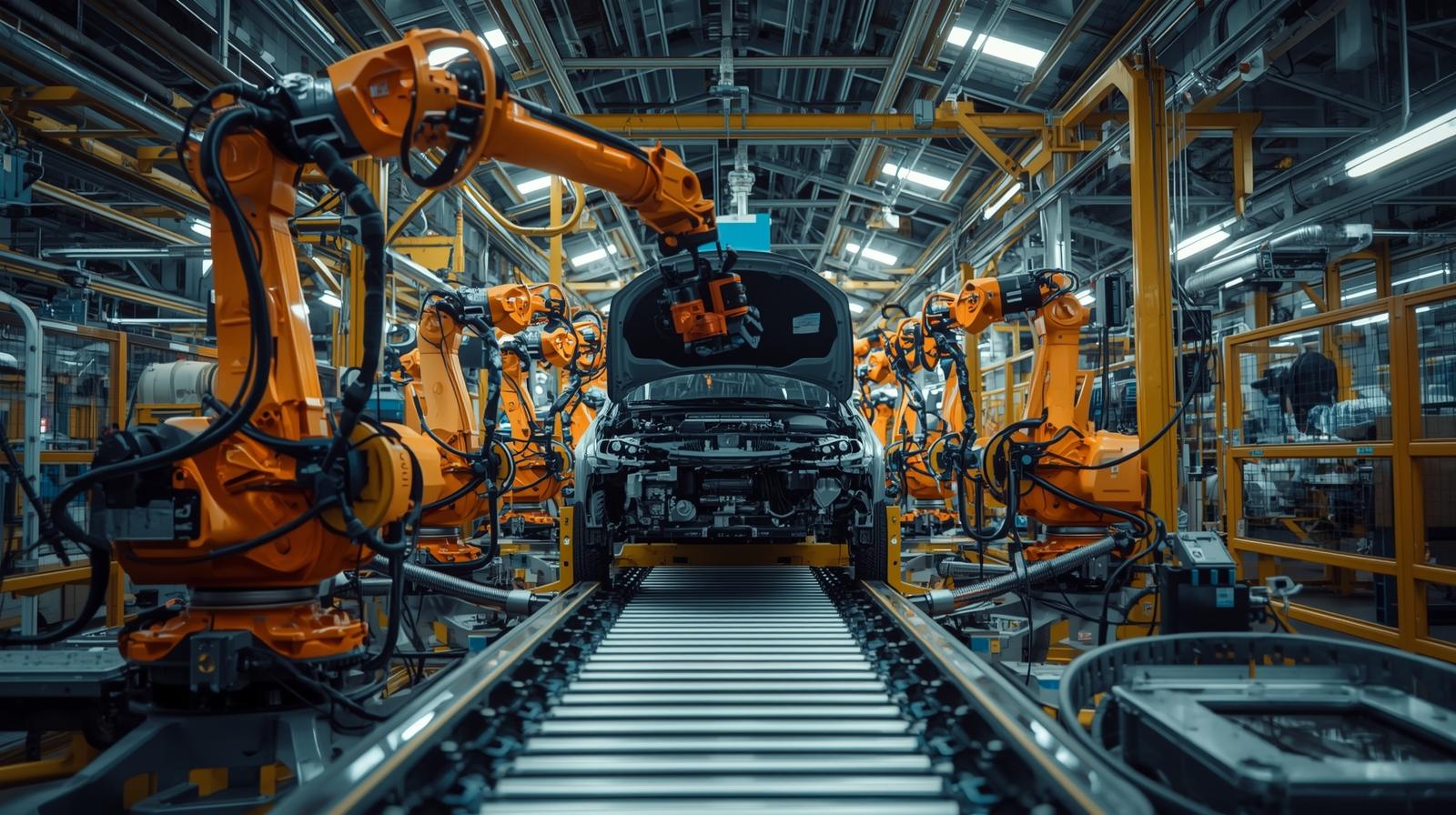
Robotics has become a core component of modern automotive manufacturing. Automakers are increasingly deploying robots for welding, painting, assembly, material handling, inspection, and other repetitive or hazardous activities.
Industrial robots provide high levels of precision, repeatability, and productivity. They can operate continuously while maintaining consistent production standards, making them particularly valuable for large-scale automotive manufacturing facilities.
Collaborative robots, or cobots, are also creating new opportunities. Unlike conventional industrial robots that typically operate in dedicated work zones, cobots can support human workers in selected production tasks. Their flexibility makes them useful for manufacturers seeking automation without completely redesigning existing production lines.
MarketsandMarkets highlights robotics adoption as an important factor supporting automotive manufacturing modernization. Commercial use cases include the deployment of ABB robots across press, painting, and body-in-white operations, while FANUC robots and CNC systems are being used to address labor shortages and improve production flexibility. KUKA has also deployed modular robot cells for automotive body-part welding and related operations.
The increasing combination of robotics with sensors, machine vision, AI, and cloud-based analytics is expected to further strengthen Automotive Manufacturing Equipment Market Growth.
Digital Transformation Enables Smart Automotive Factories
Digital transformation is changing how automotive manufacturing equipment is designed, deployed, monitored, and maintained. Industry 4.0 technologies allow machines to communicate with one another and provide manufacturers with real-time visibility into production operations.
Connected equipment can collect information related to machine utilization, temperature, vibration, production speed, energy consumption, and maintenance requirements. This data can be analyzed to improve operational efficiency and identify bottlenecks.
Digital twins are another emerging technology with significant potential. Manufacturers can create virtual representations of production equipment or entire manufacturing lines and use them to simulate production scenarios before implementing physical changes. This can reduce commissioning time, improve production planning, and minimize costly operational disruptions.
MarketsandMarkets identifies AI, IoT, connected systems, digital twins, robotics, and additive manufacturing as important technologies supporting digital transformation across the automotive industry.
For equipment suppliers, this creates opportunities to move beyond selling individual machines and offer integrated smart manufacturing platforms. Such solutions can combine equipment, software, sensors, analytics, and remote monitoring capabilities, creating additional value for automotive OEMs and component manufacturers.
Electric Vehicles Open New Growth Opportunities
The transition toward electric and hybrid vehicles is one of the strongest drivers of Automotive Manufacturing Equipment Market Growth. EV production requires different manufacturing processes and specialized equipment compared with conventional internal combustion engine vehicles.
Battery packs, electric motors, power electronics, lightweight structures, and other EV-specific components require advanced manufacturing and assembly capabilities. Automakers are therefore investing in equipment that can deliver higher precision, flexibility, and automation.
Battery manufacturing is particularly important. As global EV production expands, manufacturers require specialized equipment for battery assembly, processing, testing, and integration. The shift toward electrification is also increasing demand for equipment capable of handling lightweight materials and complex component designs.
MarketsandMarkets identifies rising EV and hybrid vehicle adoption as a major driver of the automotive manufacturing equipment market, with investments in battery, electric drivetrain, and lightweight-component manufacturing supporting equipment demand.
This transition creates opportunities for equipment suppliers that can provide flexible production systems capable of supporting multiple vehicle architectures and rapidly evolving EV technologies.
CNC Machines Remain a Key Segment
CNC machines are expected to account for the largest share of the automotive manufacturing equipment market during the forecast period. Their ability to manufacture complex components with high precision, efficiency, and repeatability makes them essential for automotive production.
CNC machines are widely used to manufacture engine components, transmission parts, chassis components, and other precision parts. As vehicle designs become more complex, manufacturers increasingly require high-accuracy machining capabilities.
The integration of CNC machines with automation and Industry 4.0 technologies further enhances their value. Connected CNC systems can provide real-time production information, support predictive maintenance, and integrate with automated material-handling systems.
Consequently, continued innovation in CNC automation, software, sensors, and machine connectivity is expected to contribute to Automotive Manufacturing Equipment Market Growth.
Automatic Equipment Gains Momentum
The automatic segment is expected to experience strong growth as manufacturers seek greater efficiency, consistency, and scalability. Fully automated equipment can reduce dependence on manual labor while supporting consistent production quality.
Automation is particularly valuable as automotive manufacturers manage increasingly complex vehicle designs and growing EV production requirements. AI, IoT, machine learning, sensors, and robotics can be integrated into automated production systems to enable real-time monitoring and process optimization.
Automated systems can also support predictive maintenance by identifying equipment abnormalities before failures occur. This helps manufacturers reduce downtime and improve overall equipment effectiveness.
The growing emphasis on flexible manufacturing means future production lines will increasingly combine automatic equipment with software-based control systems and intelligent analytics.
Lightweight Materials Drive Equipment Innovation
The automotive industry’s focus on vehicle weight reduction is another opportunity supporting Automotive Manufacturing Equipment Market Growth. Lightweight materials can help improve vehicle efficiency and, in the case of EVs, potentially extend driving range.
However, manufacturing lightweight components can require specialized equipment and processes. Advanced materials may have different machining, forming, molding, or joining characteristics compared with traditional automotive materials.
Equipment manufacturers therefore have opportunities to develop precision machinery capable of processing aluminum, advanced steels, composites, and other lightweight materials. Flexible equipment that can accommodate multiple materials and production requirements will be particularly valuable to automakers.
Asia Pacific Offers Significant Growth Potential
Asia Pacific is expected to lead the automotive manufacturing equipment market during the forecast period. Strong automotive production, increasing vehicle demand, industrialization, EV adoption, and investments in advanced manufacturing technologies are supporting regional growth.
China, India, and other Asian markets are strengthening their automotive manufacturing ecosystems while investing in automation and smart factory technologies. The region also benefits from a large manufacturing base, skilled labor availability, supportive government initiatives, and increasing foreign investment.
The expansion of EV manufacturing in Asia Pacific creates additional demand for specialized production equipment, robotics, battery-related machinery, and automated assembly systems.
For equipment manufacturers, Asia Pacific therefore represents a significant opportunity for Automotive Manufacturing Equipment Market Growth, particularly for companies offering scalable and cost-efficient automation solutions.
Emerging Economies Create Untapped Opportunities
Beyond established automotive manufacturing hubs, emerging economies are becoming important opportunities for equipment suppliers. Increasing vehicle production, industrialization, infrastructure development, and foreign investment are encouraging manufacturers to modernize production facilities.
New manufacturing plants can incorporate automation and connected technologies from the beginning rather than relying on legacy equipment. This creates opportunities for suppliers of smart robots, CNC machines, AGVs, automated inspection systems, and digital manufacturing platforms.
The expansion of automotive production in emerging economies can therefore support long-term Automotive Manufacturing Equipment Market Growth.
Cybersecurity and Interoperability Remain Key Challenges
Despite strong growth opportunities, manufacturers face several challenges when implementing connected and intelligent equipment. Cybersecurity is becoming increasingly important as factory equipment becomes connected to enterprise networks, cloud platforms, IoT systems, and external applications.
A cyberattack targeting industrial control systems, robots, or connected machinery could disrupt production and affect product quality and operational safety. Manufacturers must therefore strengthen network security, access controls, monitoring, employee training, and system testing.
Interoperability is another challenge. Automotive factories often contain equipment from multiple suppliers and generations. Ensuring that machines, sensors, software platforms, and control systems can communicate effectively can be complex.
Addressing these challenges will be essential for sustaining long-term Automotive Manufacturing Equipment Market Growth.
High Equipment Costs Create Adoption Barriers
High installation and ownership costs remain a significant restraint, particularly for small and medium-sized enterprises. Advanced robotics, sensors, software, integration services, and specialized machinery can require substantial upfront investments.
Manufacturers must also account for maintenance, employee training, customization, software upgrades, and system integration. Rapid technological development can further create concerns about equipment becoming outdated.
Equipment suppliers can address these barriers through modular automation, scalable systems, robotics-as-a-service models, flexible software platforms, and predictive maintenance solutions. These approaches can help manufacturers modernize production while managing capital expenditure.
Competitive Landscape
The automotive manufacturing equipment market includes major companies such as ABB, FANUC Corporation, KUKA AG, Yaskawa Electric Corporation, and Kawasaki Heavy Industries. These companies are focusing on product innovation, partnerships, capacity expansion, automation, and advanced robotics to strengthen their market positions.
Competition is increasingly shifting from standalone machinery toward integrated manufacturing solutions. Suppliers that combine robotics, CNC systems, AI, IoT connectivity, machine vision, analytics, and software are positioned to capture opportunities created by smart manufacturing.
The competitive landscape is therefore likely to evolve as equipment manufacturers increasingly become technology and automation partners for automotive OEMs.
Future Outlook for Automotive Manufacturing Equipment Market Growth
The future of Automotive Manufacturing Equipment Market Growth will be closely connected to the transformation of automotive production itself. The shift toward electric and hybrid vehicles, connected factories, advanced robotics, AI-powered quality control, predictive maintenance, digital twins, and automated material handling will create sustained demand for intelligent manufacturing equipment.
The global market is projected to grow from USD 31.99 billion in 2025 to USD 41.70 billion by 2030, representing a 5.4% CAGR. CNC machines are expected to maintain a leading position, while automatic equipment, robotics, AI-enabled systems, and connected manufacturing technologies create additional opportunities. Asia Pacific is expected to remain the leading regional market.
For automotive manufacturers, the competitive advantage will increasingly depend on their ability to build flexible, connected, data-driven factories. For equipment suppliers, the opportunity lies in delivering solutions that combine mechanical performance with software intelligence.
As AI, robotics, IoT, and digital transformation become embedded across automotive production, the Automotive Manufacturing Equipment Market Growth trajectory is expected to remain positive. Companies that invest in intelligent automation, cybersecurity, interoperability, and flexible manufacturing capabilities will be better positioned to capitalize on the next phase of automotive industrial transformation.
FAQs
1. What is driving Automotive Manufacturing Equipment Market Growth?
The major factors driving Automotive Manufacturing Equipment Market Growth include rising EV and hybrid vehicle production, increasing automation and robotics adoption, Industry 4.0 integration, demand for lightweight components, battery manufacturing expansion, and investments in smart factories.
2. What is the size of the automotive manufacturing equipment market?
According to MarketsandMarkets, the global automotive manufacturing equipment market was valued at USD 31.99 billion in 2025 and is projected to reach USD 41.70 billion by 2030, growing at a CAGR of 5.4% during 2025–2030.
3. How are AI and robotics influencing the market?
AI and robotics are improving production efficiency, precision, quality control, predictive maintenance, material handling, and workplace safety. AI can analyze production data and identify defects, while robots automate repetitive and hazardous manufacturing operations.
4. Which equipment segment is expected to lead the automotive manufacturing equipment market?
CNC machines are expected to hold the largest share of the market through the forecast period because of their precision, repeatability, efficiency, and increasing integration with automation and Industry 4.0 systems.
5. Which region offers significant opportunities for Automotive Manufacturing Equipment Market Growth?
Asia Pacific is expected to lead the global automotive manufacturing equipment market. Strong automotive production, EV adoption, industrialization, investments in smart manufacturing, and growing vehicle demand in countries such as China and India are supporting regional growth.