
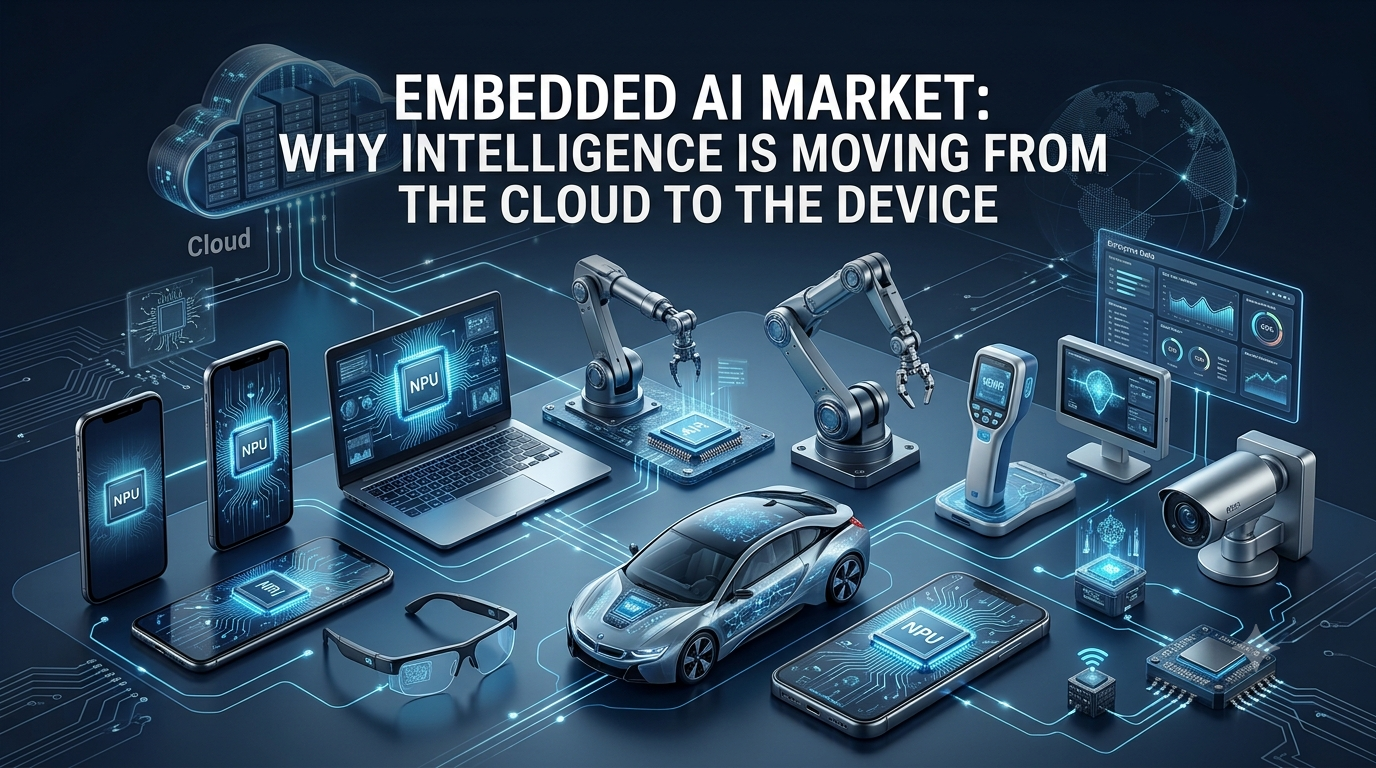
The Embedded AI Market is expanding as artificial intelligence moves from centralized cloud systems into smartphones, vehicles, cameras, robots, industrial equipment, medical devices, and connected machines, enabling faster and more private local decision-making.
AI inference is increasingly moving closer to where data is generated.
Devices can process images, audio, sensor signals, and operational data locally.
Local processing can reduce latency, connectivity dependence, and unnecessary data transmission.
Cloud infrastructure remains critical for model training, complex workloads, analytics, and centralized governance.
The emerging architecture is therefore distributed across device, edge, and cloud.
The strategic question is changing. Enterprises are no longer asking only whether they should adopt AI. They increasingly need to determine where AI inference should happen.
Deloitte’s 2026 research identifies edge AI and on-device processing as important technology signals, citing latency, privacy, cloud economics, and connectivity considerations.
The Cloud-Only AI Model Is Facing a Reality Check
Embedded intelligence does not replace cloud AI. Instead, it creates a hybrid architecture in which devices handle immediate inference while edge and cloud infrastructure manage increasingly complex workloads.
The traditional AI model concentrated training and inference in centralized data centers. That remains essential for large models and computationally intensive applications. However, continuous inference creates different infrastructure requirements.
Factory cameras can identify defects locally.
Vehicles can interpret sensor information without waiting for cloud responses.
Smartphones can perform selected speech, imaging, and personalization functions locally.
Industrial systems can continue operating when connectivity is unreliable.
Sensitive information can remain closer to its source.
Deloitte describes the emerging enterprise model as strategic hybrid computing, combining cloud for elasticity, on-premises infrastructure for consistency, and edge computing for immediacy.
Market research indicates strong trends Download the PDF to uncover business insights.
Why Companies Are Pushing AI Closer to the Device
Businesses are adopting on-device AI primarily to improve response times, reduce unnecessary data movement, strengthen privacy, increase resilience, and create new intelligent product experiences.
Lower Latency
Applications such as robotics, driver assistance, industrial inspection, and real-time video analytics may require rapid responses.
Local inference removes unnecessary cloud round trips.
Critical decisions can happen closer to the data source.
Real-time applications become less dependent on network conditions.
Lower Data Movement
Instead of continuously transmitting raw sensor, image, or audio streams, devices can process information locally and transmit only relevant results.
Less network traffic
Potentially lower cloud consumption
More efficient data pipelines
Stronger Privacy
On-device processing can reduce unnecessary transmission of sensitive information. This is particularly relevant for healthcare, personal devices, financial applications, security, and industrial environments.
Greater Resilience
Intelligent devices can continue performing selected AI functions when connectivity is weak or unavailable.
Product Differentiation
AI is becoming a product capability rather than simply a software service. Manufacturers can differentiate products through personalization, predictive functions, automation, perception, and context-aware experiences.
This Sample Report is designed to fuel your business growth—download it today.
Where Embedded AI Is Creating Real Business Value
Embedded AI is being applied across manufacturing, automotive, healthcare, retail, consumer electronics, telecommunications, energy, agriculture, robotics, and security.
Manufacturing: Visual inspection, predictive maintenance, anomaly detection, and quality control can support faster operational decisions.
Automotive: Driver assistance, perception, sensor interpretation, and vehicle intelligence require increasingly responsive computing.
Healthcare: Wearables and medical devices can support local monitoring and selected analytical functions.
Retail: Smart cameras and intelligent devices can generate real-time operational and customer insights.
Consumer Electronics: Smartphones, PCs, earbuds, and wearables increasingly incorporate local AI capabilities.
Telecommunications: Intelligent network equipment can analyze conditions and optimize selected operations closer to the network edge.
Energy: Embedded intelligence can support equipment monitoring and predictive maintenance.
Agriculture: Sensors and machines can analyze crops and equipment for precision operations.
Robotics: Local perception, object recognition, navigation, and decision-making can improve autonomous operation.
Security: Cameras and sensors can analyze events without continuously sending raw streams to centralized systems.
Deloitte also identifies smart cameras, industrial sensors, autonomous systems, and wearables as important examples of edge and on-device AI applications.
Inside the Intelligent Device: The Technology Stack Is Changing
An intelligent device typically combines sensors, processors, AI accelerators, optimized models, memory, software, and connectivity to perform inference locally.
A simplified architecture looks like this:
Sensors → Data Acquisition → CPU/GPU/NPU → AI Model → Local Decision → Device Action → Optional Cloud Synchronization
The NPU is becoming increasingly important because dedicated AI acceleration can execute neural-network workloads more efficiently than relying entirely on general-purpose processors.
Modern AI devices increasingly combine:
CPU for general-purpose computing
GPU for parallel workloads
NPU for AI inference
Memory optimized for AI workloads
Specialized accelerators
Efficient software frameworks
Secure model execution
Model optimization is equally important. Developers must consider:
Model size
Memory limits
Battery consumption
Thermal constraints
Inference latency
Accuracy
Hardware acceleration
Offline functionality
Security
Quantization, compression, pruning, and smaller models can therefore become critical to practical deployment.
Regulation Could Become a Hidden Cost of Embedded Intelligence
Embedded AI creates regulatory responsibilities around privacy, cybersecurity, transparency, data governance, safety, documentation, and risk management, particularly when AI becomes part of regulated products.
The EU AI Act is especially relevant for organizations developing or selling AI-enabled products in Europe.
As of September 2026, the Act’s enforcement framework is being implemented progressively. Rules for certain high-risk AI systems apply from December 2, 2027, while high-risk AI embedded in regulated products has an extended application date of August 2, 2028.
Applicable high-risk systems can involve requirements covering:
Risk assessment
Data quality
Logging and traceability
Technical documentation
Human oversight
Accuracy
Robustness
Cybersecurity
For product manufacturers, governance therefore needs to be designed into the architecture rather than added after deployment.
How Enterprises Can Build an Embedded AI Strategy
Enterprises should begin with the business problem, determine which workloads require local inference, select appropriate hardware, optimize the AI model, secure the device, and establish lifecycle management.
Step 1: Identify the Workload
Determine which functions require immediate local processing and which can remain cloud-based.
Step 2: Classify the Data
Assess privacy, sensitivity, retention, sovereignty, and transmission requirements.
Step 3: Define Performance Targets
Set measurable requirements for latency, accuracy, energy consumption, reliability, and availability.
Step 4: Select the Architecture
Evaluate CPU, GPU, NPU, memory, accelerator, connectivity, and edge infrastructure requirements.
Step 5: Optimize the Model
Use quantization, compression, pruning, and hardware-specific optimization where appropriate.
Step 6: Secure the Device
Implement secure boot, firmware protection, model security, access controls, encryption, and secure updates.
Step 7: Manage the AI Lifecycle
Monitor models, validate performance, manage versions, and establish controlled update processes.
Step 8: Define Cloud-Edge Coordination
Decide which information stays local, which moves to the edge, and which requires centralized cloud processing.
The Risks Could Be Just as Important as the Opportunity
The biggest Embedded AI Market challenges include limited device resources, model-update complexity, cybersecurity exposure, energy constraints, and the accuracy gap between compact and larger models.
Devices cannot match the unlimited resources of centralized data centers.
Memory can restrict model size.
Battery capacity can limit continuous inference.
Thermal constraints can restrict sustained performance.
Connectivity may complicate model updates.
Attackers can target firmware, models, interfaces, or inputs.
Smaller models may sacrifice capability for efficiency.
These limitations explain why hybrid architectures remain important. Deloitte’s 2026 analysis notes that enterprises are increasingly distributing AI workloads across cloud, on-premises, edge, and device environments according to factors such as cost, latency, security, and workload requirements.
The Competitive Battle Is Moving Beyond AI Software
Competition in embedded intelligence spans semiconductor manufacturers, device makers, AI software companies, operating-system providers, industrial technology companies, and edge-computing vendors.
The competitive landscape is developing across several layers:
AI accelerators
NPUs and SoCs
Edge computing platforms
AI model optimization
Embedded software
Developer tools
Operating systems
Industrial AI platforms
Device management
Security technologies
The challenge is integration.
A powerful processor cannot deliver maximum value without optimized software. Likewise, an advanced AI model may be impractical if it requires excessive memory, power, or compute.
The architecture therefore matters as much as the individual component.
The 2026 Trends That Could Reshape Embedded AI
Key 2026 trends include stronger NPUs, smaller AI models, AI PCs and smartphones, intelligent wearables, industrial edge AI, agentic applications, and hybrid cloud-device architectures.
Agentic AI Moves Toward Devices
AI systems are increasingly moving from simple responses toward context-aware actions. This could create demand for local processing where responsiveness, privacy, and reliability matter.
NPUs Become Mainstream
Dedicated AI acceleration is becoming an increasingly important component of modern computing platforms.
Smaller Models Gain Strategic Importance
The race is no longer only about larger models. Efficient, compressed, and specialized models can make local inference more practical.
AI PCs and Smartphones Expand
Personal devices are becoming AI-computing platforms capable of executing selected workloads locally. Deloitte expects NPUs to become standard in new enterprise PC fleets.
Wearables Become More Intelligent
Smart glasses, earbuds, and other connected devices can use local AI for voice, translation, perception, and context-aware experiences.
Industrial Edge AI Accelerates
Factories, robots, cameras, and machines increasingly require intelligent processing close to physical operations.
Hybrid AI Becomes the Practical Model
Deloitte’s 2026 research points toward heterogeneous computing environments where cloud, enterprise edge, telco edge, and device edge each handle workloads suited to their capabilities.
The Strategic Takeaway: Intelligence Is Moving Closer to the Action
Featured snippet: The Embedded AI Market represents a broader shift toward distributed intelligence, where AI workloads are strategically divided between devices, edge infrastructure, and cloud platforms.
The cloud will remain fundamental to AI training, centralized analytics, governance, and complex computation. But the first layer of intelligence is increasingly moving closer to the user, machine, vehicle, camera, sensor, or physical environment.
For enterprises, the critical question is no longer simply whether to deploy AI.
It is:
Which decisions should happen on the device, which should move to the edge, and which truly belong in the cloud?
That architectural decision could shape the next generation of intelligent products, industrial systems, connected devices, and enterprise AI infrastructure.