
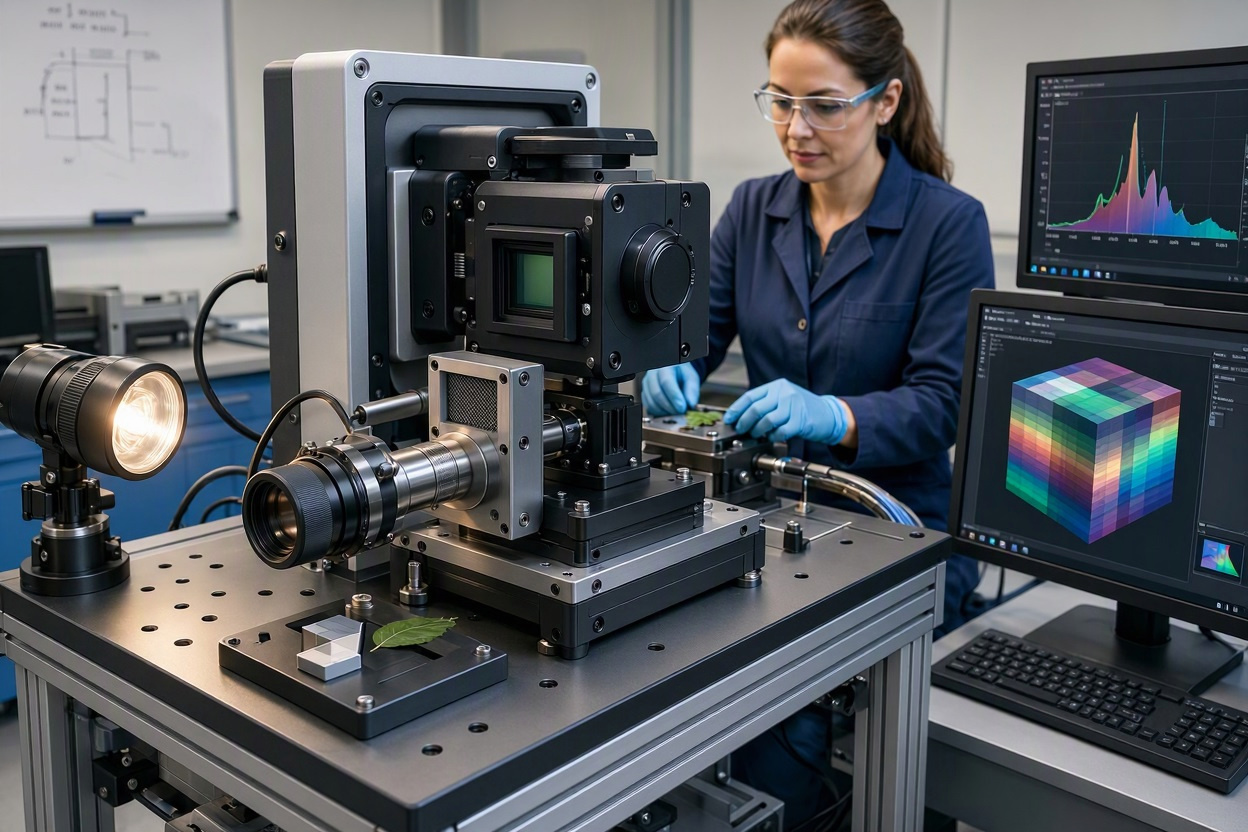
The Hyperspectral Imaging Systems Market is becoming an important part of advanced sensing as industries seek more detailed information from images. Unlike conventional imaging systems that primarily capture visible colors, hyperspectral systems collect information across numerous narrow spectral bands. This enables users to identify materials, detect subtle differences, and analyze physical or chemical characteristics that may not be visible to the human eye. The technology is increasingly being applied across agriculture, industrial inspection, remote sensing, environmental monitoring, defense, mining, pharmaceuticals, and scientific research.
According to Marketsandmarkets, the global hyperspectral imaging system market size is estimated to be USD 0.92 billion in 2025 and is projected to reach USD 1.83 billion by 2030; it is expected to register a CAGR of 14.7% during the forecast period.
Download PDF Brochure @ https://www.marketsandmarkets.com/pdfdownloadNew.asp?id=246979343
The Hyperspectral Imaging Systems Market is also evolving from specialized laboratory equipment toward more portable, integrated, and application focused solutions. Improvements in sensor sensitivity, optical design, processing capabilities, and artificial intelligence are making hyperspectral systems easier to deploy in real world environments. Companies are increasingly focusing on combining cameras, spectral sensors, software, analytics, and system integration capabilities to create complete solutions. This shift is influencing competition because customers are evaluating not only camera specifications but also software compatibility, data processing, deployment flexibility, and application support.
Competitive Landscape Is Becoming More Application Focused
Competition in the Hyperspectral Imaging Systems Market is shaped by companies offering cameras, sensors, optical components, software, analytics platforms, and integrated imaging solutions. The competitive environment includes established imaging technology providers as well as specialized companies focused on particular wavelengths, applications, or deployment platforms. The industry therefore has a diverse structure in which companies compete through product performance, spectral resolution, portability, application expertise, integration capabilities, and customer support. The supplied industry source identifies major participants including Specim, Corning, HORIBA, Resonon, BaySpec, imec, Headwall Photonics, Gamaya, Diaspective Vision, Photon etc., ClydeHSI, and Norsk Electro Optikk.
Product differentiation is particularly important because hyperspectral requirements vary significantly by application. An industrial sorting customer may prioritize high speed imaging and reliable material classification, while an agricultural user may require lightweight airborne sensors and analytics. Research laboratories can prioritize spectral resolution and flexibility, whereas defense and remote sensing applications may require ruggedized equipment capable of operating across demanding environments. This diversity creates opportunities for companies to establish specialized positions instead of competing solely on price or camera specifications.
Key Companies Strengthen Technology Portfolios
Companies operating in the Hyperspectral Imaging Systems Market are pursuing different strategies to expand their technological capabilities and application reach. Some focus on hyperspectral cameras across visible and near infrared wavelengths, while others specialize in short wave infrared, mid wave infrared, long wave infrared, snapshot imaging, or airborne sensing. The industry source identifies cameras and other systems as important product categories and highlights pushbroom, snapshot, tunable filter, imaging FTIR, and whiskbroom approaches across the technology landscape.
The competitive environment also includes companies with capabilities extending beyond hardware. Software processing, spectral libraries, artificial intelligence, machine learning, visualization, and data interpretation are becoming increasingly important components of the overall solution. As hyperspectral datasets become larger and more complex, customers require efficient methods for converting spectral information into actionable insights. Companies capable of combining imaging hardware with analytics and application specific software can therefore address a broader portion of the customer workflow.
Product Innovation Shapes Competitive Positioning
Product innovation remains a major competitive factor in the Hyperspectral Imaging Systems Market. Manufacturers are working toward smaller sensors, improved sensitivity, higher spatial and spectral resolution, lower power consumption, and greater ease of deployment. Miniaturization is particularly important because hyperspectral sensors are increasingly being incorporated into drones, aircraft, satellites, handheld systems, robotic platforms, and automated inspection equipment. Compact designs can reduce platform requirements and allow imaging capabilities to be introduced into applications where conventional hyperspectral equipment was previously difficult to deploy.
The development of portable and user friendly systems is also expanding access beyond specialist research environments. Systems that require less technical expertise can support broader adoption among industrial users, agricultural operators, inspection teams, and environmental organizations. At the same time, manufacturers must balance compact form factors with optical performance, calibration stability, data throughput, and thermal management. This creates a continuing engineering challenge and provides companies with opportunities to differentiate through system design.
Mergers and Acquisitions Reshape Industry Capabilities
Mergers and acquisitions are becoming an important element of the competitive development of the Hyperspectral Imaging Systems Market. Rather than building every capability internally, companies can use acquisitions to obtain specialized technologies, engineering expertise, intellectual property, manufacturing capabilities, customer relationships, or access to new application segments. Recent activity demonstrates that consolidation can connect hyperspectral imaging with broader geospatial, industrial inspection, optical, and sensing ecosystems.
In January 2024, Headwall Photonics announced the acquisition of inno-spec GmbH. The transaction brought together Headwall’s optical and remote sensing capabilities with inno-spec’s expertise in industrial hyperspectral imaging systems. According to the announcement, inno-spec served applications including recycling, industrial sorting, and quality testing. The transaction illustrates how acquisitions can be used to strengthen industrial machine vision capabilities and broaden the application reach of hyperspectral technology.
Another significant development occurred in 2025 when Emtek Holdings acquired a majority stake in Cubert and established the EMTEK Hyperspectral Group around the company. Cubert specializes in snapshot hyperspectral cameras and analysis software, with applications spanning machine vision, remote sensing, biomedical use, and defense. The transaction was positioned around accelerating commercialization, expanding market access, and strengthening research and development capabilities.
In June 2026, Hexagon acquired ITRES Research Limited, a Canadian provider of airborne hyperspectral and thermal imaging systems. Hexagon stated that the acquisition strengthens its airborne mapping capabilities by adding hyperspectral and thermal sensing to its broader geospatial technology portfolio. The transaction demonstrates how hyperspectral imaging is becoming increasingly connected with geospatial data acquisition, mapping, processing, and digital reality workflows.
Strategic Partnerships Expand Market Reach
Partnerships are another important competitive strategy in the Hyperspectral Imaging Systems Market. Collaboration allows companies to combine complementary capabilities without requiring a full acquisition. Hardware providers can work with software companies, system integrators, research organizations, drone manufacturers, satellite operators, and application specialists to create complete solutions. Such partnerships can reduce deployment complexity and help hyperspectral technology move into new industries.
The industry landscape shows increasing interest in partnerships involving sensor manufacturers and processing platforms. For example, a January 2024 collaboration involving Specim and GEONA hyperspectral positioned GEONA as a preferred standalone processing solution for Specim airborne hyperspectral sensors. Such arrangements demonstrate how the industry is moving toward integrated hardware and software ecosystems.
Partnerships are particularly relevant in remote sensing because hyperspectral imaging requires multiple elements, including sensor hardware, aircraft or satellite platforms, data transmission, processing software, spectral libraries, and application analytics. Companies that can connect these elements can create solutions that address complete workflows rather than individual equipment requirements.
AI Integration Changes Hyperspectral Imaging
Artificial intelligence is becoming a major technology influence within the Hyperspectral Imaging Systems Market. Hyperspectral cameras generate large volumes of spectral information, creating opportunities for machine learning algorithms to automate classification, anomaly detection, material identification, and image interpretation. AI can help transform complex spectral datasets into useful information for operators and decision makers.
AI integration is especially relevant to industrial inspection and automated sorting. A hyperspectral system can identify differences in materials that may not be visible through standard imaging. Machine learning algorithms can then classify those differences and support automated decisions. Similar approaches can be applied to agricultural monitoring, environmental assessment, mineral identification, pharmaceutical analysis, and remote sensing. The combination of spectral information and AI therefore expands the potential value of hyperspectral systems beyond image capture.
Industrial Inspection Drives Technology Adoption
Industrial inspection represents an important application area because manufacturers increasingly need accurate and non destructive methods for identifying defects and materials. Hyperspectral systems can analyze products based on their spectral characteristics rather than relying only on visible appearance. This can help identify contamination, material differences, surface characteristics, and product inconsistencies.
The technology can be integrated with automated production lines, robotic systems, optical sorting equipment, and machine vision platforms. As manufacturing environments become more automated, hyperspectral imaging can provide an additional information layer for quality control. Companies competing in this segment are therefore focusing on faster acquisition, reliable classification, compact system design, and integration with existing production equipment.
Agriculture Creates New Imaging Opportunities
Agriculture is another important application area for the Hyperspectral Imaging Systems Market. Spectral information can help identify crop stress, vegetation characteristics, soil conditions, disease indicators, and other changes that may not be immediately visible through conventional photography. When combined with drones, satellites, and analytics software, hyperspectral imaging can support precision agriculture and field level monitoring.
The move toward data driven agriculture is creating demand for imaging systems that can operate across large areas while maintaining useful spectral information. Airborne and drone based platforms are particularly relevant because they can collect information across agricultural fields without requiring extensive ground based equipment. Companies are therefore working on lightweight sensors, efficient data processing, and analytics platforms that can translate hyperspectral information into practical agricultural insights.
Remote Sensing Expands the Competitive Ecosystem
Remote sensing is contributing to the broader development of the Hyperspectral Imaging Systems Market because hyperspectral data can provide detailed information about land surfaces, vegetation, minerals, water, and environmental conditions. Airborne systems can collect high resolution data over targeted areas, while satellite based hyperspectral imaging can support wider geographic monitoring.
The increasing use of hyperspectral technology in space is also encouraging innovation in sensor miniaturization. Smaller payloads can support deployment on compact satellites and other space platforms. This creates opportunities for companies involved in sensors, optical components, satellite platforms, data processing, and Earth observation analytics. The competitive landscape is therefore extending beyond traditional camera manufacturers toward a wider remote sensing ecosystem.
Defense and Surveillance Remain Specialized Applications
Defense and surveillance applications require reliable imaging under demanding environmental conditions. Hyperspectral systems can provide spectral information that supports object detection, material classification, camouflage identification, and environmental characterization. These capabilities can complement conventional electro optical and infrared imaging technologies.
Competitive differentiation in this area depends on factors such as sensor sensitivity, wavelength coverage, size, weight, power requirements, data processing capabilities, and platform integration. Systems designed for airborne, ground based, or space based deployment may have substantially different requirements. This application diversity encourages specialized product development and partnerships between sensor manufacturers, defense technology providers, and platform companies.
Technology Segmentation Creates Multiple Competitive Niches
The Hyperspectral Imaging Systems Market includes several technology approaches that address different performance requirements. Pushbroom or line scan systems are widely used for applications where continuous spectral information needs to be collected as objects or platforms move through the imaging field. Snapshot systems can capture hyperspectral information without requiring the same scanning mechanism, making them attractive for selected real time and mobile applications.
Tunable filter and other spectral acquisition approaches provide alternative methods for collecting wavelength specific information. The choice of technology depends on factors such as imaging speed, spectral resolution, spatial resolution, operating environment, system complexity, and application requirements. As a result, competition is not limited to a single technology architecture. Companies can differentiate through specialized solutions designed around specific customer workflows.
Wavelength Capabilities Influence Product Strategy
Wavelength coverage is another important competitive factor. Visible and near infrared systems can support applications involving vegetation, food, industrial inspection, and material identification. Short wave infrared systems can provide additional information about materials and chemical characteristics. Mid wave and long wave infrared technologies can support specialized applications involving thermal and spectral information.
Manufacturers therefore need to balance wavelength coverage with detector availability, optical performance, cost, calibration, and system size. Broad wavelength portfolios can help companies serve multiple industries, while highly specialized products can provide strong differentiation within particular applications. The combination of wavelength expertise and application knowledge is consequently becoming an important competitive advantage.
Data Processing Becomes a Competitive Differentiator
The value of hyperspectral imaging increasingly depends on what happens after image acquisition. Hyperspectral datasets can be substantially more complex than conventional images because each pixel may contain information across many spectral bands. Processing, storage, visualization, classification, and interpretation therefore require appropriate computing infrastructure and specialized software.
Companies are responding by developing more efficient analytics workflows and integrating AI and machine learning into their platforms. Cloud based processing, edge computing, automated classification, spectral libraries, and real time analytics can reduce the time required to turn raw imagery into usable information. This development is changing competition because software capabilities can influence purchasing decisions alongside hardware specifications.
Competitive Landscape Moves Toward Integrated Solutions
The Hyperspectral Imaging Systems Market is gradually moving toward integrated solutions that combine sensors, optics, processing, analytics, and application specific workflows. Customers increasingly seek systems that can be deployed with fewer integration challenges. This trend benefits companies that can offer complete solutions or build strong ecosystems through partnerships.
The competitive landscape remains diverse because hyperspectral imaging serves many industries with different requirements. Established imaging companies compete through product breadth and technical capabilities, while specialized providers focus on areas such as snapshot imaging, airborne sensing, medical applications, industrial sorting, or remote sensing. Startups and emerging technology companies are also introducing new approaches involving compact sensors, AI analytics, satellite imaging, and specialized application platforms.
Key Competitive Strategies in the Industry
Companies are using several strategies to strengthen their position in the Hyperspectral Imaging Systems Market. These approaches reflect the industry’s movement toward greater integration, specialized applications, and technology convergence.
Expanding hyperspectral camera portfolios across multiple wavelength ranges and deployment platforms.
Developing AI based analytics to automate material classification, anomaly detection, and image interpretation.
Using acquisitions to add specialized optical, imaging, software, or geospatial capabilities.
Establishing partnerships with system integrators, software providers, research institutions, and platform manufacturers.
Developing compact and portable systems for drones, satellites, robotics, and field applications.
These strategies indicate that competition increasingly involves the complete technology ecosystem rather than individual camera specifications. Companies that can connect hardware, software, analytics, and application expertise can address broader customer requirements. At the same time, specialized suppliers can remain relevant by delivering high performance solutions for specific wavelengths or industries.
Challenges Affect Competitive Development
Despite growing adoption, the Hyperspectral Imaging Systems Market faces several challenges. Hyperspectral systems can generate large datasets that require substantial storage and processing capabilities. Organizations may also need specialized expertise to calibrate sensors, interpret spectral information, develop classification models, and integrate systems into existing workflows.
Another challenge involves standardization. Differences in sensors, spectral ranges, calibration procedures, data formats, and processing methods can complicate interoperability. Customers deploying systems across multiple locations may therefore prioritize platforms that offer reliable software support and standardized workflows. Addressing these technical barriers can create opportunities for companies developing integrated processing and analytics solutions.
Future Competitive Direction of Hyperspectral Imaging
The competitive direction of the Hyperspectral Imaging Systems Market is likely to remain centered on miniaturization, AI integration, automation, and broader system integration. Hyperspectral sensors are increasingly being incorporated into mobile platforms, drones, airborne systems, satellites, robotics, and industrial machinery. These developments can expand the technology beyond traditional research and laboratory environments.
At the same time, mergers, acquisitions, partnerships, and strategic investments are connecting hyperspectral imaging with larger ecosystems involving geospatial technology, industrial automation, machine vision, defense, agriculture, and environmental monitoring. Recent transactions involving industrial imaging, snapshot cameras, and airborne hyperspectral systems demonstrate how companies are using corporate development strategies to combine complementary technologies.
Key Takeaways
The Hyperspectral Imaging Systems Market is developing through a combination of sensor innovation, AI enabled analytics, application expansion, and industry consolidation. Competition includes established imaging technology providers, specialized hyperspectral companies, software developers, system integrators, and emerging technology firms. Companies are differentiating themselves through wavelength coverage, spectral performance, compact system design, application expertise, and software capabilities.
Mergers and acquisitions are becoming an important mechanism for strengthening technology portfolios and expanding geographic and application reach. The acquisition of inno-spec by Headwall, the majority investment in Cubert by Emtek, and the acquisition of ITRES by Hexagon illustrate different approaches to combining hyperspectral imaging with industrial, software, and geospatial capabilities.
FAQs About Hyperspectral Imaging Systems Market
What is the Hyperspectral Imaging Systems Market?
The Hyperspectral Imaging Systems Market covers technologies used to capture and analyze information across multiple narrow wavelength bands. These systems provide detailed spectral information that can help identify materials and distinguish objects based on their spectral characteristics. Applications include agriculture, industrial inspection, remote sensing, environmental monitoring, defense, mining, pharmaceuticals, and research.
What companies are active in hyperspectral imaging systems?
The industry includes companies such as Specim, Corning, HORIBA, Resonon, BaySpec, imec, Headwall Photonics, Gamaya, Diaspective Vision, Photon etc., ClydeHSI, and Norsk Electro Optikk. The competitive environment also includes emerging companies and specialized providers serving agriculture, remote sensing, industrial inspection, medical imaging, and other applications.
Why are mergers and acquisitions important in hyperspectral imaging?
Mergers and acquisitions can help companies obtain specialized sensor technologies, optical capabilities, software expertise, manufacturing resources, and customer access. Recent transactions demonstrate how hyperspectral imaging capabilities are being combined with industrial machine vision, snapshot imaging, and geospatial sensing technologies.
What are the major applications of hyperspectral imaging?
Major applications include agriculture, food inspection, industrial sorting, quality control, remote sensing, environmental monitoring, mineral exploration, defense, surveillance, pharmaceuticals, healthcare research, and scientific analysis. The technology is useful when material identification or spectral differences provide information beyond conventional imaging.
How is AI influencing hyperspectral imaging?
AI and machine learning can analyze complex spectral datasets and automate tasks such as classification, anomaly detection, material identification, and image interpretation. AI integration can improve workflow efficiency and support real time decision making across industrial, agricultural, environmental, and remote sensing applications.
What are the major hyperspectral imaging technologies?
Major approaches include pushbroom or line scan, snapshot, tunable filter, imaging FTIR, and whiskbroom technologies. Each approach has different characteristics related to acquisition speed, spectral resolution, spatial resolution, system complexity, and application suitability.
What factors influence competition in hyperspectral imaging?
Competition is influenced by sensor performance, wavelength coverage, spectral resolution, spatial resolution, portability, data processing capabilities, AI integration, system reliability, application expertise, and customer support. Partnerships and acquisitions are also increasingly influencing competitive positioning.
What are the major challenges for hyperspectral imaging adoption?
Key challenges include the complexity of hyperspectral data, the requirement for specialized expertise, large storage requirements, processing demands, calibration requirements, and differences in data formats and processing methods. Improvements in software automation and AI analytics can help reduce some of these barriers.
Why is miniaturization important for hyperspectral imaging?
Miniaturization allows hyperspectral sensors to be integrated into drones, satellites, handheld devices, robots, and other compact platforms. Smaller systems can expand the range of environments in which hyperspectral imaging can be deployed and can make the technology more practical for field based applications.
How is the competitive landscape changing?
The competitive landscape is moving from standalone imaging hardware toward integrated solutions combining sensors, optics, software, AI analytics, and application workflows. Strategic partnerships and acquisitions are helping companies combine complementary capabilities and address broader customer requirements across industrial, agricultural, geospatial, defense, and environmental applications.