
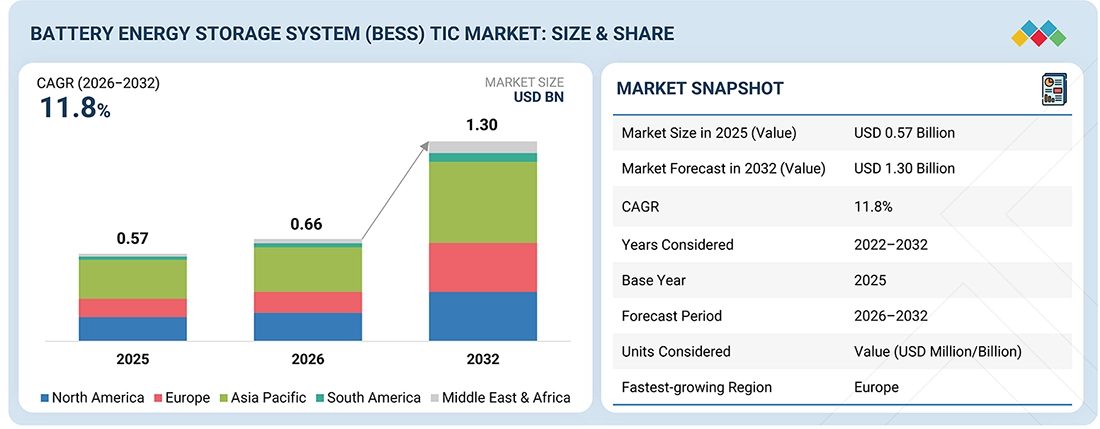
The Battery Energy Storage System (BESS) TIC Market is evolving as battery projects become larger, more complex, and increasingly important to renewable energy and grid infrastructure. Testing, inspection, and certification services are moving beyond individual equipment verification toward comprehensive lifecycle technical assurance. This approach covers project development, design, manufacturing, installation, commissioning, operation, maintenance, performance monitoring, safety management, and end-of-life activities. As stakeholders seek greater visibility into technical risks and long-term asset performance, lifecycle assurance is expected to become an increasingly important part of BESS project management.
Growing Importance of Lifecycle Technical Assurance
BESS assets operate across long project lifecycles and are exposed to changing electrical, thermal, environmental, and operational conditions. Technical risks can emerge at different stages, from battery cell manufacturing to system commissioning and long-term operation. Lifecycle TIC services provide a structured approach to identifying and managing these risks throughout the asset’s development and operation.
Independent technical assurance can provide project developers, asset owners, utilities, lenders, insurers, and operators with greater confidence in equipment quality, system performance, safety, and compliance. This creates opportunities for TIC providers to develop integrated service models rather than focusing only on individual testing activities.
Download PDF Brochure @ https://www.marketsandmarkets.com/pdfdownloadNew.asp?id=177783585
Technical Assurance During Project Development
The future of lifecycle assurance begins during project planning and development. TIC providers can support feasibility assessments, technology evaluation, site considerations, system configuration reviews, and technical due diligence.
Early-stage assessments can examine battery chemistry, expected operating conditions, degradation assumptions, power conversion equipment, thermal management, safety systems, and grid requirements. Identifying technical limitations before construction can help reduce the likelihood of costly changes or performance issues later in the project lifecycle.
Design and Engineering Verification
BESS design verification is becoming increasingly important as systems incorporate batteries, power conversion systems, energy management software, cooling equipment, fire protection, monitoring systems, and grid interfaces. TIC providers can review system architecture and engineering documentation to assess whether designs align with project objectives and applicable requirements.
Engineering assurance can also examine electrical protection, thermal management, ventilation, emergency shutdown systems, control logic, and communication interfaces. A comprehensive design review can establish a technical baseline against which subsequent inspection and testing activities can be performed.
Manufacturing and Equipment Inspection
Battery manufacturing quality directly affects the reliability and performance of BESS assets. Lifecycle technical assurance can include factory inspections, production process assessments, equipment testing, quality documentation reviews, and factory acceptance testing.
Inspection services can help verify that battery modules, racks, inverters, transformers, cooling systems, and other equipment conform to approved specifications. Manufacturing traceability and documentation can also provide valuable information for future warranty claims, maintenance activities, and asset history management.
Inquiry Before Buying @ https://www.marketsandmarkets.com/Enquiry_Before_BuyingNew.asp?id=177783585
Installation and Commissioning Assurance
Installation and commissioning represent important transition points between equipment delivery and commercial operation. TIC providers can inspect site installation, verify equipment configuration, review electrical connections, and support functional testing.
Commissioning assurance can evaluate system controls, charging and discharging functions, protection mechanisms, thermal management, communication systems, and performance parameters. Establishing reliable baseline data during commissioning provides a reference for future degradation and performance assessments.
Operational Performance Monitoring
Lifecycle assurance is increasingly extending into the operational phase of BESS assets. Continuous monitoring can provide information about battery capacity, efficiency, temperature, state of charge, state of health, power output, and operating cycles.
TIC providers can combine periodic testing with operational data analysis to identify deviations from expected performance. This approach can support predictive maintenance, warranty management, degradation tracking, and operational risk reduction.
Safety and Risk Management
Safety assurance will remain a central component of BESS lifecycle technical services. Battery systems can experience thermal, electrical, mechanical, and fire-related risks if components or operating conditions deviate from expected parameters.
Lifecycle TIC programs can evaluate thermal runaway prevention, fire detection and suppression systems, electrical protection, cooling performance, emergency procedures, and safety compliance. Regular inspections and assessments can help identify emerging risks before they develop into major operational incidents.
View detailed Table of Content here – https://www.marketsandmarkets.com/Market-Reports/bess-tic-market-177783585.html
Digitalization and Predictive Technical Assurance
Digital technologies are expected to transform lifecycle TIC services. Cloud platforms, artificial intelligence, machine learning, digital twins, remote monitoring, and automated analytics can improve the collection and interpretation of BESS operating data.
Digital assurance platforms can integrate testing records, inspection reports, commissioning data, sensor information, maintenance histories, and performance results into a unified asset record. Predictive analytics can help identify abnormal behavior and prioritize technical assessments, enabling more proactive lifecycle management.
Future Market Outlook
The Battery Energy Storage System (BESS) TIC Industry is expected to increasingly focus on integrated lifecycle technical assurance as battery storage becomes a critical component of modern energy infrastructure. Future TIC services will likely combine design verification, manufacturing inspection, commissioning support, operational monitoring, safety assessment, predictive analytics, and end-of-life evaluation. The integration of digital technologies will further enable continuous technical oversight and data-driven risk management. As BESS deployments expand across renewable energy, utilities, commercial facilities, and grid-connected applications, lifecycle technical assurance can play an important role in improving reliability, transparency, safety, and long-term asset performance.