
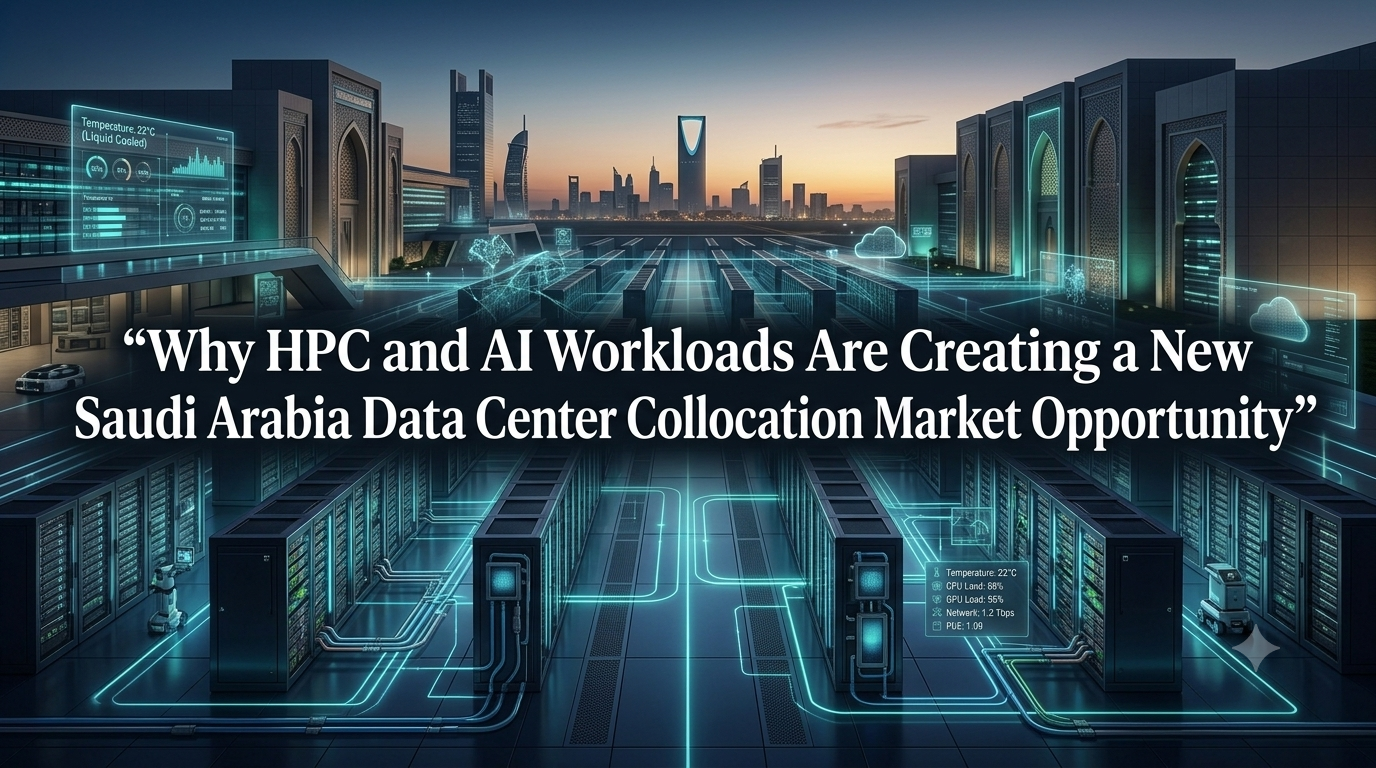
Convergence of Trust and Technology
Saudi Arabia’s colocation market is entering an AI-led growth cycle as HPC, cloud, hyperscale infrastructure, and high-density computing reshape facility requirements.
- Market size: USD 949.6 million in 2025
- Forecast market size: USD 1.9826 billion by 2030
- Overall CAGR: 15.9%
- HPC and AI workload CAGR: 17.4%
The Saudi Arabia Data Center Colocation Market is moving beyond conventional rack-and-space models. Artificial intelligence and high-performance computing are changing what enterprises and hyperscalers expect from digital infrastructure.
AI workloads require greater computing intensity, power availability, cooling capacity, networking performance, and scalability. Consequently, colocation providers are being pushed to deliver more than physical space. The new proposition is resilient, secure, AI-ready infrastructure capable of supporting demanding workloads without forcing customers to build and operate every component themselves.
For Saudi Arabia, this convergence creates a significant infrastructure opportunity.
The Market Is Entering an AI-Driven Phase
AI adoption is increasing demand for scalable computing, while hyperscalers and enterprises are creating new requirements for high-density colocation capacity.
- Hyperscalers are the fastest-growing end-user segment.
- Large enterprises are the fastest-growing organization-size segment.
- Wholesale colocation is projected to grow at 21.5% CAGR.
- Managed colocation is projected to grow at 23.8% CAGR.
The Saudi Arabia Data Center Colocation Market trends reflect a broader digital transformation. Cloud adoption, enterprise modernization, hyperscale expansion, and AI deployment are reinforcing one another.
The cycle is straightforward. More AI creates demand for computing. More computing increases rack density. Higher density raises power and cooling requirements. Those requirements make specialized colocation increasingly attractive.
The market is therefore shifting toward flexible infrastructure that can accommodate rapidly changing workloads.
Discover emerging business opportunities Download the PDF supported by extensive market research.
Why HPC Is Changing the Infrastructure Equation
HPC and AI workloads are accelerating colocation demand because they require concentrated computing power, higher rack density, advanced cooling, and scalable infrastructure.
- AI training and inference
- Advanced analytics
- Digital twins
- Scientific computing
- Simulation workloads
- High-performance enterprise applications
Traditional enterprise infrastructure generally scales progressively. AI infrastructure can change the equation much faster. A concentrated GPU deployment can significantly increase power, thermal, networking, and space requirements.
That makes HPC a critical catalyst for the Saudi Arabia Data Center Colocation Market analysis.
The HPC and AI segment is projected to grow at 17.4% CAGR, exceeding the overall market growth rate of 15.9%. For providers, the opportunity is therefore not simply additional capacity. It is the development of infrastructure specifically engineered for AI-era workloads.
This Sample Report is designed to fuel your business growth download it today.
From Power Density to Intelligent Cooling
AI-ready data centers must address power density, thermal management, connectivity, redundancy, and monitoring as an integrated infrastructure challenge.
- Higher power requirements per rack
- Advanced thermal management
- High-speed connectivity
- Intelligent monitoring
- Greater redundancy
- Flexible capacity expansion
AI changes the physical architecture of data centers. As computing density rises, cooling becomes increasingly important. Conventional air-cooling approaches may not meet every high-density requirement, creating greater interest in advanced cooling architectures.
The wider Saudi infrastructure ecosystem is also expanding. The Saudi modular data center market is projected to reach USD 1.015 billion by 2030, from USD 451.7 million in 2025, representing a 17.6% CAGR.
For colocation operators, modular infrastructure can provide a pathway for phased expansion as demand develops.
The Business Problem Behind AI Infrastructure
The primary challenge for enterprises is not obtaining AI computing power alone, but developing the physical infrastructure required to deploy it efficiently and at scale.
Organizations deploying AI may encounter:
- Rising power and cooling requirements
- High capital expenditure
- Longer infrastructure deployment cycles
- Difficulty scaling capacity
- Complex connectivity requirements
- Security and compliance considerations
- Greater operational complexity
Building specialized infrastructure internally can require substantial capital and technical expertise. It can also make capacity planning difficult when AI demand changes quickly.
This creates a clear role for colocation.
Organizations can place selected workloads within purpose-built facilities while maintaining greater control over their computing environment. For businesses seeking scalable infrastructure without becoming full-time data center operators, that model can be strategically attractive.
A Solution-Oriented Colocation Model
Next-generation colocation combines high-density capacity with managed services, connectivity, monitoring, security, resilient power, and scalable deployment.
- AI-ready high-density capacity
- Managed infrastructure
- Automated monitoring
- Predictive maintenance
- Resilient power systems
- High-performance connectivity
- Flexible expansion
The next phase of colocation increasingly resembles infrastructure-as-a-service.
AI-enabled monitoring can track temperature, power utilization, equipment performance, capacity, and facility conditions. Predictive analytics can help operators identify maintenance requirements before they become disruptive events.
For customers, the proposition is equally important: access specialized infrastructure without carrying the entire burden of facility development and operations.
This supports the broader Saudi Arabia Data Center Colocation Market outlook, particularly as managed and wholesale services gain momentum.
Data-Driven Market Signals
Market forecasts indicate that Saudi Arabia’s colocation sector is expected to more than double between 2025 and 2030, with AI and HPC growing faster than the overall market.
Key market indicators include:
- 2025 market size: USD 949.6 million
- 2030 market size: USD 1.9826 billion
- Overall CAGR: 15.9%
- HPC and AI workload CAGR: 17.4%
- Wholesale colocation CAGR: 21.5%
- Managed colocation CAGR: 23.8%
- Fastest-growing end user: Hyperscalers
- Fastest-growing organization size: Large enterprises
These figures provide an important foundation for the Saudi Arabia Data Center Colocation Market size and market growth discussion.
However, market growth should not be confused with guaranteed company-level returns. Actual ROI depends on workload utilization, contract structure, energy economics, infrastructure configuration, and deployment strategy.
The Enterprise and Hyperscaler Opportunity
Hyperscalers and large enterprises are creating complementary demand for scalable colocation infrastructure across AI, cloud, analytics, and data-intensive workloads.
- Hyperscale deployments require large capacity blocks.
- Enterprises need scalable AI and cloud infrastructure.
- Manufacturing represents an important growth vertical.
- Managed services can reduce operational complexity.
- Colocation supports infrastructure flexibility.
A manufacturer may require AI-enabled industrial analytics. A financial organization may need intensive data processing. A telecommunications provider may require scalable compute and connectivity.
The underlying requirement is similar: infrastructure must scale without forcing each organization to construct a dedicated facility.
This is where the Saudi Arabia Data Center Colocation Market share conversation increasingly moves from floor space toward capability.
Real-World Infrastructure Scenarios
Colocation can help organizations transition from conventional infrastructure toward higher-density environments designed for AI workloads.
Before: An enterprise operates moderate-density infrastructure. AI expansion introduces additional power, cooling, networking, and space requirements.
After: Selected AI workloads move into a high-density colocation environment with scalable capacity, resilient connectivity, and advanced cooling.
Relevant performance measures include:
- Deployment time
- Infrastructure utilization
- Energy efficiency
- Workload performance
- Capacity availability
- Avoided capital expenditure
For hyperscalers, wholesale colocation can similarly support phased capacity deployment rather than requiring every infrastructure expansion to follow a large, fixed build cycle.
These scenarios illustrate the commercial logic behind Saudi Arabia Data Center Colocation Market growth without assigning an unsupported ROI percentage.
Business Impact and ROI
The business value of AI-ready colocation can include faster deployment, scalable capacity, infrastructure flexibility, operational resilience, and potentially lower capital requirements.
The potential business impact includes:
- Revenue growth: Scalable infrastructure can support AI-enabled products and services.
- Cost management: Colocation can reduce the need to finance an entire dedicated facility.
- Deployment speed: Existing capacity can accelerate infrastructure deployment.
- Scalability: Customers can expand as workloads grow.
- Resilience: Purpose-built facilities can provide redundant infrastructure.
For providers, the opportunity extends into higher-value managed services, interconnection, monitoring, and specialized support.
The Saudi Arabia Data Center Colocation Market report therefore represents more than a capacity-growth story. It reflects an evolving infrastructure business model.
Risks Behind the AI-Colocation Expansion
AI-driven colocation growth must be balanced against power constraints, cooling complexity, technology changes, utilization risk, security requirements, and demand uncertainty.
Key risks include:
- Power availability can constrain high-density expansion.
- Cooling requirements can increase facility complexity.
- AI hardware evolves rapidly.
- Overbuilding can affect utilization.
- Underbuilding can create capacity shortages.
- Security and governance remain critical.
Providers must balance long-term AI expectations with actual customer demand.
Customers, meanwhile, should evaluate service-level commitments, connectivity, security, scalability, infrastructure design, and expansion capabilities rather than capacity alone.
Competitive Advantage and Future Outlook
The next competitive advantage in Saudi colocation will increasingly depend on the ability to deliver scalable, AI-ready infrastructure rather than conventional rack capacity alone.
The Saudi Arabia Data Center Colocation Market forecast points toward substantial expansion through 2030. Market size is expected to rise from USD 949.6 million in 2025 to USD 1.9826 billion by 2030.
The next competitive battleground will involve:
- AI-ready high-density facilities
- Advanced cooling
- Flexible power infrastructure
- Strong connectivity
- Managed services
- Scalable capacity
- Intelligent facility operations
AI and HPC will not operate in isolation. Cloud adoption, enterprise modernization, hyperscale expansion, and digital transformation will continue influencing demand.
But the fundamental change is already visible: data centers are evolving from facilities that simply host servers into infrastructure platforms designed around increasingly demanding computational workloads.
For Saudi Arabia, that creates a new chapter in the Saudi Arabia Data Center Colocation Market. The question is no longer simply where workloads will be hosted. The larger question is how efficiently infrastructure can convert compute capacity into scalable digital business capability.
The 2030 Infrastructure Question
Saudi Arabia’s colocation opportunity will depend on how effectively providers translate accelerating AI and HPC demand into reliable, scalable, and commercially sustainable infrastructure.
The market’s projected 15.9% CAGR and the 17.4% CAGR expected for HPC and AI workloads point to a structural shift in the infrastructure landscape.
For enterprises, hyperscalers, and colocation providers, the opportunity lies at the intersection of compute, power, cooling, connectivity, and intelligent operations.
That convergence could define the next stage of Saudi Arabia’s digital infrastructure growth.