
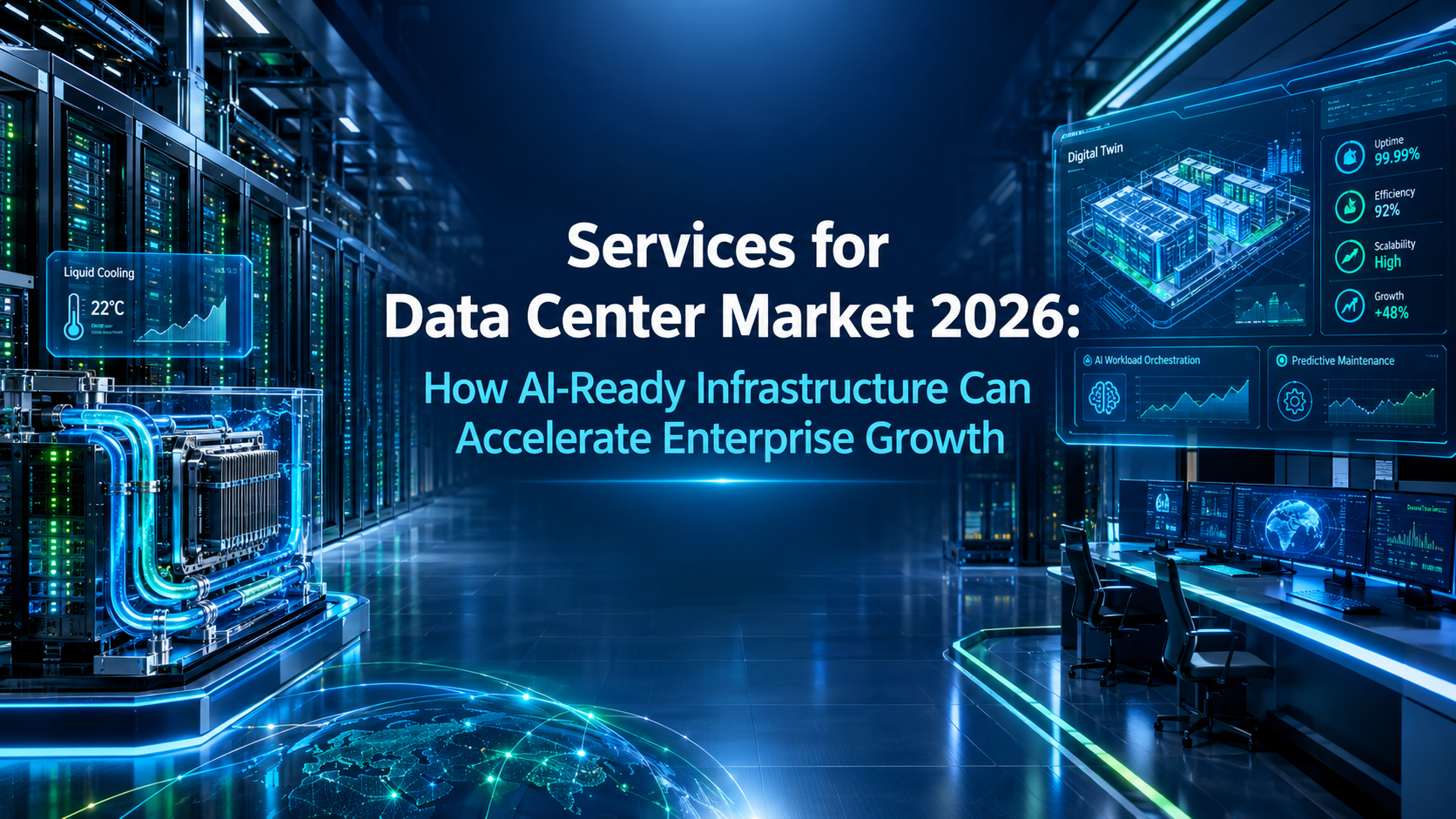
The Services for Data Center Market is entering a strategic turning point. AI is moving from experimentation into production, forcing enterprises to rethink what their infrastructure must deliver. Servers and connectivity are no longer enough. Businesses increasingly need dependable power, advanced cooling, intelligent monitoring, predictive maintenance, rapid deployment and specialized expertise. Market research projects the market to grow from USD 115.94 billion in 2025 to USD 320.89 billion by 2030, representing a 22.6% CAGR.
The Enterprise Infrastructure Shift
AI is changing the definition of enterprise infrastructure.
For years, organizations could treat data-center operations mainly as a facilities and IT responsibility. That model is becoming harder to sustain as AI workloads demand greater computing density, power availability and thermal capacity.
S&P Global identifies AI-driven high-density infrastructure, cooling requirements and electricity availability among the forces reshaping data-center development in 2026.
- AI is increasing infrastructure complexity.
- High-density workloads require specialized services.
- Power and cooling are becoming strategic constraints.
- Lifecycle expertise is becoming more valuable.
For business leaders, the consequence is clear: infrastructure readiness can influence how quickly an organization launches products, scales AI and responds to changing customer demand.
Discover emerging business opportunities Download the PDF supported by extensive market research.
Why AI Is Changing the Data Center Equation
The AI infrastructure race is not simply about purchasing GPUs.
Every accelerator depends on a surrounding ecosystem of power, cooling, networking, monitoring, security, commissioning and maintenance. If one layer becomes a bottleneck, expensive computing capacity can remain underutilized.
S&P Global notes that AI training infrastructure requires more energy and efficient cooling than traditional IT environments, while access to electricity is becoming a potential constraint on AI infrastructure growth.
This changes the role of data-center service providers.
The strategic question is no longer:
How do we operate the data center?
It is:
How do we make infrastructure capable of supporting the next stage of business growth?
That shift puts services much closer to enterprise strategy.
This Sample Report is designed to fuel your business growth download it today.
From Data Center Capacity to AI-Ready Capability
Buying computing capacity does not automatically create business value.
AI-ready infrastructure requires coordination across design and engineering, deployment and integration, facility management, commissioning and testing, IT infrastructure management, implementation and support, and specialized consulting.
These are among the service categories covered by the current market definition.
- Design services prepare infrastructure for future workloads.
- Integration connects complex technology environments.
- Commissioning validates operational readiness.
- IT services support modernization.
- Consulting helps organizations manage transformation.
The business benefit is speed.
When infrastructure is designed, tested and supported properly, enterprises can reduce the friction between technology investment and production deployment.
A bank can accelerate AI analytics. A manufacturer can scale industrial automation. A healthcare organization can support demanding workloads while protecting continuity. A retailer can expand AI-powered forecasting and personalization.
The service layer transforms infrastructure from a physical asset into an operational capability.
Where Data Center Services Create Enterprise Value
The opportunity is bigger than outsourcing.
It is about reducing the distance between infrastructure investment and business outcomes.
Facility services can support power and cooling management, maintenance, monitoring and operational continuity. IT services can support infrastructure management, cloud integration and modernization. Consulting and certification can help organizations address architecture, compliance and transformation.
Markets research identifies Facility Services as the largest category, while IT Services is projected to grow faster, at a 26.1% CAGR during 2025–2030.
- Facility services protect operational continuity.
- IT services support modernization and integration.
- Consulting improves infrastructure decisions.
- Testing validates performance and reliability.
- Lifecycle services help enterprises manage change.
That makes the Services for Data Center Market increasingly relevant to CIOs, CTOs, infrastructure executives and business leaders.
The Rise of Intelligent Facility Management
AI is also changing how infrastructure is operated.
Traditional maintenance often responds after equipment shows signs of failure. Intelligent operations use monitoring, analytics and predictive techniques to identify problems earlier.
This matters because modern data centers contain increasingly interconnected power and cooling systems. A failure affecting one critical component can disrupt a much larger computing environment.
- AI can improve infrastructure visibility.
- Analytics can identify abnormal equipment behavior.
- Predictive maintenance can support earlier intervention.
- Intelligent monitoring can improve operational resilience.
The business value is not simply fewer maintenance tasks.
It is greater confidence that critical infrastructure can support critical applications.
Why Predictive Maintenance Is Becoming a Business Tool
Predictive maintenance is moving beyond a technical feature and becoming a resilience strategy.
In high-density AI environments, cooling or power problems can affect large concentrations of computing resources. Schneider Electric describes predictive maintenance as an important enabler for liquid-cooled AI infrastructure because higher-density systems increase the consequences of thermal failures.
For enterprises, better maintenance can support:
- Higher infrastructure availability
- Earlier fault detection
- Better maintenance planning
- Reduced operational disruption
- Improved asset visibility
- More predictable infrastructure costs
This is where Services for Data Center Market trends increasingly intersect with enterprise risk management.
The most valuable maintenance strategy may be the one that prevents an operational problem from becoming a business problem.
Liquid Cooling, Power and High-Density AI
AI is changing the physical requirements of infrastructure.
Higher-power processors generate more concentrated heat, placing pressure on traditional cooling systems. S&P Global reports that 21% of surveyed enterprise data-center decision-makers planned to introduce liquid cooling within one year, while another 25% expected to do so within two to four years.
For service providers, this creates demand for expertise in design, installation, maintenance, monitoring and retrofit planning.
- AI increases rack-level thermal pressure.
- Liquid cooling is gaining enterprise attention.
- High-density facilities require specialized expertise.
- Cooling is becoming part of infrastructure strategy.
A facility may have sufficient physical space yet still lack the power and thermal capability needed for next-generation AI systems.
The message is straightforward:
AI-ready infrastructure requires AI-ready services.
How IT Infrastructure Services Support Growth
The IT layer is equally important.
Enterprises increasingly combine private infrastructure, cloud platforms, colocation and distributed environments. Managing these systems requires integration rather than isolated technology silos.
The current Services for Data Center Market report includes IT infrastructure management, implementation and support, and decommissioning and relocation among its service categories.
These services can help organizations modernize legacy infrastructure, migrate workloads, improve operational visibility and prepare facilities for changing computing requirements.
For enterprises, that flexibility can reduce the risk of becoming locked into infrastructure designed for yesterday’s workloads.
The Business Case: From Cost Center to Growth Engine
The strongest enterprise argument for data-center services is not cost reduction alone.
It is business agility.
A technology company launching an AI product may have only a limited window to capture market demand. Infrastructure delays can become product delays.
A manufacturer deploying industrial AI needs infrastructure that can scale alongside automation. A healthcare organization may prioritize resilience and availability. A financial institution may place greater weight on security, compliance and performance.
The application differs. The principle does not.
- Faster infrastructure deployment can accelerate innovation.
- Reliable services can protect business continuity.
- Scalable infrastructure supports expansion.
- Specialized expertise reduces operational complexity.
- Intelligent services can improve infrastructure decisions.
Reliable data-center services allow enterprises to focus more attention on customers, products and growth instead of constantly solving infrastructure problems.
Market Intelligence: Size, Share, Growth and Forecast
The market trajectory demonstrates the scale of this transformation.
Market research estimates the Services for Data Center Market size at USD 115.94 billion in 2025 and forecasts USD 320.89 billion by 2030, representing a 22.6% CAGR. Facility Services currently holds the largest share.
Asia Pacific is projected to be the fastest-growing region, with a 35.4% CAGR from 2025 to 2030, supported by digitalization, cloud adoption, hyperscale expansion and infrastructure investment.
- 2025 market size: USD 115.94 billion
- 2030 forecast: USD 320.89 billion
- Forecast CAGR: 22.6%
- Asia Pacific CAGR: 35.4%
- Facility Services: largest market category
- IT Services: 26.1% projected CAGR
The Services for Data Center Market forecast therefore represents more than traditional facility outsourcing. It reflects a growing ecosystem supporting AI, cloud, edge computing, modernization and enterprise digital transformation.
The Risks Enterprises Cannot Ignore
AI-ready infrastructure introduces new risks alongside new opportunities.
Power availability can delay expansion. Cooling requirements can increase complexity. Skills shortages can make advanced infrastructure harder to operate. Supply-chain disruption can affect deployment schedules.
S&P Global also warns that some planned data-center projects may face delays or commercial viability concerns as energy requirements, regulation and workload demand evolve.
- Power constraints can limit expansion.
- Cooling upgrades can increase complexity.
- Skills shortages can affect operations.
- Supply-chain issues can delay deployment.
- Sustainability requirements are becoming more important.
Enterprises should therefore evaluate service providers on resilience, technical expertise, scalability, security, sustainability and future-readiness—not price alone.
The Enterprise Roadmap for AI-Ready Infrastructure
Organizations should ask five questions before making long-term infrastructure decisions.
- What workloads are coming next?
Plan for AI, analytics and high-performance computing, not just today’s applications. - Can infrastructure scale?
Power, cooling and computing capacity must grow with demand. - Can operations become smarter?
Monitoring, analytics and predictive maintenance can improve visibility and resilience. - Can the architecture evolve?
Infrastructure should accommodate new processors, cooling technologies and deployment models. - Can the service partner support growth?
The right provider should operate as a strategic infrastructure partner, not merely a maintenance contractor.
Services Become the AI Infrastructure Layer
The next stage of digital transformation will depend on infrastructure that can adapt as quickly as software.
AI is increasing compute density. Power availability is influencing infrastructure decisions. Liquid cooling is gaining attention. Predictive maintenance is becoming more important. Enterprises and hyperscalers are demanding greater operational efficiency.
The market is consequently moving toward integrated services that span infrastructure planning, deployment, management, modernization and lifecycle support. Market research describes the market as encompassing professional and managed offerings designed to support efficient operation, optimization and lifecycle management of data-center infrastructure.
The strategic shift is clear.
The future data center will not be defined only by the hardware inside it. It will be defined by how intelligently that infrastructure can be designed, deployed, operated, maintained and evolved.
For enterprises, this makes the Services for Data Center Market outlook increasingly important to business planning.
The winners will not necessarily be organizations that own the most infrastructure.
They will be organizations that can turn infrastructure into an adaptable business capability—one that supports AI, protects continuity, manages risk and accelerates growth.
AI may create demand for more compute. Intelligent data-center services will determine how effectively enterprises turn that compute into business value.