
The Aerospace Testing Market Growth is being driven by the rapid evolution of aircraft, propulsion systems, avionics, unmanned aerial vehicles (UAVs), and space technologies. As aerospace platforms become lighter, more connected, electrified, and autonomous, manufacturers and operators require increasingly sophisticated testing methods to validate safety, reliability, durability, and performance.
AI Is Transforming Aerospace Testing
Artificial intelligence is emerging as one of the most important technologies influencing Aerospace Testing Market Growth. AI-driven tools can analyze large volumes of test data, identify anomalies, recognize patterns, and support predictive assessments.
Traditional aerospace testing can generate enormous datasets from structural, environmental, propulsion, avionics, and flight tests. AI can help engineers interpret this information more efficiently and identify potential issues earlier in the development process.
MarketsandMarkets identifies AI-driven predictive tools as an emerging trend within aerospace testing. These technologies are helping the industry move toward faster validation, improved reliability, and more predictive maintenance strategies
Digital Twins Improve Aircraft Validation
Digital twins are another major technology shaping Aerospace Testing Market Growth. A digital twin creates a virtual representation of a physical aircraft, component, engine, or system and can incorporate data collected from real-world testing.
Engineers can use digital twins to simulate operating conditions, evaluate component behavior, identify potential failure points, and optimize designs before conducting extensive physical testing.
The technology can therefore complement traditional testing rather than simply replace it. By combining simulations with physical test results, aerospace companies can develop a more comprehensive understanding of aircraft performance.
MarketsandMarkets highlights digital twins as one of the technologies reshaping how modern aircraft are validated.
Download PDF Brochure @ https://www.marketsandmarkets.com/pdfdownloadNew.asp?id=32924426
Advanced NDT Strengthens Aircraft Safety
Non-destructive testing (NDT) is becoming increasingly important as aircraft manufacturers adopt lightweight composites and advanced materials.
NDT allows engineers to inspect components without damaging them. Techniques can help identify cracks, defects, delamination, corrosion, and other potential problems in aircraft structures and components.
The aerospace testing industry is increasingly adopting advanced NDT alongside structural testing and materials evaluation. MarketsandMarkets identifies advanced NDT as an important technology trend supporting more efficient and reliable aircraft validation.
For aircraft operators, effective inspection can also contribute to reduced maintenance risks and improved asset reliability.
Avionics Testing Is the Fastest-Growing Testing Segment
One of the most significant findings related to Aerospace Testing Market Growth is the expected rapid expansion of avionics/flight and electronics testing.
MarketsandMarkets projects the avionics/flight & electronics testing segment to register the highest CAGR from 2025 to 2030. The growth is attributed to increasing complexity and integration of aircraft electronics, including flight-control systems, communication technologies, navigation systems, and autonomous systems.
The increasing adoption of electric aircraft and UAVs is also creating additional requirements for comprehensive avionics testing.
As aircraft become more software- and electronics-intensive, testing must increasingly evaluate not only individual components but also interactions among interconnected systems.
Advanced Materials Increase Testing Requirements
Modern aircraft manufacturers are increasingly focused on reducing weight while maintaining structural strength and durability.
Lightweight composite materials can contribute to improved fuel efficiency and aircraft performance. However, their characteristics can differ significantly from traditional metallic materials, creating new testing and inspection requirements.
MarketsandMarkets identifies lightweight materials as an important factor influencing the evolution of aerospace testing. Specialized materials and environmental testing are becoming increasingly important for validating performance under demanding operating conditions.
This creates opportunities for testing companies with expertise in composite materials, advanced inspection, and environmental simulation.
Electrified Propulsion Creates New Testing Needs
The development of electric and hybrid-electric aircraft is another important driver of Aerospace Testing Market Growth.
Electrified propulsion introduces new components and systems, including batteries, electric motors, power electronics, thermal-management systems, and advanced control architectures.
These systems require specialized testing to assess performance, thermal behavior, reliability, safety, and integration with other aircraft systems.
MarketsandMarkets specifically identifies hybrid-electric propulsion systems among advanced aircraft technologies creating demand for specialized testing services.
As aerospace electrification progresses, testing methodologies will need to evolve alongside propulsion technologies.
Autonomous Aircraft Require Comprehensive Testing
Autonomous flight capabilities are also creating new opportunities.
Autonomous aircraft depend on complex combinations of sensors, flight-control systems, navigation technologies, communication networks, computing platforms, and software.
Testing these systems requires more than conventional mechanical validation. Engineers must evaluate how systems respond to different environmental and operational conditions and how multiple technologies interact.
MarketsandMarkets identifies autonomous flight capabilities as an emerging technology creating demand for specialized aerospace testing.
This trend is particularly relevant to UAVs and next-generation autonomous aerospace platforms.
UAV Adoption Supports Market Expansion
Growing UAV adoption is a significant contributor to Aerospace Testing Market Growth.
UAVs are increasingly used for defense, surveillance, logistics, inspection, agriculture, mapping, and other commercial applications. As their use expands, manufacturers need testing solutions that validate airframe structures, propulsion, avionics, communication systems, flight performance, and environmental durability.
MarketsandMarkets identifies the growing use of UAVs in military and commercial applications as one of the key drivers of the aerospace testing market.
The expansion of UAV applications therefore creates opportunities for specialized testing laboratories and service providers.
Space Exploration Is a High-Growth Opportunity
Space exploration represents another important area within Aerospace Testing Market Growth.
According to MarketsandMarkets, the space exploration segment is expected to register the highest CAGR of 7.4% among end users during the forecast period.
The expansion of satellite programs, launch systems, space exploration missions, and commercial space activities is increasing the need for rigorous qualification and verification.
Space systems must operate under extreme conditions involving vibration, temperature, vacuum, radiation, and other environmental stresses. Comprehensive testing is therefore essential before deployment.
Structural Testing Remains Essential
Despite the emergence of AI and digital technologies, physical structural testing remains a fundamental part of aerospace validation.
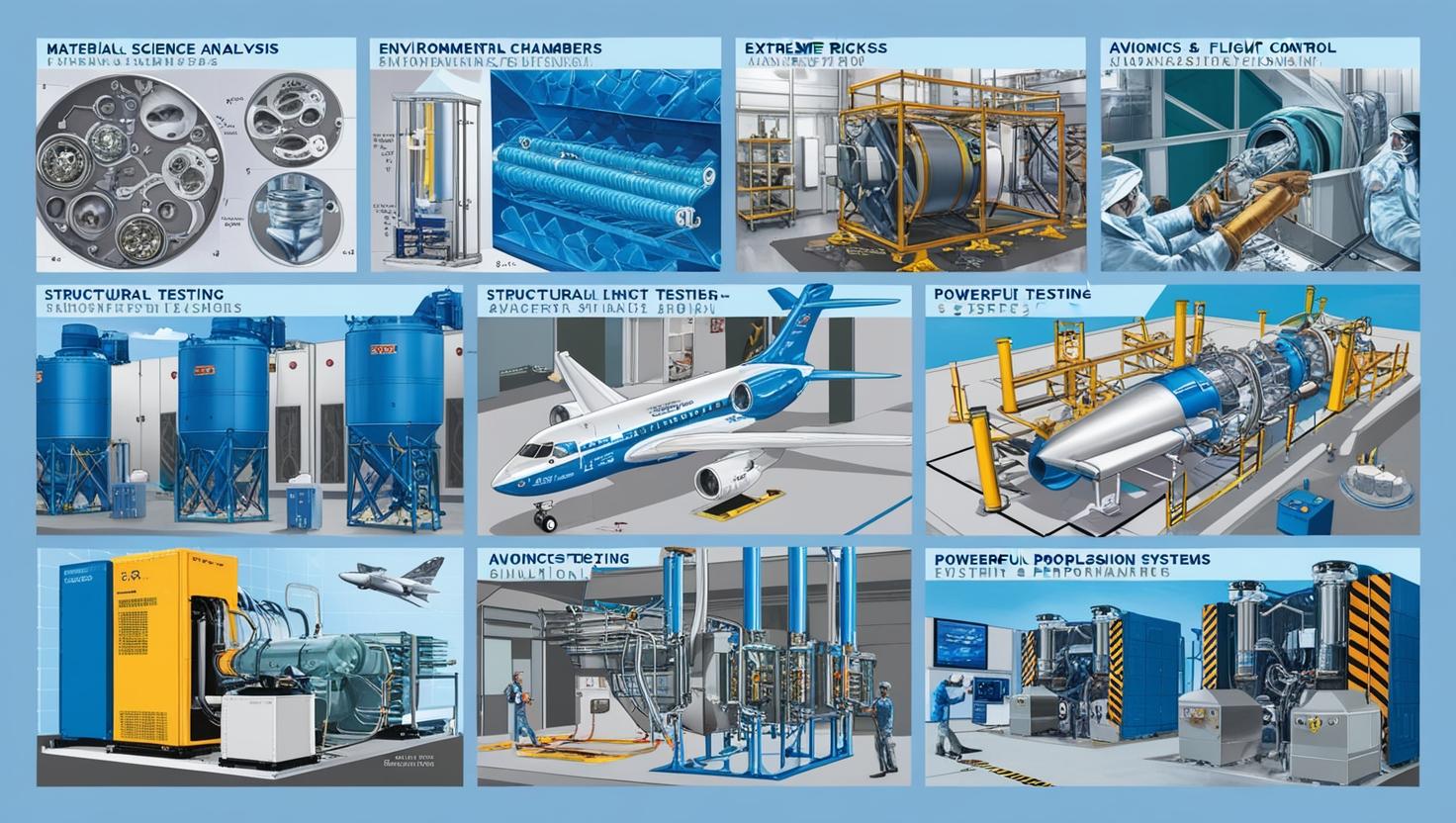
Full-scale structural testing, fatigue testing, vibration testing, and component testing help determine whether aircraft structures can withstand expected operational stresses.
MarketsandMarkets notes that full-scale structural testing and fatigue testing can help validate airframe durability, improve safety margins, reduce maintenance risks, and support certification timelines.
Digital tools may make testing more efficient, but physical validation remains critical for safety-critical aerospace systems.
Environmental Testing Validates Extreme Conditions
Aircraft and aerospace components must operate across a wide range of environmental conditions.
Environmental testing can evaluate performance under temperature extremes, humidity, vibration, climatic conditions, and other stresses.
As aircraft increasingly use composite materials and sophisticated electronics, environmental testing becomes even more important.
MarketsandMarkets identifies environmental testing as one of the major testing categories covered by the aerospace testing market.
These tests help manufacturers understand how materials and systems behave under conditions that may be encountered throughout an aircraft’s operational life.
Propulsion Testing Supports Next-Generation Engines
Propulsion systems are another major area of testing investment.
Modern aircraft engines must balance thrust, fuel efficiency, emissions, durability, and reliability. New propulsion concepts introduce additional testing requirements.
Testing can include performance evaluation, thermal analysis, vibration assessment, materials testing, and other specialized procedures.
The development of advanced propulsion technologies, including electrified and high-performance systems, is expected to create new opportunities for aerospace testing providers.
5G and Connected Aircraft Increase Electronics Complexity
Aircraft are becoming increasingly connected. Communication systems, navigation equipment, sensors, flight computers, and other electronics must work together reliably.
As connectivity technologies evolve, aerospace manufacturers must validate system performance and interoperability.
This increasing electronic complexity is one reason avionics/flight and electronics testing is expected to be the fastest-growing testing category.
Testing providers with expertise in advanced electronics, communications, cybersecurity, and automated test equipment can therefore benefit from this transformation.
Avionics Cybersecurity Becomes More Important
Cybersecurity is emerging as another consideration within modern aerospace testing.
Connected aircraft and autonomous systems introduce additional digital interfaces. Protecting avionics and communication systems against cyber threats is becoming increasingly important.
MarketsandMarkets identifies avionics cybersecurity as one of the emerging areas affecting aerospace testing.
Testing methodologies will increasingly need to assess not only whether an avionics system performs correctly but also whether it remains secure under potential cyber threats.
Commercial Aviation Remains a Major End User
Commercial aviation dominated the aerospace testing market in 2024, according to MarketsandMarkets.
Growing passenger traffic, fleet expansion, demand for fuel-efficient aircraft, and the development of next-generation aircraft are supporting testing requirements. Safety, regulatory compliance, and performance optimization further reinforce the need for comprehensive testing.
The increasing demand for commercial aircraft in developing economies is also identified as a major market driver.
Asia Pacific Offers Strong Growth Potential
Asia Pacific is expected to be the fastest-growing region in the aerospace testing market.
MarketsandMarkets attributes this growth to increasing commercial and military aircraft production in countries including China, India, and Japan, along with rising air travel demand and government investment in defense and space programs.
The region’s expanding aerospace manufacturing base is creating opportunities for testing laboratories, certification providers, inspection companies, and specialized technology suppliers.
India is also experiencing significant growth. MarketsandMarkets projects India’s aerospace testing market to grow from USD 41.7 million in 2025 to USD 60.1 million by 2030, representing a 7.6% CAGR.
North America Maintains a Strong Position
North America remains a major aerospace testing market. It accounted for 39.2% of global aerospace testing revenue in 2024,
The region benefits from an established aerospace manufacturing ecosystem, significant defense spending, commercial aviation activity, advanced testing infrastructure, and strong regulatory requirements.
MarketsandMarkets projects the North American market to increase from approximately USD 2.16 billion in 2025 to USD 2.74 billion by 2030, representing a 4.9% CAGR.
Outsourcing Creates Opportunities for Testing Providers
While in-house testing is expected to remain dominant, the outsourced segment is projected to register a 5.7% CAGR, according to MarketsandMarkets.
Outsourcing allows aerospace companies to access specialized laboratories, equipment, technical expertise, and accreditation without maintaining every testing capability internally.
As aerospace technologies become more specialized, third-party providers may increasingly offer advanced NDT, environmental testing, materials analysis, electronics testing, and certification support.
Regulatory Compliance Remains a Challenge
Aerospace is one of the most highly regulated industries, making regulatory compliance a central consideration in Aerospace Testing Market Growth.
Testing processes can be complex and time-consuming because aerospace products must satisfy stringent safety and quality requirements. Extensive documentation, validation, certification, and regulatory procedures can increase development costs and timelines.
Testing companies must therefore combine technological capabilities with strong knowledge of aerospace standards and certification requirements.
Cost Pressures Encourage Testing Innovation
Budget constraints represent another challenge.
Aerospace manufacturers face pressure from material, labor, fuel, and supply-chain costs. Companies therefore need to control testing expenses without compromising safety or regulatory compliance.
This is encouraging interest in technologies that can make testing faster and more efficient.
AI-driven analytics, digital twins, automated testing, predictive tools, and advanced NDT can potentially reduce unnecessary testing cycles and improve resource utilization.
Competitive Landscape
The aerospace testing market includes testing and certification companies, aerospace manufacturers, inspection specialists, and technology providers.
Element Materials Technology, SGS, Intertek, Applus+, TÜV SÜD, TÜV Rheinland, TÜV NORD Group, Rohde & Schwarz, Eurofins Scientific, Boeing, Airbus, MISTRAS Group, Lockheed Martin, Bureau Veritas, and DEKRA among key market players.
Companies are increasingly investing in advanced testing equipment, specialized laboratories, digital technologies, and expanded testing capabilities to support next-generation aerospace programs.
Future Outlook for Aerospace Testing Market Growth
The future of Aerospace Testing Market Growth will be closely linked to the pace of aerospace innovation.
AI, digital twins, advanced NDT, structural health monitoring, autonomous systems, electrified propulsion, lightweight materials, and increasingly complex avionics are creating new testing requirements.
At the same time, the growth of commercial aviation, UAVs, defense programs, and space exploration is expanding the overall customer base.
MarketsandMarkets projects the global aerospace testing market to reach USD 6.91 billion by 2030, up from USD 5.50 billion in 2025.
The testing industry is therefore moving toward a more connected, predictive, automated, and technology-driven model.
Aerospace Testing Market Growth is increasingly being shaped by technologies that are changing the design and operation of aircraft and spacecraft. AI is improving data analysis, digital twins are supporting virtual validation, advanced NDT is strengthening inspection capabilities, and automated testing is helping manufacturers improve efficiency.
Meanwhile, electric aircraft, autonomous systems, UAVs, lightweight materials, sophisticated avionics, and expanding space programs are creating demand for specialized testing methodologies.
The industry must also overcome regulatory complexity, testing costs, interoperability requirements, and the need for highly skilled professionals.
Ultimately, aerospace testing is evolving from a largely traditional validation function into a data-driven, predictive, digitally connected discipline. As aerospace platforms become more sophisticated, testing will remain essential to ensuring that the next generation of aircraft and space systems delivers the safety, reliability, efficiency, and performance demanded by the industry.