
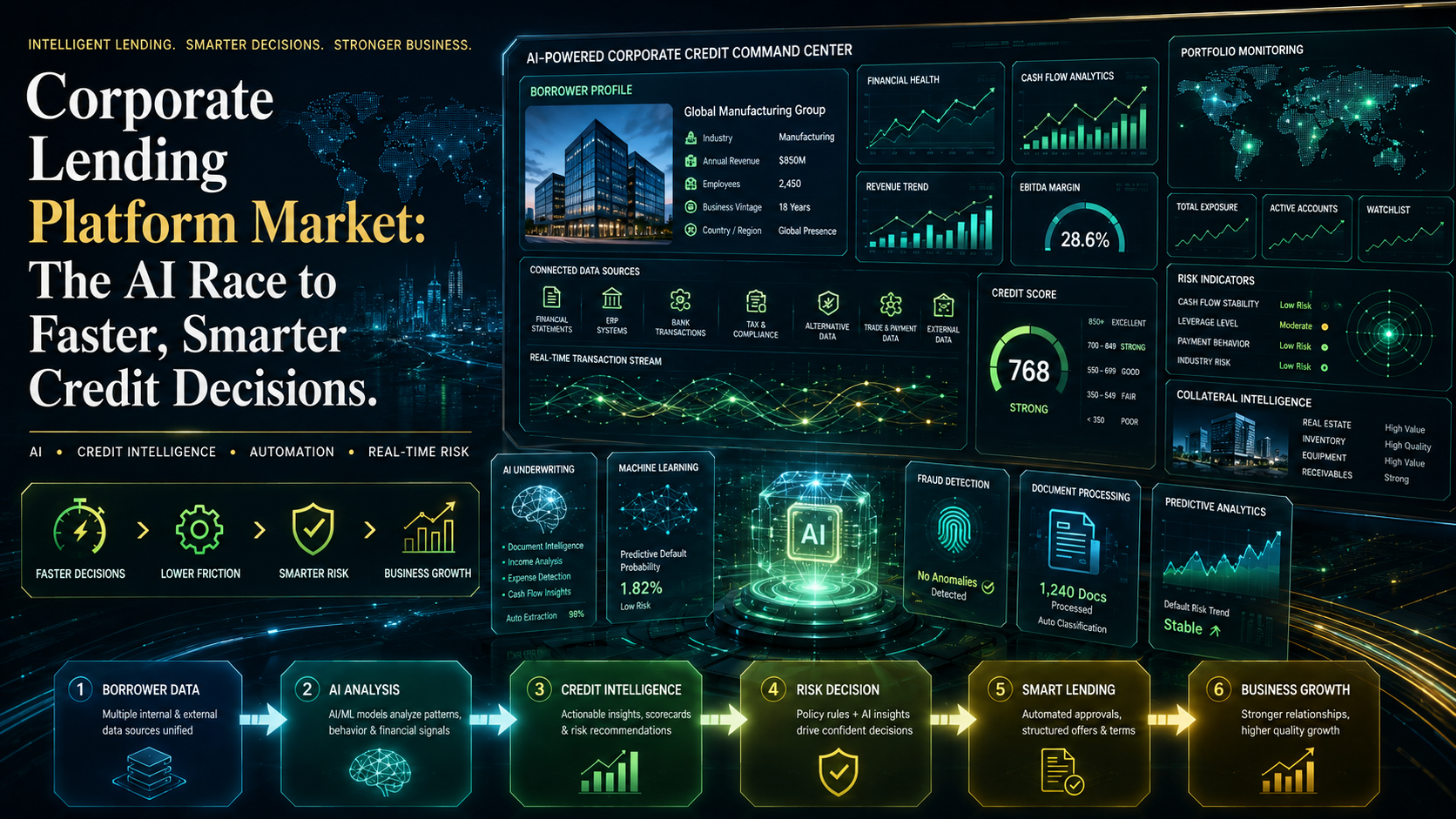
The New Credit Battlefield: Where Trust Meets Technology
AI-powered lending platforms combine financial data, automation, analytics and human oversight to help lenders make faster, more informed corporate credit decisions.
The Corporate Lending Platform Market is entering a high-stakes technology cycle. Corporate borrowers expect financing experiences that match the speed and transparency of modern digital services, while lenders must accelerate decisions without weakening credit discipline.
That tension is creating a new convergence of trust and technology.
Traditional corporate lending still relies on relationship managers, financial statements, credit committees, spreadsheets, documentation and layered approvals. Those controls remain essential. What is changing is the technology supporting them.
- AI can extract information from complex documents.
- Machine learning can identify patterns across borrower data.
- Cloud platforms can connect lending teams and systems.
- APIs can introduce external and operational data.
- Real-time analytics can strengthen post-origination monitoring.
The strategic question is no longer whether lending becomes digital. It is how intelligently digital lending can operate without compromising trust.
Market Context: Why Corporate Lending Is Entering an AI Growth Cycle
The global corporate lending platform market is projected to expand from USD 3.0 billion in 2024 to USD 11.0 billion by 2030, representing a 24.5% CAGR, according to the supplied market assessment.
This expansion signals more than software modernization. It reflects a structural shift in how lenders originate, evaluate, manage and service commercial credit.
Key regional projections in the supplied assessment include:
- Asia Pacific: USD 837 million in 2024 to USD 3.64 billion by 2029, at 27.8% CAGR.
- Europe: USD 741.1 million to USD 2.65 billion, at 23.6% CAGR.
- United States: USD 669.6 million to USD 2.23 billion, at 22.2% CAGR.
- India: USD 86.8 million to USD 447.8 million, at 31.5% CAGR.
These figures highlight an expanding opportunity for banks, fintechs, NBFCs, credit unions and alternative lenders.
The Corporate Lending Platform Market size is therefore becoming an indicator of a broader transformation: credit infrastructure is becoming increasingly software-driven, connected and intelligence-led.
Discover emerging business opportunities Download the PDF supported by extensive market research.
The Broken Workflow: Where Legacy Lending Loses Time and Margin
Legacy corporate lending can be slowed by fragmented data, manual documentation, disconnected systems, repetitive underwriting and lengthy approval processes.
The biggest problem is not necessarily insufficient information. It is the difficulty of turning information into a timely decision.
Common pain points include:
- Manual borrower-data extraction.
- Repeated financial-document requests.
- Disconnected origination and servicing platforms.
- Limited post-approval risk visibility.
- High operational costs.
- Slow exception management.
- Difficult alternative-data integration.
- Increasing compliance requirements.
For borrowers, delays can become business risks. Slow working-capital financing can affect inventory. Delayed equipment financing can postpone expansion. Trade-finance delays can disrupt supply-chain commitments.
That makes the Corporate Lending Platform Market analysis less about digitizing paperwork and more about redesigning the complete credit journey.
From Applications to Intelligence: The AI-Enabled Lending Stack
An AI-enabled corporate lending platform can connect origination, document intelligence, credit analytics, decision support, approval, monitoring and servicing within one workflow.
A modern lending architecture can follow this path:
Digital Application → Data Aggregation → AI Document Intelligence → Credit Analytics → Decision Support → Approval → Portfolio Monitoring
AI becomes particularly valuable in the analytical middle layer.
- Natural language processing can interpret unstructured documents.
- Machine learning can identify patterns in historical information.
- Generative AI can support summaries and credit documentation.
- Predictive models can flag potential deterioration.
- Automated workflows can route exceptions to appropriate teams.
However, AI should not become an unchecked approval engine.
The stronger enterprise model is AI-assisted decision intelligence, where algorithms accelerate analysis while experienced credit professionals retain accountability for material decisions.
That balance can improve efficiency without turning lending into a black-box process.
Data Is Becoming the New Credit Infrastructure
Modern corporate lending increasingly combines financial, transactional, operational and alternative data to improve borrower intelligence and risk visibility.
The competitive advantage will increasingly depend on connecting data sources securely and interpreting them consistently.
Relevant inputs can include:
- Financial statements and tax information.
- Transaction and cash-flow histories.
- ERP and accounting information.
- Supply-chain signals.
- Industry and market indicators.
- Collateral information.
- Customer and payment behavior.
- Macroeconomic conditions.
The objective is not simply to collect more data. It is to identify which signals matter, when they matter and how they should influence a credit decision.
This principle will shape the next stage of Corporate Lending Platform Market trends.
Enterprise Applications: Where Intelligent Lending Creates Value
Digital corporate lending platforms can help financial institutions automate origination, improve borrower experiences, strengthen risk monitoring and scale commercial lending operations.
The applications extend across the complete loan lifecycle.
Faster Loan Origination
Automated workflows can reduce repetitive data entry and document handling, allowing relationship managers to focus on higher-value borrower conversations.
Intelligent Credit Assessment
AI-supported analytics can organize borrower information and highlight potential risks for credit professionals.
Continuous Portfolio Monitoring
Instead of relying exclusively on periodic reviews, lenders can monitor changing borrower conditions more continuously.
Relationship Manager Productivity
A centralized borrower view can provide faster access to relevant financial and operational information.
SME and Mid-Market Lending
Digital processes can potentially make smaller commercial loans more economically viable by reducing manual processing.
Cross-Selling Opportunities
A richer borrower profile can help identify opportunities across payments, treasury, insurance and trade finance.
For corporate borrowers, the value can include greater transparency, faster communication and more predictable financing workflows.
Before vs. After: The Intelligent Lending Advantage
The transition from legacy lending to intelligent lending focuses on removing unnecessary manual work while improving decision visibility and risk intelligence.
| Traditional Lending | Intelligent Lending |
| Disconnected systems | Unified workflows |
| Manual document review | AI-assisted extraction |
| Periodic risk reviews | Continuous monitoring |
| Static borrower data | Dynamic data environment |
| Long approval cycles | Automated workflow routing |
| Limited visibility | Real-time dashboards |
| Reactive risk management | Predictive risk signals |
These improvements should not be treated as guaranteed ROI. Results depend on loan complexity, data quality, integration maturity, regulation and implementation design.
The strongest business case begins with measurable baselines and tracks improvements after deployment.
Business Impact: Measuring the ROI of Faster Credit
Digital lending ROI should connect technology investment with improvements in processing efficiency, operating costs, borrower experience, risk management and revenue opportunities.
Executives should measure:
- Time: Application-to-decision cycle.
- Cost: Operating cost per loan.
- Productivity: Loans handled per employee.
- Conversion: Qualified applications becoming funded loans.
- Risk: Early identification of deteriorating exposures.
- Retention: Borrower renewal and relationship expansion.
- Scalability: Additional volume supported without equivalent headcount growth.
The supplied market assessment projects the global market to reach USD 11 billion by 2030, reinforcing the scale of the opportunity.
The lesson is straightforward: speed creates value when it improves economics, customer relationships and risk outcomes—not simply when it produces faster screens.
The Trust Problem: AI, Regulation and Credit Accountability
Successful AI lending requires explainability, data governance, cybersecurity, regulatory compliance, model monitoring and clear human accountability.
The greatest barrier may not be technology. It may be trust.
Key risks include:
- Poor-quality or incomplete data.
- Model drift.
- Cybersecurity threats.
- Explainability gaps.
- Privacy concerns.
- Incorrect automated recommendations.
- Legacy integration failures.
- Regulatory uncertainty.
A sophisticated platform that cannot explain an important credit recommendation can create more risk than value.
The future is therefore not AI versus humans. It is AI working under disciplined human governance.
Competitive Advantage: Building a Lending Platform That Learns
Leading platforms will differentiate through intelligent automation, connected data, flexible architecture, strong borrower experiences and continuous risk intelligence.
The Corporate Lending Platform Market share battle is moving beyond basic digitization.
Competitive priorities include:
- Faster implementation.
- Better AI-assisted decisioning.
- API and ecosystem connectivity.
- Cloud scalability.
- Portfolio intelligence.
- User experience.
- Security and compliance.
- Multi-product lending capabilities.
Strategic partnerships will also become important as banks combine institutional trust and balance-sheet strength with fintech innovation, cloud infrastructure and specialized data capabilities.
2026 Trends: Where Corporate Credit Technology Is Heading
Major 2026 lending trends include AI-assisted underwriting, cloud-native infrastructure, alternative data, real-time monitoring, API integration and automated loan lifecycle management.
The most important Corporate Lending Platform Market trends include:
- Generative AI for document-heavy credit workflows.
- AI-assisted underwriting for faster assessment.
- Real-time portfolio monitoring beyond periodic reviews.
- Cloud-native infrastructure for scalable lending.
- Alternative data integration for broader borrower intelligence.
- API-first architectures connecting financial ecosystems.
- Embedded lending inside business workflows.
- Explainable AI for decision transparency.
- Digital covenant monitoring and automated alerts.
- Predictive risk analytics for earlier intervention.
- Intelligent servicing across the post-origination lifecycle.
Together, these developments are shifting lending from transaction processing toward continuous credit intelligence.
Strategic Outlook: The Banks That Move First May Win More Than Speed
The future of corporate lending will combine AI, trusted data, automation, cloud infrastructure and human credit expertise to create faster and more accountable decisions.
The Corporate Lending Platform Market outlook is ultimately about institutional transformation.
The winners will not necessarily be the organizations with the most AI features. They will be those that connect technology to measurable business outcomes.
- Banks can reduce friction without weakening credit discipline.
- Fintechs can turn technology agility into sustainable lending economics.
- Enterprises can gain more responsive and transparent financing experiences.
- Lenders can transform fragmented data into actionable credit intelligence.
The supplied Corporate Lending Platform Market forecast points to expansion from USD 3.0 billion in 2024 to USD 11.0 billion by 2030 at a 24.5% CAGR.
The deeper opportunity extends beyond market size.
Corporate credit is becoming an intelligence business.
Institutions that successfully combine trust, technology and timing can turn faster decisions into stronger relationships, better operating economics and more resilient growth.