
The Automotive Battery Management System (BMS) Market is expanding rapidly as the automotive industry accelerates its transition toward electric, hybrid, and plug-in hybrid vehicles. A BMS serves as a critical control and monitoring system for vehicle batteries, helping manage battery safety, performance, charging, state of charge, temperature, and overall lifecycle.
The global automotive battery management system market is estimated to be USD 6.53 billion in 2025 and is projected to reach USD 15.65 billion by 2030, registering a CAGR of 19.1% The growing adoption of EVs, advances in battery technologies, increasing safety requirements, and demand for connected and intelligent vehicles are among the major factors supporting market growth.
Automotive BMS Market Overview
An automotive battery management system monitors and controls the electrical and thermal behavior of a battery pack. It can monitor parameters such as cell voltage, current, temperature, state of charge (SoC), and state of health (SoH).
The major functions of an automotive BMS include:
- Battery monitoring
- Cell balancing
- Battery protection
- Charging and discharging control
- Thermal management
- State-of-charge estimation
- State-of-health monitoring
- Fault detection
- Battery optimization
- Safety and compliance
As EV battery packs become larger and more sophisticated, BMS technology is becoming increasingly important for maintaining reliable and safe vehicle operation.
Electric Vehicle Adoption Drives Market Growth
The rapid growth of the electric vehicle industry is the primary driver of the Automotive Battery Management System Market.
EVs depend on large battery packs containing numerous interconnected cells. These cells must operate within specific voltage and temperature ranges to maintain performance and safety. A BMS continuously monitors battery conditions and can help prevent problems caused by overcharging, excessive discharge, overheating, or cell imbalance.
MarketsandMarkets identifies the strong growth of the electric vehicle industry as a key market driver. Government incentives, emission-reduction targets, technological advances, and growing consumer interest in electrified transportation are accelerating EV adoption and consequently increasing demand for advanced BMS solutions.
Download PDF Brochure @ https://www.marketsandmarkets.com/pdfdownloadNew.asp?id=15321159
Growing Focus on Battery Safety and Efficiency
Battery safety is becoming a major priority for automotive manufacturers. High-capacity lithium-ion battery packs can experience thermal and electrical stresses during charging, acceleration, and other demanding operating conditions.
Advanced BMS platforms provide real-time monitoring and control capabilities that can help manufacturers improve battery safety and efficiency.
MarketsandMarkets highlights growing safety concerns for EVs as a factor encouraging OEMs to implement advanced BMS platforms that meet evolving standards and consumer expectations.
BMS technology also contributes to battery efficiency by monitoring individual cells, balancing them, and optimizing charging and discharging behavior.
Lithium-Ion Batteries Dominate the Market
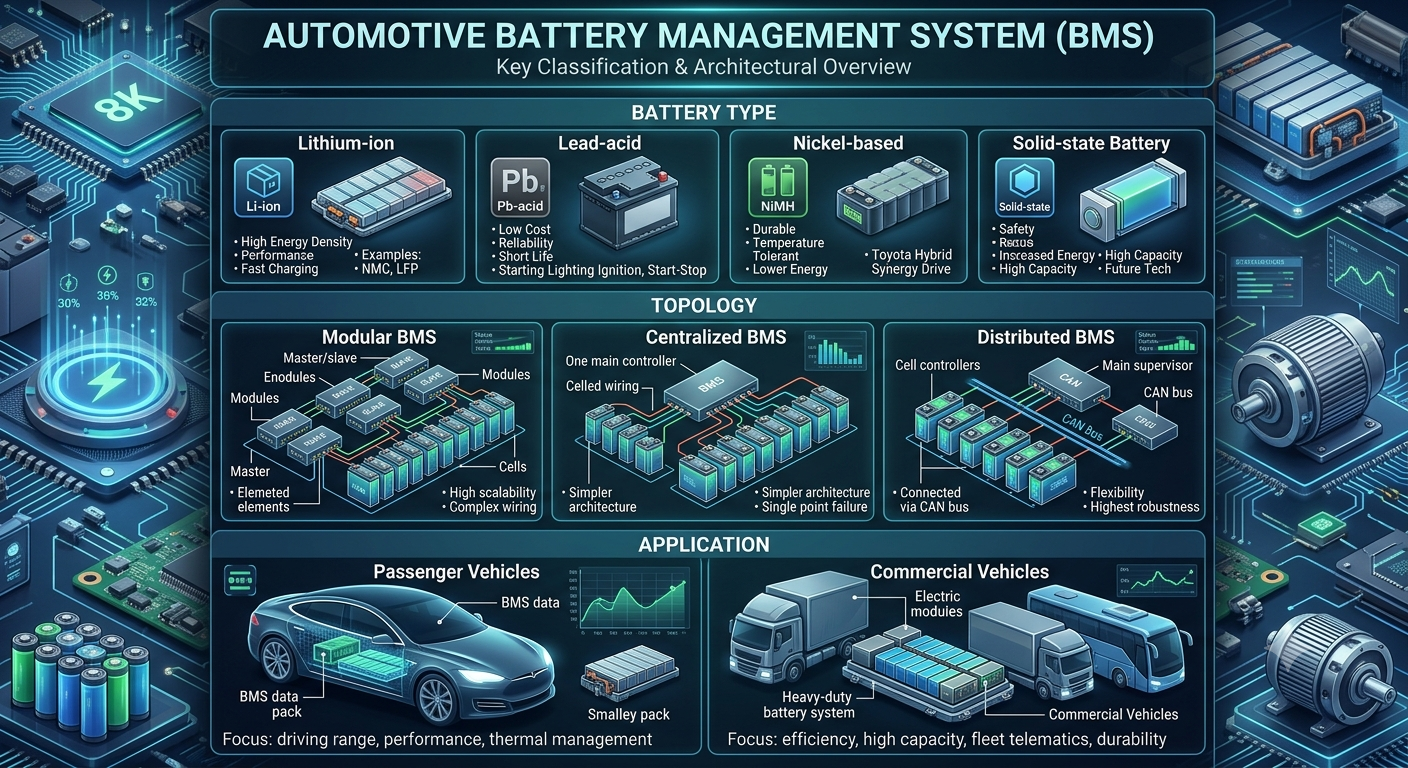
By battery type, the lithium-ion segment is expected to register the highest CAGR of 19.5% during the forecast period. MarketsandMarkets also expects lithium-ion batteries to hold the largest share of the automotive BMS market in 2030.
Lithium-ion batteries are widely used in EVs because they offer high energy and power density in a relatively compact form factor, along with strong charge/discharge efficiency.
The growing deployment of lithium-ion battery packs therefore directly increases the need for sophisticated battery monitoring and management systems.
Other battery types covered in the market include:
- Lead-acid
- Nickel-based batteries
- Solid-state batteries
The development of next-generation battery technologies is expected to create further opportunities for BMS manufacturers as new chemistries require specialized monitoring and control capabilities.
Centralized BMS Topology Gains Importance
The Automotive BMS Market is segmented by topology into centralized, modular, and distributed architectures.
According to MarketsandMarkets, the centralized topology segment is anticipated to significantly influence market expansion through 2030. Centralized BMS configurations use a single control board to oversee the battery pack and manage parameters such as voltage, current, and state of charge.
The demand for compact and cost-efficient power solutions is supporting interest in centralized architectures.
However, modular and distributed architectures are also gaining attention as battery packs become larger and more complex. These configurations can provide greater flexibility in monitoring individual battery modules and may help address wiring and scalability requirements.
Passenger Vehicles Represent a Major Growth Area
By application, the market includes passenger vehicles and commercial vehicles, with other vehicles also covered in the MarketsandMarkets segmentation.
The passenger vehicle segment is expected to register a CAGR of 19.8% during the forecast period. MarketsandMarkets identifies increasing EV adoption, growing environmental awareness, and stricter global emission standards as important factors supporting this segment.
Electric passenger vehicles require increasingly sophisticated battery systems to provide longer driving ranges, rapid charging, and reliable performance.
As automakers expand their EV portfolios, BMS technology will become increasingly integrated with vehicle electronics, charging systems, thermal-management systems, and connected vehicle platforms.
Commercial Vehicles Offer Additional Opportunities
Electric commercial vehicles represent another important opportunity for BMS suppliers.
Electric buses, trucks, delivery vehicles, and fleet vehicles can have large battery packs and demanding operating cycles. Their batteries may undergo frequent charging and discharging, creating greater requirements for battery monitoring and thermal management.
Fleet operators are also increasingly interested in battery health monitoring because battery performance directly affects vehicle range, operating costs, and fleet availability.
As electrification expands into commercial transportation, demand for robust and scalable BMS solutions is expected to increase.
Smart and Connected BMS Solutions Gain Momentum
The evolution of connected vehicles is changing the role of battery management systems.
Modern BMS platforms can integrate real-time diagnostics, embedded software, communication interfaces, and cloud-based analytics. These capabilities can help manufacturers and fleet operators monitor battery performance beyond the vehicle itself.
MarketsandMarkets identifies increasing demand for connected and smart vehicles as a growth driver for intelligent BMS solutions.
Connected BMS technologies can support applications such as:
- Remote battery monitoring
- Predictive maintenance
- Battery health estimation
- Fault detection
- Lifetime prediction
- Fleet battery analytics
- Performance optimization
This evolution is transforming BMS from a standalone electronic control system into an increasingly connected component of the vehicle’s digital architecture.
AI and Cloud-Based Battery Management
Artificial intelligence is opening new opportunities for advanced battery management.
AI-based BMS systems can analyze large volumes of battery data to identify patterns associated with degradation, abnormal behavior, charging performance, and battery health.
MarketsandMarkets highlights commercial use cases involving AI, cloud services, real-time analytics, anomaly detection, and battery lifetime prediction. Such solutions can potentially improve diagnostics and enable predictive maintenance.
Cloud-connected BMS platforms can also allow manufacturers and fleet operators to analyze battery performance across large numbers of vehicles.
Wireless BMS Creates New Opportunities
The emergence of wireless battery management systems is another important opportunity in the market.
Traditional BMS architectures require extensive wiring between battery cells, modules, and control units. Wireless BMS technologies can reduce wiring requirements and potentially simplify battery-pack architecture.
MarketsandMarkets specifically identifies the advantages of wireless BMS over traditional systems as an important market opportunity.
Potential advantages include:
- Reduced wiring
- Lower weight
- Greater design flexibility
- Easier battery-pack assembly
- Improved scalability
However, wireless BMS technologies must meet demanding requirements related to communication reliability, cybersecurity, electromagnetic interference, functional safety, and automotive-grade performance.
Fast Charging and Vehicle-to-Grid Technologies
The development of fast charging is increasing the importance of sophisticated battery management. Higher charging power places additional demands on cells and thermal-management systems.
A BMS must accurately monitor battery conditions during fast charging and help ensure that charging remains within appropriate operating limits.
Vehicle-to-grid (V2G) technology is another trend influencing the market. V2G enables compatible EVs to potentially supply electricity back to the grid, turning vehicle batteries into flexible energy resources.
MarketsandMarkets identifies fast charging and V2G among trends affecting energy efficiency and vehicle reliability and contributing to demand for smarter BMS solutions.
Solid-State Batteries Create Future Growth Opportunities
The emergence of novel battery technologies represents a significant opportunity for the Automotive BMS Market.
Solid-state batteries are attracting attention because of their potential for higher energy density and improved safety characteristics. As these technologies develop, BMS providers will need to adapt monitoring, charging, thermal, and safety-management strategies.
MarketsandMarkets identifies the emergence of novel battery technologies as an important opportunity for the automotive BMS industry.
The development of new cell chemistries could therefore expand the role of BMS technology beyond conventional lithium-ion battery management.
Lack of Universal Standards Remains a Restraint
Despite strong growth, the market faces challenges associated with the development of universal BMS standards.
Different BMS products can vary in technical specifications, measurement parameters, estimation methods, communication channels, and other characteristics. These differences can make it difficult to compare systems and establish consistent performance benchmarks.
MarketsandMarkets identifies the development of universal battery-management-system standards for different applications as a key restraint.
Greater standardization could help improve interoperability, simplify testing, and support broader adoption of advanced BMS technologies.
External Conditions Can Affect BMS Performance
Automotive BMS systems operate under challenging environmental conditions. Extreme temperatures can affect battery performance as well as the accuracy of BMS measurements and calculations.
MarketsandMarkets identifies the impact of external factors on BMS performance as a key challenge. Maintaining accurate measurements and reliable operation in real-world conditions is particularly important for automotive applications.
BMS manufacturers therefore need to develop systems capable of maintaining accuracy and reliability across a wide range of operating temperatures and vehicle conditions.
Asia Pacific Leads the Global Market
Asia Pacific is expected to lead the global Automotive Battery Management System Market through 2030. The region’s strong position is supported by rising EV adoption, advances in battery technologies, the presence of major battery manufacturers, and government policies promoting vehicle electrification.
Asia Pacific accounted for 47.3% of global automotive BMS market revenue in 2024, according to MarketsandMarkets.
The region’s large automotive manufacturing ecosystem and expanding EV supply chain make it an important market for BMS manufacturers.
North America is also expected to experience significant growth. MarketsandMarkets projects the North American automotive BMS market to increase from USD 1.11 billion in 2025 to USD 2.25 billion by 2030, representing a 15.3% CAGR.
Competitive Landscape
The Automotive BMS Market includes automotive technology companies, battery manufacturers, electronics suppliers, and specialized BMS providers.
MarketsandMarkets identifies companies such as LG Energy Solution, Sensata Technologies, Ficosa Internacional, Eberspächer, and AVL among key players.
The competitive landscape is increasingly focused on:
- Advanced battery monitoring
- Wireless BMS
- AI-powered diagnostics
- Cloud connectivity
- Safety and compliance
- Fast-charging support
- Thermal management
- Battery lifecycle optimization
Companies are also developing partnerships and integrated solutions to address the growing complexity of EV battery systems.
Future Outlook
The Automotive Battery Management System Market is entering a period of significant transformation as electric mobility expands worldwide.
MarketsandMarkets forecasts the market to reach USD 15.65 billion by 2030, growing at 19.1% CAGR from 2025 to 2030.
The future of BMS technology will be shaped by the convergence of EVs, advanced batteries, AI, cloud computing, wireless connectivity, fast charging, and intelligent energy management.
Lithium-ion batteries will remain central to the market, while solid-state and other emerging battery technologies could create new opportunities. Passenger vehicles are expected to remain a major application, while commercial electrification will provide additional demand.
Ultimately, the BMS is becoming much more than a battery monitoring system. It is evolving into an intelligent platform that can help improve battery safety, efficiency, reliability, performance, and lifecycle management.
As automakers compete to deliver safer EVs with longer range and faster charging, advanced BMS technology will remain a critical enabler of the global transition toward electric mobility.