
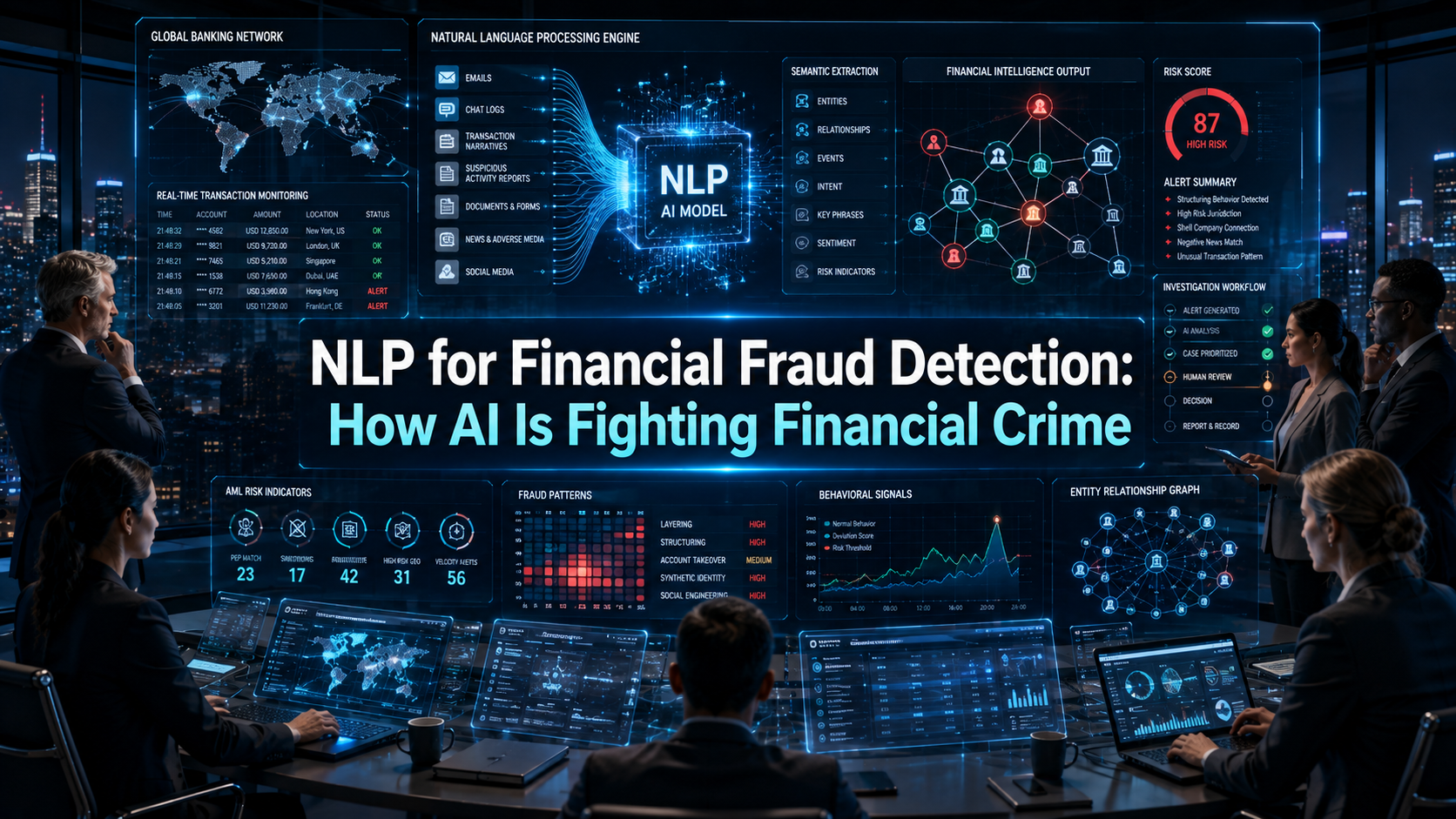
Financial crime is becoming faster, more coordinated and increasingly digital. In 2026, fraudsters are using AI, social engineering, synthetic identities and cross-channel campaigns to scale deception, while financial institutions are responding with AI-assisted detection, behavioral analytics, graph technology and natural language processing (NLP).
The opportunity for the NLP in Finance Market is therefore moving beyond chatbots and document automation. NLP is increasingly becoming an intelligence layer capable of interpreting emails, customer communications, transaction descriptions, suspicious-activity narratives, regulatory documents, adverse media and other unstructured information that traditional transaction-monitoring systems often struggle to understand.
The strategic question for financial institutions is no longer simply whether they should deploy NLP.
It is how effectively they can combine language intelligence with transaction data, behavioral signals, graph analytics and human investigation.
Strategic Introduction: When Financial Crime Becomes a Language Problem
NLP helps financial institutions detect fraud signals hidden in emails, conversations, reports and documents that transaction-monitoring systems may miss.
Banks use rules, behavioral models and graph analytics, yet financial crime increasingly appears in language.
Emails, conversations, applications and adverse media can reveal risks hidden outside transactions.
NLP converts unstructured language into intelligence for fraud and AML controls. INTERPOL’s 2026 assessment highlights financial fraud as an evolving transnational threat and points to AI-enhanced fraud.
Criminals scale deception with AI; banks must respond faster.
Download the PDF for business opportunities as outlined in the latest market research findings.
Market Context & Growth Narrative: Why NLP Is Entering the Fraud Stack
The NLP in Finance Market is expanding as banks apply language intelligence to fraud detection, AML, compliance, documents, customer interactions and risk management.
Estimates vary by definition and methodology, so a credible NLP in Finance Market report should explain its scope.
Financial organizations are applying NLP to:
- Fraud detection
- Risk and compliance
- Document analysis
- Customer communications
- Regulatory intelligence
Research also identifies compliance, risk management, sentiment and narrative processing as major applications.
Fraud prevention is becoming an important part of NLP in Finance Market growth.
This Sample Report is designed to fuel your business growth download it today.
Business Value Proposition: Turning Unstructured Signals Into Action
NLP creates value by connecting language signals with transactions, behavioral data and relationships, giving investigators broader context.
Fraudsters communicate.
Traditional monitoring favors structured data; NLP adds intelligence from language.
A bank may see several normal-looking transactions. NLP can examine related conversations, descriptions, emails, case notes, adverse media and investigation records.
It can identify recurring language, entities and relationships that deserve review. NLP does not prove fraud; it connects signals.
The Federal Reserve’s 2026 discussion describes hybrid systems combining predictive models, graph analytics and generative AI.
The winning architecture is coordinated intelligence, not AI alone.
Industry Use Cases: Where NLP Can Expose Hidden Fraud
Financial institutions can use NLP across AML investigations, customer communications, adverse-media screening, KYC, insurance claims, payment monitoring and internal investigations.
- AML: Extract entities, relationships, suspicious terminology and recurring patterns.
- Customer communications: Identify language linked to impersonation, urgency or suspicious requests.
- Investigation support: Summarize files, extract entities and prioritize documents.
- Adverse media: Classify public information and identify risk themes.
- KYC: Extract information from corporate documents and filings.
- Insurance and payment fraud: Detect inconsistencies and contextual risk.
- Internal investigations: Search communications and case records.
The opportunity is financial crime intelligence.
Technology Architecture Overview: Building an AI Financial-Crime Intelligence Layer
A strong NLP fraud architecture connects data sources to NLP processing, AI analytics, financial-crime decisions and human investigation.
A practical architecture follows: data sources → NLP → AI analytics → decisions → human investigation.
Data includes transactions, communications, documents and regulatory information. NLP performs extraction, classification and semantic search; analytics adds ML, LLMs, graphs and risk scoring.
Human investigators remain essential. A model may flag wording while other data provides context.
Explainability matters: institutions should know why an alert was generated and how confident it is.
Regulatory & Compliance Landscape: Innovation Without Losing Control
AI-powered financial crime systems require privacy, validation, auditability, human oversight, explainability, access controls and continuous model governance.
FATF’s 2026 work highlights cyber-enabled fraud, money-laundering risks and emerging AI threats.
Priority controls include:
- Data privacy and access
- Model validation and monitoring
- Auditability and lineage
- Human oversight and explainability
- Bias and third-party AI risk
The EU AI Act also adds governance requirements for applicable high-risk systems.
The objective is defensible AI adoption.
Implementation Roadmap: From Pilot to Production
Enterprises should begin with one high-value NLP workflow, establish governance, validate a pilot, integrate transaction intelligence and measure outcomes.
- Identify the problem: Start with adverse-media screening or case review.
- Govern data: Define processing, storage and access.
- Pilot NLP: Validate extraction, search and summarization.
- Connect intelligence: Combine language, behavior and transactions.
- Add graphs: Map customers, accounts and entities.
- Keep humans in control: Validate findings.
- Measure outcomes: Track false positives, investigation time and detection.
The objective is better outcomes.
Challenges & Risk Considerations: The Limits of AI Detection
NLP can uncover hidden signals, but contextual ambiguity, model drift, bias, adversarial behavior and overautomation remain significant risks.
Financial language is contextual, historical data can reproduce bias, and criminals adapt.
Key risks include:
- False positives: Legitimate customers may be flagged.
- False negatives: Sophisticated fraud may remain hidden.
- Model drift: Criminal patterns change.
- Data leakage: Sensitive information requires protection.
- Explainability gaps: Investigators need understandable evidence.
- Overautomation: Excessive reliance on AI can weaken judgment.
The right model is not AI versus humans. It is AI plus expert judgment.
Competitive Advantage & Future Outlook: From Rules to Intelligence
The next generation of financial crime technology will combine NLP, generative AI, graph analytics and behavioral intelligence to understand relationships across transactions, communications and networks.
Traditional systems asked whether a transaction broke a rule. Emerging systems ask what is happening across the customer, network, communication and transaction ecosystem.
KPMG’s 2026 analysis identifies GenAI and agentic AI as emerging tools for fraud, AML and KYC.
Future systems may:
- Detect anomalies
- Gather evidence
- Analyze communications
- Map relationships
- Draft and escalate investigation summaries
This marks the shift to AI-assisted investigation.
2026 Trends: The Next Generation of AI-Powered Fraud Prevention
In 2026, financial crime technology is moving toward hybrid AI, real-time behavioral intelligence, agentic investigation, graph-NLP convergence, explainable AI and stronger intelligence sharing.
- Hybrid AI: Rules, ML, NLP, GenAI and graph analytics work together.
- Real-time intelligence: Continuous behavioral signals replace isolated checks.
- Agentic AI: Agents coordinate investigative tasks under human governance.
- AI-enabled social engineering: More convincing scams increase demand for contextual detection.
- Graph + NLP: Language and relationship mapping create richer risk views.
- Explainable AI: Institutions need defensible reasons for consequential decisions.
Strategic Conclusion: Financial Crime Detection Becomes an Intelligence Business
NLP is becoming a strategic financial-crime capability because it connects unstructured language with transactions, identities, networks and behavioral intelligence while keeping human judgment in the loop.
The NLP in Finance Market forecast reflects more than demand for language-processing software. It reflects a deeper change in how financial institutions understand risk.
Financial crime crosses conversations, documents, identities, devices and payment networks. Traditional controls remain essential, but isolated signals are not enough.
NLP bridges structured and unstructured intelligence. Combined with machine learning, graph analytics, behavioral data and expert investigation, it can reveal relationships conventional systems may overlook.
The strongest institutions will combine better data, context and governance.
The future is not simply detecting a suspicious transaction; it is understanding the story behind it.