
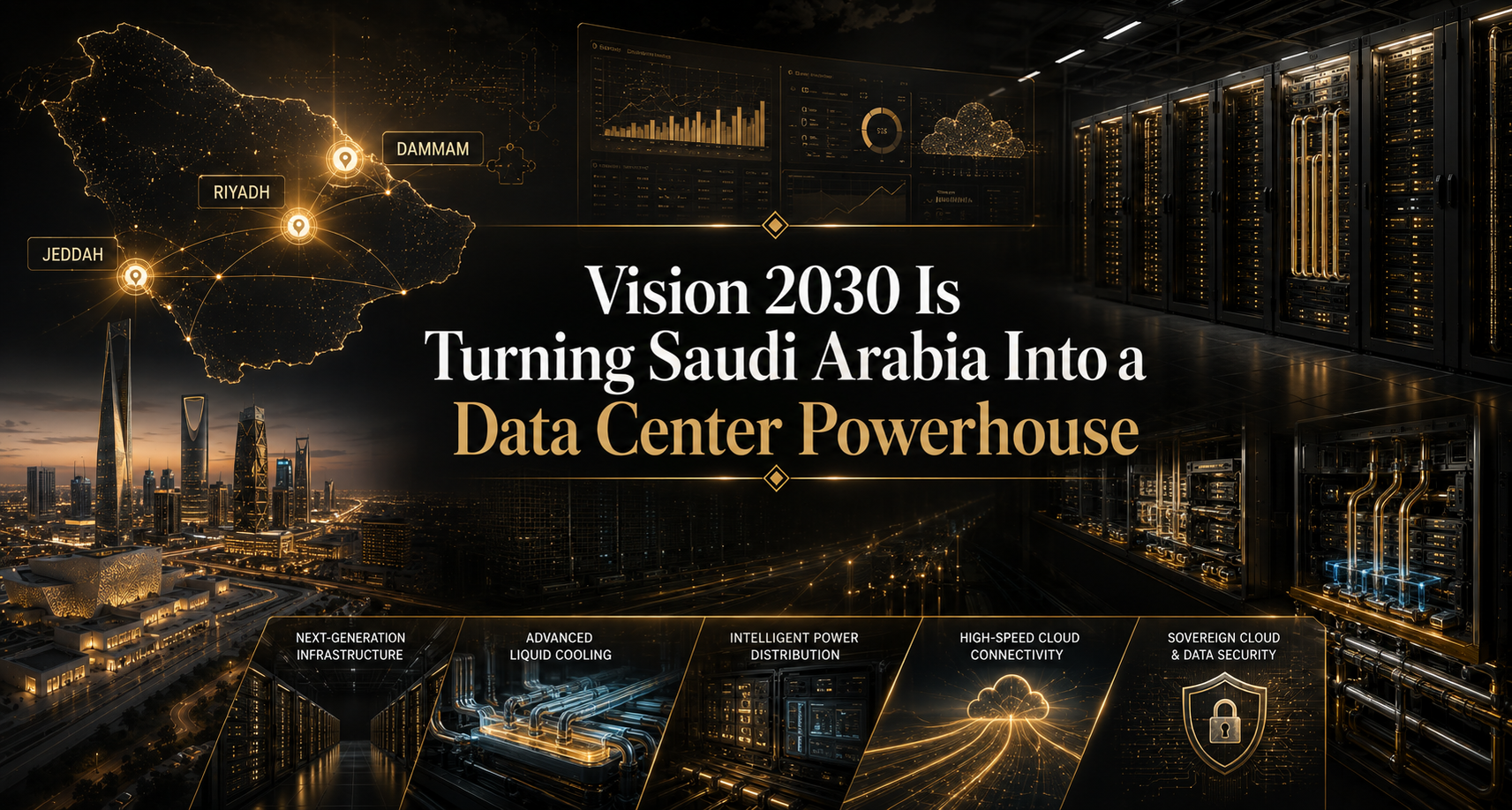
Vision 2030 Is Rewriting the Data Center Playbook
Saudi Arabia is rapidly expanding data-center infrastructure to support AI, cloud computing, digital government and enterprise transformation, making infrastructure a strategic business asset.
The Saudi Arabia Data Center Colocation Market is entering a decisive growth phase as Vision 2030 moves beyond digital ambition toward large-scale infrastructure execution.
The opportunity is bigger than adding server capacity. Saudi Arabia is building the physical foundation for:
- Artificial intelligence
- Cloud computing
- Digital government
- Fintech
- Smart cities
- Industrial automation
- Sovereign digital services
Saudi Arabia’s designation of 2026 as the Year of Artificial Intelligence further reinforces AI as a national economic priority.
The equation is becoming difficult for business leaders to ignore:
Vision 2030 + AI + cloud + digital services = rising demand for resilient digital infrastructure.
AI Is Making Colocation a Strategic Business Decision
AI workloads are increasing demand for scalable power, computing, cooling, connectivity and security, making colocation an increasingly strategic enterprise infrastructure model.
Generative AI, machine learning, analytics and high-performance computing are changing infrastructure requirements.
Modern AI deployments increasingly depend on:
- GPU-intensive computing
- High-density racks
- Accelerated networking
- Advanced cooling
- Large-scale storage
- Low-latency connectivity
- High availability
- Continuous monitoring
For enterprises, colocation offers an alternative to building an entire facility internally.
Instead of carrying the full capital and operational burden of data-center development, organizations can access specialized infrastructure while concentrating investment on applications, data, customers and innovation.
That can translate into faster deployment, flexible capacity and more efficient infrastructure planning.
According to market research, you can Download the PDF to explore detailed business opportunities.
The Capacity Surge Is Becoming Impossible to Ignore
Saudi Arabia’s operational data-center capacity increased from 68 MW in 2021 to more than 440 MW in 2025, demonstrating the scale of the Kingdom’s infrastructure expansion.
The numbers tell a compelling story.
According to the supplied market evidence, Saudi Arabia had more than 60 data centers developed by over 20 companies in 2025, with investments exceeding SAR 16 billion.
Other research estimates differ because methodologies and market definitions vary.
For executives, however, the most important signal is direction rather than precision:
Saudi Arabia is entering a major digital infrastructure investment cycle.
Take the first step toward business growth download our Sample Report now.
Riyadh, Jeddah and Dammam Are Becoming Strategic Hubs
Riyadh is emerging as a primary technology and data-center hub, while Jeddah and Dammam add commercial, connectivity and industrial advantages.
Riyadh’s growing technology ecosystem makes it central to enterprise demand.
Jeddah contributes strategic connectivity and commercial importance, while Dammam benefits from its industrial base.
For organizations, location can directly influence:
- Cloud access
- Disaster recovery
- Business continuity
- Low-latency applications
- AI deployment
- Hybrid-cloud architecture
- Customer experience
Consequently, Saudi Arabia Data Center Colocation Market analysis must look beyond facility numbers.
Power availability, connectivity, workload requirements, resilience and expansion potential increasingly determine the real strategic value of a facility.
What Enterprises Gain From Colocation
Enterprise colocation provides scalable power, cooling, connectivity, security and operational infrastructure without requiring organizations to build and manage an entire data center.
The business case is straightforward.
Faster deployment: Enterprises can provision capacity without waiting for a greenfield development.
Lower infrastructure burden: Specialized providers manage critical physical infrastructure.
Scalability: Capacity can expand as workloads and customers increase.
Resilience: Enterprise-grade facilities can support redundancy and business-continuity requirements.
Connectivity: Workloads can be positioned closer to cloud platforms, networks and customers.
AI readiness: High-density environments can accommodate demanding AI and analytics workloads.
This makes Saudi Arabia Data Center Colocation Market growth increasingly connected with enterprise modernization.
The AI-Ready Data Center Is an Integrated Platform
AI-ready colocation combines compute, resilient power, advanced cooling, high-speed networking, security and intelligent infrastructure management.
The modern data center is no longer simply a collection of server racks. It is becoming an integrated technology platform.
- Compute: GPUs, CPUs, accelerators and high-performance servers
- Power: UPS systems, resilient distribution and high-capacity electrical infrastructure
- Cooling: Advanced air and liquid-cooling technologies
- Networking: High-speed interconnects for AI and cloud workloads
- Security: Physical protection, cybersecurity and access controls
- Management: DCIM, telemetry and predictive analytics
These capabilities are shaping Saudi Arabia Data Center Colocation Market trends.
The executive question is shifting from:
“How much rack space is available?”
to:
“How much business-critical compute can the infrastructure support?”
Sovereign Cloud Is Strengthening the Infrastructure Case
Local data-center infrastructure can support data residency, security, latency, cloud connectivity and digital-sovereignty objectives.
Saudi Arabia’s digital strategy places significant emphasis on data, AI and advanced infrastructure.
Microsoft has stated that its Saudi Arabia East cloud region is expected to become available in Q4 2026, with three availability zones designed around independent power, cooling and networking infrastructure.
For enterprises, local infrastructure can support:
- Data-residency strategies
- Lower-latency services
- Hybrid-cloud deployments
- AI workloads
- Government platforms
- Financial services
- Healthcare systems
- Industrial applications
The implication is significant: colocation is becoming part of digital trust and sovereignty—not simply physical hosting.
The Latin America Lesson: Colocation Can Accelerate Growth
The Latin America Data Center Colocation Market demonstrates how enterprises can access specialized infrastructure without assuming the complete cost and operational complexity of facility ownership.
Saudi Arabia and Latin America have different regulatory and infrastructure environments, but the enterprise principle is similar.
Colocation can help organizations:
- Launch digital services faster
- Expand into new markets
- Support AI workloads
- Improve business continuity
- Reduce facility-management complexity
- Scale infrastructure according to demand
For multinational organizations, distributed colocation can create a flexible infrastructure strategy.
Companies can select facilities based on customers, regulations, connectivity, resilience and workload requirements.
The broader lesson is powerful:
Infrastructure ownership is not the only route to infrastructure control.
A Practical Enterprise Deployment Roadmap
Enterprises should evaluate workloads, location, power, cooling, connectivity, security, compliance and scalability before selecting a colocation strategy.
A disciplined deployment approach can begin with seven decisions:
- Identify critical workloads
- Separate AI, cloud and conventional workloads
- Calculate current and future capacity
- Evaluate data-residency requirements
- Assess connectivity and cloud access
- Compare power, cooling and resilience
- Build a long-term expansion strategy
The objective should not be to purchase the largest capacity available.
It should be to create the right infrastructure economics for the business.
That distinction strengthens the long-term value behind the Saudi Arabia Data Center Colocation Market forecast.
The Risks That Could Slow Saudi Arabia’s Data Center Boom
Power availability, capital intensity, cooling complexity, supply constraints, cybersecurity, workforce shortages and rapid AI hardware evolution remain major considerations.
Growth does not eliminate execution risk.
Enterprise leaders and infrastructure providers should monitor:
- Energy availability
- Cooling complexity
- Cybersecurity exposure
- Hardware supply constraints
- Skilled workforce requirements
- Sustainability expectations
- Regulatory changes
- Accelerating AI hardware cycles
The wrong strategy is simply to maximize capacity.
The smarter approach is to build flexible capacity capable of adapting to changing accelerator architectures, AI models and enterprise workloads.
The 2030 Competitive Advantage
Saudi Arabia’s data-center opportunity is moving from basic capacity expansion toward AI-ready, cloud-connected and enterprise-grade infrastructure aligned with Vision 2030.
The Saudi Arabia Data Center Colocation Market outlook is being shaped by multiple forces arriving simultaneously:
- Vision 2030
- The 2026 Year of AI
- Cloud adoption
- Enterprise digitization
- Government transformation
- AI infrastructure
- Data sovereignty
- Hyperscale investment
- Regional digital demand
Saudi Arabia’s National Strategy for Data and AI targets international leadership by 2030, while the rapid expansion of physical infrastructure demonstrates the scale of the opportunity.
For investors and technology providers, the opportunity is substantial.
For enterprise leaders, the question is more direct:
Can your infrastructure keep pace with your digital ambition?
The strongest organizations will connect:
AI strategy → cloud strategy → data strategy → cybersecurity → customer experience → business growth.
That is where Saudi Arabia Data Center Colocation Market size, share, analysis, trends, outlook, report, growth and forecast become commercially meaningful.
The Enterprise Bottom Line
Saudi Arabia’s expanding data-center ecosystem can help enterprises deploy AI faster, strengthen resilience, scale digital services and reduce the operational burden of building infrastructure from scratch.
Vision 2030 is creating more than a digital economy.
It is creating the infrastructure required to operate one.
For business leaders, the opportunity can be summarized in five priorities:
- Build less: Reduce the need for complete facility ownership.
- Access more: Use specialized infrastructure strategically.
- Deploy faster: Accelerate cloud, AI and digital-service launches.
- Scale intelligently: Match capacity with evolving workloads.
- Grow confidently: Align infrastructure with long-term business strategy.
The next competitive advantage may not belong to the company with the largest technology budget.
It may belong to the organization capable of converting Saudi Arabia’s expanding digital infrastructure into faster AI deployment, stronger resilience, lower operational friction and new avenues for enterprise growth.
Corporate Impact: What Businesses Should Do Now
- AI leaders: Secure infrastructure capable of supporting accelerated computing.
- CIOs: Evaluate colocation as part of long-term hybrid-cloud architecture.
- CFOs: Compare facility ownership against scalable infrastructure services.
- Security leaders: Prioritize resilience, access controls and cybersecurity.
- Expansion teams: Evaluate Riyadh, Jeddah and Dammam based on workload and connectivity.
- Digital businesses: Use local infrastructure to support latency-sensitive and data-intensive services.