

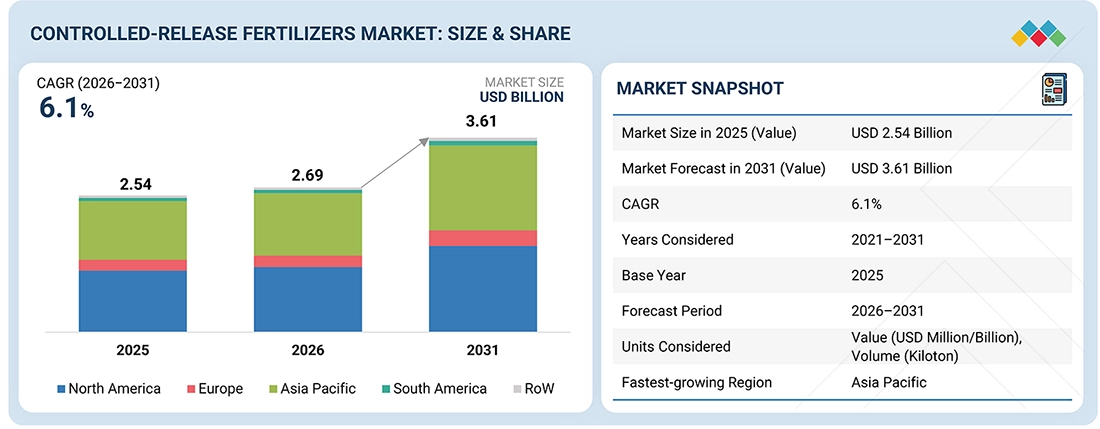
The controlled-release fertilizers market is witnessing steady growth as farmers increasingly focus on improving nutrient use efficiency, enhancing crop productivity, and adopting sustainable agricultural practices. The market is projected to grow from USD 2.69 billion in 2026 to USD 3.61 billion by 2031, registering a CAGR of 6.1% during the forecast period.
Controlled-release fertilizers (CRFs) are designed to release nutrients gradually and in alignment with crop requirements. Unlike conventional fertilizers, which can result in significant nutrient losses through leaching, volatilization, and runoff, CRFs provide a more controlled nutrient supply. This enables farmers to improve fertilizer efficiency while reducing application frequency and supporting consistent crop growth.
Key Factors Driving the Controlled-Release Fertilizers Market
The growing demand for higher agricultural productivity is one of the major factors supporting the adoption of controlled-release fertilizers. As farmers seek to increase yields from available farmland, efficient nutrient management has become increasingly important. CRFs help provide plants with a steady supply of nutrients throughout critical growth stages, supporting healthier development and improved productivity.
Environmental sustainability is another significant market driver. Excessive use of conventional fertilizers can contribute to soil degradation, water contamination, nutrient runoff, and greenhouse gas emissions. Controlled-release formulations help minimize nutrient losses and improve nutrient uptake, making them increasingly attractive for sustainable farming systems.
Technological advancements are also transforming the CRF industry. Innovations in polymer-coated fertilizers, biodegradable coatings, multi-nutrient formulations, and advanced release mechanisms are improving fertilizer performance across different crops, soil types, and climatic conditions.
In addition, government initiatives promoting sustainable nutrient management, growing awareness of long-term cost savings, and the increasing adoption of precision agriculture technologies are creating new opportunities for controlled-release fertilizer manufacturers.
Download PDF Brochure: https://www.marketsandmarkets.com/pdfdownloadNew.asp?id=136099624
Nitrogen Stabilizers to Hold a Significant Market Share
By type, the nitrogen stabilizers segment is estimated to account for a significant share of the global controlled-release fertilizers market. Nitrogen stabilizers play an important role in improving nitrogen use efficiency and reducing nutrient losses from agricultural soils.
These products include urease inhibitors and nitrification inhibitors, which slow the transformation of nitrogen in soil. By extending nitrogen availability, they allow crops to absorb nutrients more efficiently over a longer period.
Nitrogen stabilizers can reduce nitrogen volatilization and leaching while supporting soil fertility and crop productivity. They can also reduce the need for frequent fertilizer applications, providing operational and cost benefits for large-scale farming operations and high-value crops.
The increasing emphasis on sustainable agriculture and efforts to minimize nitrogen runoff are further supporting the adoption of nitrogen-stabilized fertilizer solutions. Major industry participants, including ICL, Nutrien, SQM, and Yara, are incorporating advanced nitrogen management technologies into their fertilizer portfolios to address both productivity and environmental sustainability requirements.
Time-release Systems Lead the Function Segment
By function, time-release systems are expected to hold the largest share of the controlled-release fertilizers market. These systems are designed to deliver nutrients progressively over a defined period, helping synchronize nutrient availability with crop uptake.
Time-release fertilizers include polymer-coated and matrix-based formulations that can reduce nutrient losses caused by leaching, volatilization, and runoff. Their flexibility makes them suitable for a wide range of crops, including cereals, vegetables, fruits, ornamental plants, and high-value plantation crops.
Farmers are increasingly adopting time-release systems because they can reduce the frequency of fertilizer applications while supporting consistent crop nutrition. This is particularly beneficial for large-acreage farms where labor and application costs can significantly affect overall production economics.
The development of biodegradable coatings and advanced multi-nutrient formulations is further enhancing the performance of time-release fertilizers. These innovations are expected to strengthen the position of time-release systems within the CRF market.
Request Sample Pages: https://www.marketsandmarkets.com/requestsampleNew.asp?id=136099624
North America Leads the Controlled-release Fertilizers Market
By region, North America is estimated to account for the largest share of the controlled-release fertilizers market. The region benefits from well-developed agricultural infrastructure, extensive farmland, advanced farming technologies, and high levels of mechanization.
Farmers across North America are increasingly focusing on efficient nutrient management to improve crop yields while reducing the environmental impact of fertilizer use. This has created favorable conditions for the adoption of controlled-release fertilizers across row crops, horticulture, and high-value agricultural applications.
The presence of established industry participants, including ICL, Nutrien, Yara, and SQM, along with well-developed manufacturing and distribution networks, further supports regional market growth.
Technological innovation is another important factor contributing to North America’s market position. Polymer-coated fertilizers, biodegradable CRFs, multi-nutrient products, and precision nutrient-management technologies are helping farmers address diverse crop and soil requirements.
Government initiatives supporting sustainable agriculture and precision farming are also encouraging the efficient application of fertilizers. At the farm level, reduced application frequency, improved nutrient efficiency, and lower labor requirements can provide additional economic benefits.
Leading Controlled-release Fertilizers Companies
The competitive landscape includes several global fertilizer manufacturers and agricultural input companies. Key players profiled in the market include:
- Yara (Norway)
- Nutrien Ltd. (Canada)
- Mosaic (US)
- ICL (Israel)
- Nufarm (Australia)
- Kingenta (China)
- ScottsMiracle-Gro (US)
- Koch Industries (US)
- Helena Chemicals (US)
- SQM (Chile)
- Haifa Negev Technologies Ltd. (Israel)
- JCAM AGRI Co., Ltd. (Japan)
- COMPO EXPERT (Germany)
- The Andersons Inc. (US)
- Van Iperen International (Netherlands)
Future Outlook
The controlled-release fertilizers market is positioned for continued expansion as agriculture moves toward greater nutrient efficiency, sustainability, precision, and resource optimization. Increasing pressure to reduce nutrient losses, combined with the need to improve agricultural productivity, is expected to encourage farmers to adopt advanced fertilizer technologies.
Continued innovation in coating technologies, biodegradable materials, nitrogen stabilization, and precision nutrient management will likely create new opportunities for market participants. As growers increasingly evaluate fertilizers based on both productivity and environmental performance, controlled-release solutions are expected to play an increasingly important role in modern sustainable agriculture.