
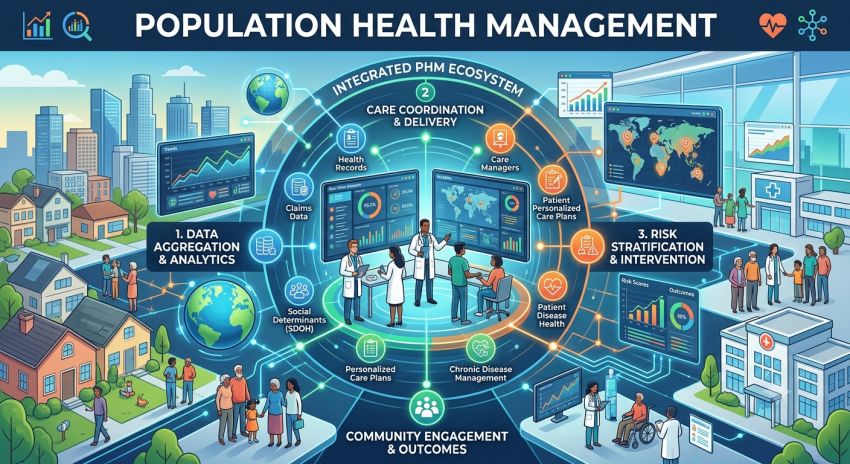
The global population health management (PHM) market is projected to grow from USD 46.93 billion in 2026 to USD 98.41 billion by 2031, at a CAGR of 16.0% during the forecast period. Market growth is being fueled by the increasing need to improve clinical outcomes while reducing healthcare costs through proactive, data-driven care management strategies.
Download PDF Brochure:- https://www.marketsandmarkets.com/pdfdownloadNew.asp?id=263411936
Healthcare providers, payers, government organizations, and employers are increasingly adopting PHM solutions to identify high-risk populations, manage chronic diseases, enhance preventive care, and improve care coordination. These platforms integrate clinical, claims, pharmacy, laboratory, and social determinants of health (SDOH) data to deliver comprehensive insights into patient populations, enabling better decision-making and improved health outcomes.
Advanced PHM platforms support functionalities such as risk stratification, predictive analytics, care gap identification, patient engagement, and remote patient monitoring—key capabilities that are essential for success in value-based care and accountable care models.
Cloud-Based Deployment to Witness Fastest Growth
By delivery mode, the cloud-based segment is expected to register the fastest growth during the forecast period. This growth is driven by increasing demand for scalable, interoperable healthcare IT infrastructure and the need for real-time population health insights.
Cloud-based PHM solutions enable seamless integration of diverse data sources, lower upfront costs, faster implementation, and easier access to advanced analytics and AI-driven tools. These advantages make cloud deployment particularly attractive for healthcare organizations seeking to enhance collaboration, improve efficiency, and accelerate digital transformation.
Healthcare Providers Lead Adoption
Based on end users, the healthcare providers segment accounted for the largest share of the PHM market in 2025. Hospitals, physician groups, integrated delivery networks (IDNs), and accountable care organizations (ACOs) are increasingly leveraging PHM platforms to improve patient outcomes while controlling costs.
Providers use these solutions to identify high-risk patients, manage chronic conditions, close care gaps, and coordinate multidisciplinary care. The ongoing transition to value-based reimbursement models is further accelerating adoption, as providers focus on improving quality metrics, reducing readmissions, and optimizing resource utilization.
Sepak To Analyst:- https://www.marketsandmarkets.com/speaktoanalystNew.asp?id=263411936
North America Dominates the Market
North America accounted for the largest share of the global PHM market in 2025. The region’s leadership is driven by the widespread adoption of value-based care models, strong healthcare IT infrastructure, and extensive use of electronic health records (EHRs) and advanced analytics.
Healthcare organizations across the US and Canada are increasingly investing in PHM platforms to improve care coordination, enhance patient outcomes, and manage rising healthcare costs. Government initiatives promoting digital health and interoperability, along with growing adoption of AI and remote patient monitoring, continue to support market expansion in the region.
Competitive Landscape
Key players operating in the population health management market include Oracle, Veradigm LLC, Merative, Epic Systems Corporation, Koninklijke Philips N.V., i2i Population Health, Health Catalyst, Optum Inc., Cedar Gate Technologies, eClinicalWorks, athenahealth, Innovaccer, Lumeris, ZeOmega, and several other emerging companies.
These organizations are focusing on AI-driven innovation, advanced analytics capabilities, and strategic partnerships to strengthen their PHM offerings and expand their global footprint.