

The global biostimulants market is emerging as an important segment of sustainable agriculture, driven by the increasing need to improve crop productivity, enhance soil health, and reduce dependence on conventional agricultural inputs. Biostimulants help plants improve nutrient utilization, tolerate environmental stresses, and achieve better growth and crop quality.
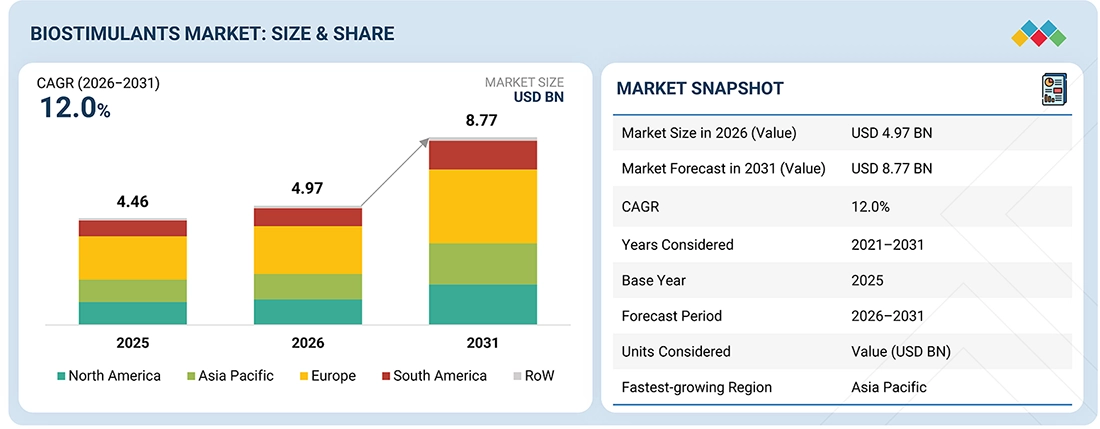
According to MarketsandMarkets, the global biostimulants market is projected to grow from USD 4.97 billion in 2026 to USD 8.77 billion by 2031, registering a CAGR of 12.0% during 2026–2031. The market is being supported by the growing adoption of sustainable farming practices, increasing demand for organic agriculture, advancements in biological formulations, and greater awareness of soil health and crop resilience.
What Are Biostimulants?
Biostimulants are substances, materials, or biological inputs that stimulate natural processes in plants and soils to improve nutrient-use efficiency, crop quality, growth, and tolerance to environmental stresses. They are increasingly being incorporated into modern crop management programs alongside fertilizers, biological products, and other agricultural inputs.
Biostimulant products can include seaweed extracts, humic substances, amino acids, microbial-based ingredients, minerals, vitamins, and other bioactive compounds. Their applications span a broad range of crops and farming systems, including cereals, oilseeds, fruits, vegetables, and horticultural crops.
Biostimulants Market Size and Growth
The biostimulants market was valued at approximately USD 4.46 billion in 2025 and is estimated to reach USD 4.97 billion in 2026. The market is expected to reach USD 8.77 billion by 2031, representing a CAGR of 12.0% from 2026 to 2031.
This growth reflects the transition toward more sustainable and resource-efficient agricultural systems.
Key Factors Driving the Biostimulants Market
- Growing Adoption of Sustainable Agriculture: The push toward sustainable intensification of agriculture is one of the major factors supporting the biostimulants market. Farmers are looking for solutions that can improve crop productivity while optimizing the use of fertilizers and other agricultural inputs. Biostimulants can support nutrient uptake, plant development, stress tolerance, and soil health, making them increasingly relevant to sustainable crop production systems.
- Rising Demand for Organic and Sustainably Produced Food: Consumer interest in organic and sustainably produced food is encouraging growers to adopt agricultural practices that reduce dependence on conventional chemical inputs. This trend is creating opportunities for biostimulant manufacturers to develop products compatible with sustainable and organic farming systems.
- Increasing Environmental Stress on Crops: Drought, salinity, temperature fluctuations, and other environmental stresses can negatively affect crop productivity. Biostimulants are gaining attention because they can help plants improve their resilience to these stresses and maintain better physiological performance.
- Advancements in Microbial and Seaweed-Based Products: Product innovation is another important growth factor. Manufacturers are developing microbial, seaweed-based, humic, and other formulations designed to improve plant growth, nutrient efficiency, and stress tolerance across different crops.
Download PDF Brochure: https://www.marketsandmarkets.com/pdfdownloadNew.asp?id=1081
Seaweed Extracts Lead the Active Ingredient Segment
Among active ingredients, seaweed extracts are expected to dominate the biostimulants market, accounting for around one-third of market demand. Seaweed extracts contain various organic compounds, plant-related bioactive substances, vitamins, minerals, and other components that can support plant growth and stress tolerance.
The broad application potential of seaweed-based products across horticulture, field crops, and specialty crops is contributing to their strong market position.
Other important active ingredient categories include:
- Humic substances
- Amino acids
- Microbial-based ingredients
- Minerals and vitamins
- Other bioactive compounds
Fruits and Vegetables Represent a High-Growth Crop Segment
The fruits & vegetables segment is projected to register the highest CAGR of 13.1% during the forecast period. Fruits and vegetables require efficient nutrient management to achieve optimum growth, yield, appearance, and quality.
Biostimulants can support nutrient absorption and help crops cope with drought, salinity, heat, and other environmental conditions. This makes them particularly valuable in high-value horticultural production.
Request Sample Pages: https://www.marketsandmarkets.com/requestsampleNew.asp?id=1081
Foliar Treatment Remains a Major Application Method
Foliar treatment accounted for the largest market share in 2025. Foliar application enables biostimulants to be delivered directly to plant leaves, supporting rapid uptake and allowing growers to target specific crop growth stages.
The increasing availability of application technologies and compatibility with precision agriculture equipment could further support the use of foliar biostimulants.
Soil treatment and other application methods also remain important, particularly for products designed to influence root development and soil biological activity.
Liquid Biostimulants Gain Traction
Liquid formulations are becoming increasingly important because they can be conveniently applied through foliar spraying, fertigation, and irrigation systems. MarketsandMarkets projects the liquid segment to grow at a CAGR of 11.7% during the forecast period.
Liquid products can provide uniform crop coverage and allow growers to integrate biostimulants into existing agricultural application systems. Their flexibility makes them attractive for both conventional and modern precision farming operations.
Make an Inquiry: https://www.marketsandmarkets.com/Enquiry_Before_BuyingNew.asp?id=1081
Asia Pacific to Witness the Fastest Growth
Asia Pacific is projected to be the fastest-growing regional market for biostimulants, with a CAGR of 12.8% from 2026 to 2031. The region benefits from a large agricultural base, increasing food-production requirements, growing awareness of sustainable farming, and government initiatives supporting soil health and reduced chemical inputs.
Biostimulant adoption is expanding across cereals, horticultural crops, oilseeds, and other agricultural applications as farmers seek higher productivity and improved crop resilience.
The region’s growing agricultural modernization and increasing interest in biological agricultural inputs are expected to create significant opportunities for manufacturers.
Technology and Precision Agriculture Create New Opportunities
The integration of biostimulants with precision agriculture represents an emerging opportunity for market participants. Sensor-based soil monitoring, AI-powered crop monitoring, targeted application technologies, and data-driven farm management can help growers optimize the timing and quantity of biostimulant applications.
This convergence of agricultural biotechnology and digital farming could encourage companies to develop more customized formulations and application solutions. Partnerships between biostimulant manufacturers, agri-tech companies, and data analytics providers could also become increasingly important.
Competitive Landscape
The biostimulants market includes established agricultural input companies as well as specialized biological and biotechnology companies. Major players identified by MarketsandMarkets include UPL Limited, FMC Corporation, Corteva Agriscience, Sumitomo Chemical, Nufarm, Novonesis, BASF, Bayer, PI Industries, T. Stanes & Company, J.M. Huber Corporation, Gowan Company, Koppert Biological Systems, Acadian Seaplants, and Qingdao Seawin Biotech Group.
Companies are focusing on portfolio expansion, product innovation, formulation technologies, precision application, and sustainable crop management solutions to strengthen their positions in this growing market.