
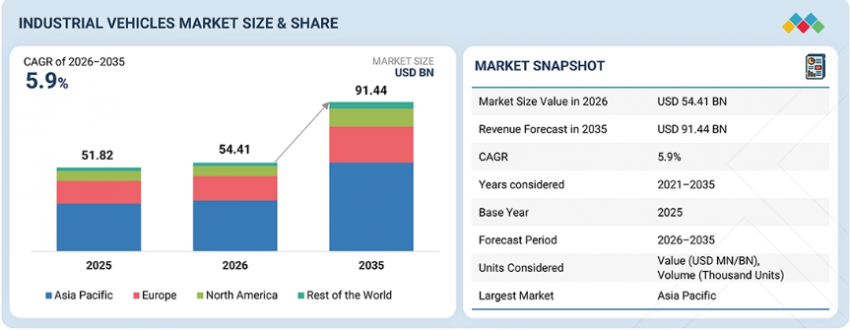
The global Industrial Vehicles Industry is undergoing significant transformation as manufacturing, warehousing, and logistics operations increasingly embrace automation, electrification, and digital connectivity. Industrial vehicles are evolving from conventional material handling equipment into intelligent, software-defined platforms capable of supporting autonomous operations, predictive maintenance, and real-time fleet management. The rapid expansion of e-commerce, smart warehouses, and advanced manufacturing facilities continues to create strong demand for next-generation industrial vehicles.
The Industrial Vehicles Industry size is projected to grow from USD 54.41 billion in 2026 to USD 91.44 billion by 2035, registering a CAGR of 5.9% during the forecast period. Growth is supported by increasing warehouse automation, electrification, software-defined vehicle architectures, and the adoption of intelligent material handling solutions across global industries.
Industrial Vehicles Industry Overview
Industrial vehicles are specialized machines designed for material handling, storage, transportation, and logistics operations across warehouses, factories, ports, airports, and distribution centers. The industry includes forklifts, aisle trucks, tow tractors, and container handlers, each designed to improve operational efficiency while reducing manual labor.
Modern industrial vehicles increasingly integrate telematics, IoT connectivity, AI-powered diagnostics, autonomous navigation, fleet optimization software, and over-the-air (OTA) updates. These technologies enable real-time monitoring, predictive maintenance, and seamless integration into smart warehouse ecosystems, making industrial vehicles essential components of Industry 4.0.
Software-Defined Industrial Vehicles Driving Industry Growth
One of the biggest drivers of the Industrial Vehicles Industry is the transition toward software-defined industrial vehicles (SDVs). Rather than functioning solely as mechanical equipment, modern industrial vehicles are becoming intelligent platforms capable of receiving software upgrades, collecting operational data, and supporting autonomous warehouse operations.
The emergence of connected fleets, predictive maintenance, and Vehicle-as-a-Service (VaaS) business models is helping businesses reduce total cost of ownership while improving fleet productivity and operational efficiency. Growing investments in digital transformation across manufacturing and logistics sectors are expected to further accelerate adoption.
Aisle Trucks Leading the Industrial Vehicles Industry
Aisle trucks are projected to account for the largest share of the Industrial Vehicles Industry during the forecast period. Their strong adoption in high-density warehouses, automated distribution centers, and e-commerce fulfillment facilities contributes significantly to market growth.
Reach trucks, order pickers, and very narrow aisle (VNA) trucks are increasingly equipped with telematics, fleet management software, and automation technologies that improve warehouse throughput while maximizing storage utilization. The continued expansion of modern warehouse infrastructure is expected to sustain demand for aisle trucks globally.
Download PDF Brochure @ https://www.marketsandmarkets.com/pdfdownloadNew.asp?id=164686137
Battery-Powered Industrial Vehicles Accelerating Market Demand
Battery-operated industrial vehicles are expected to witness strong adoption as companies prioritize sustainability, lower operating costs, and reduced emissions. Lithium-ion battery technology, faster charging systems, and improved battery management solutions are enabling industrial vehicles to operate more efficiently while minimizing downtime.
Electric forklifts, aisle trucks, and other battery-powered vehicles are increasingly replacing conventional internal combustion engine equipment, particularly in indoor warehouse environments where low emissions and quieter operation are essential.
Warehouse Automation and AI Transforming Material Handling
Warehouse automation remains one of the strongest trends shaping the Industrial Vehicles Industry. Artificial intelligence, autonomous navigation, IoT connectivity, autonomous mobile robots (AMRs), automated guided vehicles (AGVs), and predictive analytics are transforming warehouse operations by improving productivity, safety, and inventory accuracy.
Industrial vehicles are increasingly integrated with Warehouse Management Systems (WMS), Enterprise Resource Planning (ERP) platforms, and cloud-based fleet management software, enabling synchronized warehouse operations and real-time decision-making. These technologies are helping businesses optimize labor utilization while improving supply chain efficiency.
Manufacturing & E-commerce Driving Industrial Vehicle Adoption
Manufacturing facilities, logistics providers, and e-commerce fulfillment centers continue to represent the largest application areas for industrial vehicles. Rapid expansion of online retail has increased demand for high-performance material handling equipment capable of supporting fast-moving warehouse operations.
Growing investments in automated factories, smart logistics infrastructure, and connected manufacturing systems are expected to create new opportunities for industrial vehicle manufacturers throughout the forecast period.
Asia Pacific Leading the Industrial Vehicles Industry
Asia Pacific is expected to dominate the Industrial Vehicles Industry, supported by strong manufacturing activity, expanding warehouse infrastructure, and rapid e-commerce growth. China is projected to remain the largest regional market, while major manufacturers across Japan and China continue investing in battery-powered industrial vehicles, automation technologies, and factory expansion.
The region’s leadership in manufacturing, logistics, and warehouse development will continue driving demand for advanced industrial vehicles through 2035. Germany is expected to remain the leading market in Europe due to its strong industrial base and innovation in intralogistics technologies.
Future Outlook for the Industrial Vehicles Industry
The future of the Industrial Vehicles Industry will be defined by software-defined vehicles, electrification, autonomous warehouse operations, AI-powered fleet management, and connected industrial ecosystems. As manufacturing and logistics companies continue investing in digital transformation, industrial vehicles will become increasingly intelligent, efficient, and autonomous.
Growing adoption of battery-powered equipment, Vehicle-as-a-Service (VaaS), telematics, predictive maintenance, autonomous navigation, and smart warehouse technologies will create significant opportunities for OEMs, warehouse operators, logistics companies, and industrial automation providers. As a result, the Industrial Vehicles Industry is expected to witness sustained technological innovation, expanding market share, and robust global growth through 2035.
Request Free Sample Report @ https://www.marketsandmarkets.com/requestsampleNew.asp?id=164686137