
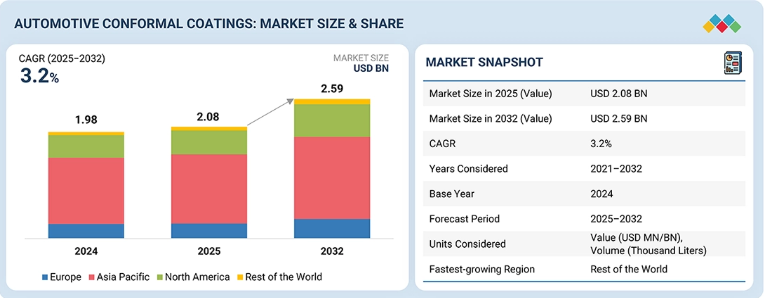
The Automotive Conformal Coatings Industry size is projected to grow from USD 2.08 billion in 2025 to USD 2.59 billion by 2032, registering a CAGR of 3.2% during the forecast period. Rising electrification, increasing semiconductor content per vehicle, and growing deployment of software-defined vehicle platforms are expected to drive sustained market growth.
The global Automotive Conformal Coatings Market is witnessing steady growth as vehicle manufacturers integrate increasingly sophisticated electronic systems into modern passenger and commercial vehicles. Advanced Driver Assistance Systems (ADAS), electric powertrains, infotainment systems, connected vehicle technologies, and software-defined vehicle architectures have significantly increased the number of electronic components that require reliable protection against moisture, dust, chemicals, corrosion, and thermal stress. Automotive conformal coatings play a vital role in improving the durability, safety, and long-term performance of these critical electronic assemblies.
Automotive Conformal Coatings Industry Overview
Automotive conformal coatings are thin polymeric protective films applied to printed circuit boards (PCBs), electronic control units (ECUs), sensors, battery management systems, LED modules, and infotainment electronics. These coatings provide insulation and protect electronic assemblies from humidity, salt spray, vibration, dust, chemicals, and temperature fluctuations that can reduce component reliability.
Manufacturers use materials such as acrylic, silicone, epoxy, polyurethane, and parylene to meet different performance requirements depending on operating environments. As vehicles become increasingly software-driven and electronics-intensive, conformal coatings have become an essential element of automotive electronics reliability.
Vehicle Electronics Driving Automotive Conformal Coatings Market Growth
The rapid increase in automotive electronics remains the primary growth driver of the Automotive Conformal Coatings Market. Modern vehicles incorporate numerous ECUs, high-density PCBs, sensors, power electronics, and communication modules that require protection throughout the vehicle lifecycle.
Growing adoption of connected vehicles, autonomous driving technologies, electrified powertrains, and digital cockpit systems continues increasing electronics content per vehicle. Automotive manufacturers are therefore investing in advanced coating technologies that enhance reliability while reducing maintenance costs and warranty claims.
As software-defined vehicles continue evolving, demand for high-performance conformal coatings is expected to increase significantly.
Acrylic Coatings Leading the Automotive Conformal Coatings Market
Acrylic coatings are expected to account for the largest Automotive Conformal Coatings Market share because they provide an excellent balance between performance, cost, process efficiency, and ease of rework. They offer effective protection against moisture, dust, and electrical leakage while supporting high-volume automotive manufacturing.
Their fast curing characteristics and compatibility with automated coating lines make acrylic coatings the preferred solution for protecting body electronics, infotainment systems, lighting modules, and numerous interior electronic assemblies. Continued expansion of electronics in mass-market passenger vehicles will support long-term demand for acrylic-based conformal coatings.
Download PDF Brochure @ https://www.marketsandmarkets.com/pdfdownloadNew.asp?id=11900039
PCB Protection Driving Market Demand
Printed Circuit Boards (PCBs) represent one of the fastest-growing application areas within the Automotive Conformal Coatings Market. Increasing use of compact multilayer PCBs across ADAS, infotainment, lighting, body electronics, battery management systems, and power electronics is creating strong demand for protective coating solutions.
Automotive PCB coatings improve insulation performance, reduce corrosion risk, and enhance long-term signal reliability under harsh environmental conditions. As PCB complexity increases across modern vehicles, conformal coatings will continue serving as a critical layer of electronics protection.
EVs, ADAS and Software-Defined Vehicles Accelerating Adoption
The expansion of electric vehicles and advanced driver assistance systems is accelerating adoption of automotive conformal coatings. High-voltage battery management systems, onboard chargers, traction inverters, domain controllers, radar modules, LiDAR systems, and centralized computing platforms all require durable protection against thermal cycling and environmental exposure.
Manufacturers are increasingly adopting silicone and parylene coatings for demanding EV applications where higher thermal stability and dielectric performance are required. The transition toward software-defined vehicles further increases demand for reliable electronics capable of supporting continuous software updates and long operating lifecycles.
Smart Manufacturing and Precision Coating Technologies
Automated selective coating systems, robotic dispensing, AI-powered quality inspection, and precision spray technologies are transforming automotive conformal coating production. Manufacturers are improving coating consistency, reducing material waste, and increasing production efficiency while meeting stringent automotive quality standards.
Advanced process monitoring and digital manufacturing technologies enable manufacturers to maintain precise coating thickness, improve traceability, and enhance overall product reliability. These innovations are expected to remain key trends throughout the forecast period.
Asia Pacific Leading the Automotive Conformal Coatings Market Share
Asia Pacific is expected to account for the largest Automotive Conformal Coatings Market share, supported by its leadership in passenger vehicle production, electric vehicle manufacturing, automotive electronics, and semiconductor supply chains. China, Japan, South Korea, and India continue investing heavily in vehicle electrification and electronics manufacturing, creating strong demand for automotive-grade conformal coatings.
The region’s expanding automotive production capacity and increasing adoption of ADAS and connected vehicle technologies will continue strengthening its market leadership through 2032.
Future Outlook for the Automotive Conformal Coatings Market
The future of the Automotive Conformal Coatings Market will be driven by software-defined vehicles, electric mobility, autonomous driving technologies, advanced automotive electronics, and increasing functional safety requirements. As vehicles become increasingly dependent on high-performance electronic systems, conformal coatings will remain essential for ensuring long-term durability, safety, and reliability.
Growing investments in EV electronics, high-density PCBs, intelligent coating materials, automated manufacturing, and next-generation automotive architectures will continue creating significant opportunities for coating manufacturers, OEMs, Tier-1 suppliers, and electronics companies. As a result, the Automotive Conformal Coatings Market is expected to witness sustained innovation, expanding market share, and steady global growth through 2032.
Request Free Sample Report @ https://www.marketsandmarkets.com/requestsampleNew.asp?id=11900039