
Global enterprises are entering a new era where multilingual communication has become a strategic necessity rather than an operational requirement. Businesses today operate across diverse markets, serving customers through websites, mobile applications, digital platforms, customer support channels, and regulatory documentation in multiple languages. The rapid expansion of global digital ecosystems has created enormous demand for faster, more accurate, and scalable localization solutions.
Traditional translation processes based on manual file transfers, disconnected workflows, and repetitive human intervention are struggling to support the complexity of modern business operations. Companies require localization systems capable of managing continuous content updates while maintaining consistency, accuracy, and brand identity across every customer interaction.
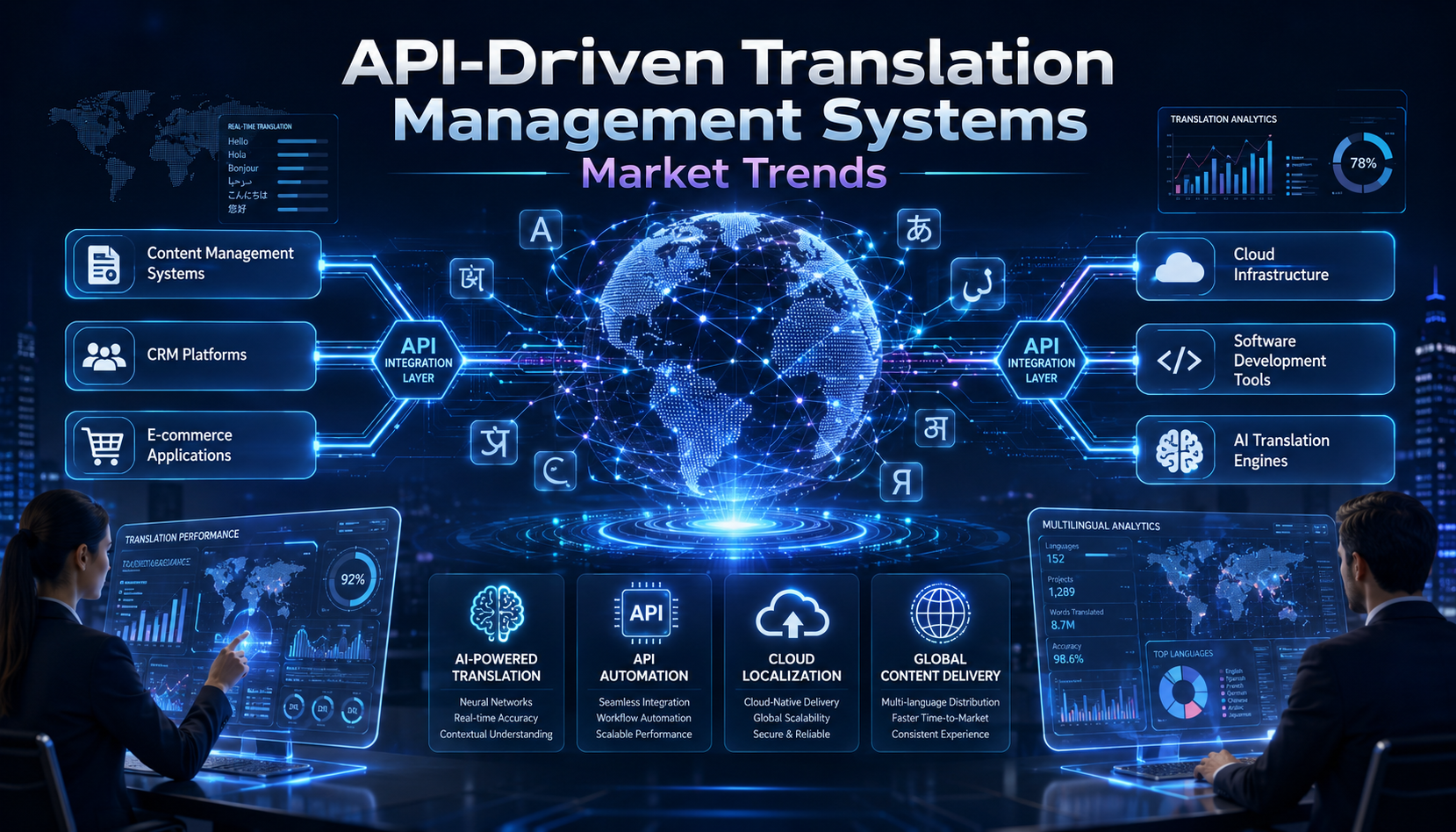
This transformation has accelerated the adoption of API-driven localization technologies. By connecting Translation Management Systems (TMS) with content management platforms, software development environments, customer relationship management tools, and e-commerce applications, enterprises can automate multilingual content workflows and significantly improve operational efficiency. As organizations continue their digital transformation initiatives, the Translation Management Systems Market is becoming an essential component of global content strategies.
Artificial intelligence, machine learning, cloud computing, and workflow automation are further reshaping enterprise localization. These technologies enable organizations to translate, review, optimize, and distribute content faster while reducing operational costs. As businesses focus on international expansion and personalized customer experiences, the Translation Management Systems Market growth trajectory continues to strengthen.
The Strategic Role of API-Driven Translation Management Systems
An API-driven Translation Management System creates a direct connection between enterprise applications and localization platforms through secure application programming interfaces. Unlike traditional methods that require manual exporting and importing of documents, API-based systems allow content to move automatically between business applications, translation engines, human reviewers, and publishing environments.
This connected approach creates a seamless localization ecosystem where organizations can manage multilingual content with greater speed and control. Content updates generated within websites, applications, marketing platforms, or digital products can automatically enter translation workflows, undergo quality checks, and reach global audiences with minimal delays.
Modern API-enabled platforms integrate with a wide range of enterprise technologies, including content management systems, e-commerce platforms, marketing automation solutions, software development tools, customer support applications, and digital asset management platforms. These integrations help organizations maintain terminology consistency, improve translation accuracy, and ensure compliance with regional requirements.
Artificial intelligence has become a major force behind the evolution of these platforms. AI-powered capabilities such as automated content classification, translation memory optimization, terminology management, quality assessment, and workflow prioritization allow businesses to handle large volumes of multilingual content more effectively.
The growing demand for intelligent and scalable localization solutions is also influencing the expansion of the Translation Management Systems Market size. Enterprises increasingly prefer cloud-based platforms that can integrate easily with existing technology infrastructures and support global operations without requiring complex deployment processes.
Why APIs Are Transforming Enterprise Localization
The modern enterprise landscape is built around constant content creation. Marketing teams launch international campaigns, software developers release frequent updates, customer service teams expand knowledge resources, and compliance departments produce region-specific documentation. Managing multilingual versions of this continuously changing content manually creates significant challenges.
API-driven translation solutions address these limitations by automating the movement of content between enterprise systems and localization platforms. New information can be identified, translated, reviewed, approved, and published through streamlined workflows. This reduces turnaround times while improving consistency across global digital experiences.
Beyond automation, API-driven systems provide organizations with centralized terminology control, improved visibility into localization projects, automated quality management, and stronger collaboration between business and language teams. These capabilities are transforming localization from a basic translation activity into a strategic business function.
The increasing importance of scalable localization infrastructure is shaping key Translation Management Systems Market trends. Companies expanding into new geographic regions require flexible platforms that support multilingual websites, digital commerce experiences, mobile applications, and customer engagement initiatives.
As global competition intensifies, organizations are recognizing that language accessibility directly influences customer satisfaction, brand perception, and market growth. API-powered Translation Management Systems provide the foundation needed to deliver consistent digital experiences across international markets while supporting continuous innovation.
Discover emerging business opportunities Download the PDF supported by extensive market research.
Major Trends Shaping the Translation Management Systems Market
The enterprise localization landscape is undergoing significant transformation as organizations adopt artificial intelligence, cloud-native technologies, and automated workflows. Businesses are moving away from traditional translation models toward intelligent localization ecosystems that can manage multilingual content continuously and efficiently.
Artificial intelligence has emerged as one of the most influential technologies driving this transformation. AI-powered translation engines, large language models (LLMs), neural machine translation, and automated quality evaluation tools are improving translation speed while reducing manual workloads. These innovations allow enterprises to scale global content operations without sacrificing accuracy or consistency.
The integration of generative AI is expected to further influence the Translation Management Systems Market outlook by enabling advanced language processing, contextual translation, and adaptive content optimization. Organizations can leverage AI-driven platforms to understand audience preferences, maintain brand voice, and deliver localized experiences tailored to different regions.
Cloud-based Translation Management Systems are also gaining strong adoption among enterprises. Software-as-a-Service (SaaS) platforms provide faster deployment, centralized collaboration, automatic updates, and seamless integration with existing business applications. These advantages make cloud-based solutions particularly attractive for organizations seeking flexible and scalable localization infrastructure.
Another major trend reshaping the industry is continuous localization. Instead of translating content in occasional batches, companies are embedding localization directly into software development, marketing operations, and digital publishing workflows. API-based automation enables organizations to update multilingual content rapidly, supporting faster product launches and improved customer engagement.
This Sample Report is designed to fuel your business growth download it today.
Enterprise Applications Across Multiple Industries
Technology companies represent some of the largest users of API-driven localization solutions. Software providers frequently release product updates, technical documentation, user interfaces, and customer support resources across multiple languages. Automated localization workflows help reduce release delays while ensuring consistent experiences for international users.
E-commerce organizations are also increasing investments in Translation Management Systems to support global digital commerce strategies. Retailers require accurate localization of product descriptions, pricing information, customer reviews, promotional campaigns, and payment interfaces. API integrations enable businesses to synchronize product data across multiple markets, helping them expand internationally with greater efficiency.
Financial institutions are adopting advanced localization platforms to manage multilingual banking applications, regulatory documents, customer communications, and compliance materials. Automated workflows improve accuracy, strengthen governance, and help financial organizations deliver consistent services across global markets.
Healthcare providers, government organizations, manufacturing companies, and educational institutions are similarly embracing intelligent localization technologies. From medical documentation and technical manuals to legal content and digital learning platforms, API-driven Translation Management Systems simplify multilingual communication while improving accessibility and operational performance.
These diverse industry applications continue to strengthen the Translation Management Systems Market growth potential as enterprises recognize localization as a critical component of digital transformation strategies.
Investment Opportunities and Market Expansion
The increasing demand for multilingual digital experiences is creating significant opportunities throughout the localization technology ecosystem. Software providers are expanding their capabilities through artificial intelligence, automation, cloud infrastructure, analytics, and enterprise integration solutions.
Leading companies in the Translation Management Systems Market are investing in advanced technologies to improve translation efficiency, workflow automation, and integration capabilities. Partnerships between localization providers, cloud platforms, content management vendors, and customer experience companies are creating comprehensive solutions designed for large-scale enterprise deployments.
The rise of global digital commerce, remote collaboration, and international customer engagement is expected to accelerate future market opportunities. Organizations seeking faster product launches, improved customer relationships, and streamlined operations are likely to increase investments in intelligent localization platforms.
Challenges Impacting Enterprise Localization Strategies
Despite technological advancements, enterprises continue to face challenges when implementing API-driven localization systems. Integrating Translation Management Systems with complex enterprise environments requires effective planning, standardized processes, and strong governance frameworks.
Legacy applications, fragmented data structures, and inconsistent workflows can create difficulties during implementation. Organizations must ensure that their localization platforms connect effectively with existing technology ecosystems while maintaining operational security and reliability.
Data protection is another critical concern. Enterprises handling sensitive financial documents, healthcare information, legal materials, and customer data must implement strong security measures throughout the translation lifecycle. Encryption, authentication protocols, access management, and continuous monitoring are becoming essential features for modern localization platforms.
Translation quality remains an important consideration as well. Although AI-based translation technologies have advanced considerably, many enterprise documents still require human expertise to maintain cultural relevance, technical accuracy, and brand consistency. Combining artificial intelligence with professional linguistic review has become a preferred approach for balancing speed and quality.
Future Outlook for the Translation Management Systems Market
The future of enterprise localization will be shaped by intelligent automation, generative AI, real-time translation capabilities, and API-first digital ecosystems. As organizations continue expanding globally, multilingual communication will become increasingly important for customer engagement, product innovation, and competitive differentiation.
Emerging technologies such as AI agents, predictive translation models, adaptive translation memory, and automated quality assessment are expected to redefine localization workflows. Enterprises will increasingly rely on intelligent platforms capable of managing translation processes with minimal human intervention while maintaining high standards of accuracy.
Cloud-native architectures, headless content management systems, and composable digital platforms will further accelerate adoption. API-driven integrations will allow organizations to connect localization processes directly with marketing platforms, customer relationship management systems, e-commerce solutions, and software development pipelines.
The Translation Management Systems Market forecast indicates continued expansion as businesses prioritize scalable localization strategies and global digital transformation. Companies that invest in secure API ecosystems, AI-powered automation, and flexible localization infrastructure will be better positioned to compete in an increasingly connected marketplace.
Key Industry Insights
Several important developments are shaping the future of enterprise localization:
- AI-powered translation and large language models are improving multilingual content efficiency and accuracy.
- API-first architectures are enabling continuous localization across enterprise applications.
- Cloud-based platforms are improving collaboration, scalability, and global deployment.
- Real-time localization is becoming essential for digital commerce, software development, and customer engagement.
- Growing enterprise adoption is expanding the Translation Management Systems Market share across industries including technology, healthcare, banking, retail, manufacturing, education, and government.
Conclusion
Multilingual communication has evolved into a strategic business capability that supports global expansion and customer engagement. Enterprises require localization platforms that integrate seamlessly with digital ecosystems while delivering speed, consistency, and operational efficiency.
API-driven Translation Management Systems are helping organizations overcome traditional localization challenges by automating workflows, improving translation quality, and enabling faster global content delivery. The continued adoption of artificial intelligence, cloud computing, and workflow automation is strengthening the Translation Management Systems Market and creating new opportunities for enterprises and technology providers.
As businesses continue operating in increasingly interconnected markets, intelligent localization infrastructure will become a fundamental driver of digital transformation. Organizations that embrace AI-powered translation, secure API integration, and scalable localization strategies will be better prepared to deliver meaningful multilingual experiences and achieve sustainable global growth.