
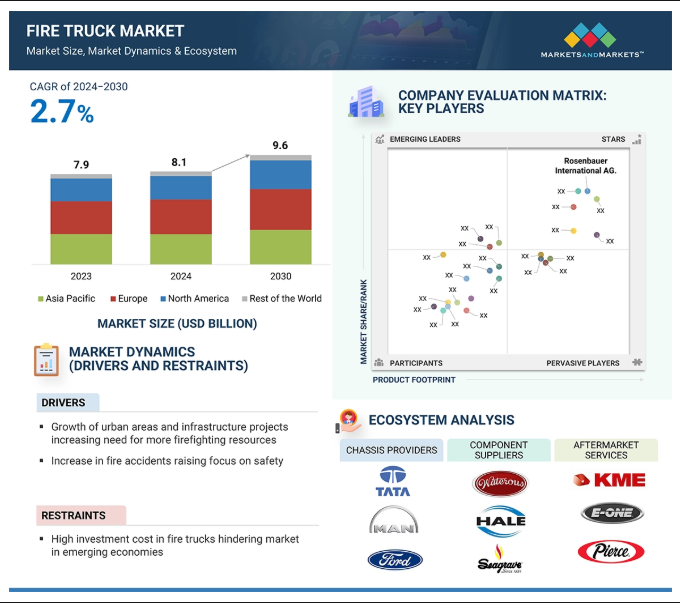
The Fire Truck Market size is projected to grow from USD 8.1 billion in 2024 to USD 9.6 billion by 2030, registering a CAGR of 2.7% during the forecast period. Increasing government investments, fleet replacement programs, technological advancements, and growing demand for specialized firefighting vehicles are expected to support long-term market growth.
The global Fire Truck Market is experiencing steady growth as governments and emergency service organizations continue investing in modern firefighting fleets to improve public safety and emergency response capabilities. Rapid urbanization, expanding infrastructure projects, increasing industrial development, and stricter fire safety regulations are creating sustained demand for advanced fire trucks equipped with intelligent firefighting technologies. Manufacturers are also introducing electric fire trucks, connected vehicle systems, and smart firefighting equipment to improve operational efficiency while reducing environmental impact.
Fire Truck Industry Overview
Fire trucks are specialized emergency response vehicles designed to transport firefighters, firefighting equipment, water, rescue tools, and emergency medical supplies to incident locations. The market includes engine pumper trucks, aerial ladder trucks, water tenders, airport rescue and firefighting (ARFF) vehicles, and hazardous materials (HazMat) response vehicles, each serving specific operational requirements across municipal, industrial, airport, and military applications.
Modern fire trucks integrate advanced pumping systems, aerial platforms, thermal imaging cameras, telematics, GPS navigation, smart communication systems, and digital fleet management technologies to improve response times and operational effectiveness. As emergency services increasingly adopt connected and intelligent vehicle platforms, fire trucks continue evolving into highly sophisticated emergency response solutions.
Urbanization and Fire Safety Regulations Driving Fire Truck Market Growth
Rapid urbanization and expanding infrastructure development remain the primary drivers of the Fire Truck Market. Growing populations, high-rise buildings, industrial facilities, logistics hubs, and commercial developments require advanced firefighting capabilities to respond effectively to increasingly complex emergencies.
Governments worldwide continue strengthening fire safety regulations while investing in fleet modernization programs to replace aging firefighting vehicles with technologically advanced alternatives. Increased public spending on emergency preparedness and disaster management is further supporting demand for next-generation fire apparatus.
As cities continue expanding and infrastructure investments increase, fire departments are expected to modernize their fleets with more capable emergency response vehicles.
Engine Pumper Fire Trucks Leading Market Demand
Engine pumper fire trucks are expected to account for the largest Fire Truck Market share due to their versatility across residential, commercial, industrial, and municipal firefighting operations. These vehicles combine water tanks, high-capacity pumps, hoses, ladders, and rescue equipment, enabling rapid response to a wide range of emergencies.
Fire departments continue investing in advanced pumper trucks equipped with digital pump controls, enhanced water delivery systems, improved maneuverability, and integrated communication technologies. Their ability to perform multiple emergency response functions makes them the backbone of firefighting operations worldwide.
Download PDF Brochure @ https://www.marketsandmarkets.com/pdfdownloadNew.asp?id=69483030
Electric Fire Trucks Transforming Emergency Response
Electric fire trucks are emerging as one of the most significant innovations within the Fire Truck Market. Battery-electric and hybrid fire trucks reduce emissions, lower operating costs, minimize noise, and improve energy efficiency while maintaining the performance required for emergency response operations.
Municipalities increasingly view electric firefighting vehicles as part of broader sustainability initiatives aimed at reducing the environmental impact of public service fleets. Improvements in battery technology, charging infrastructure, and electric powertrains are expected to accelerate adoption over the coming years.
The shift toward low-emission emergency vehicles is expected to create new growth opportunities for fire truck manufacturers.
Smart Firefighting Technologies Enhancing Operational Efficiency
Artificial intelligence, IoT connectivity, telematics, predictive maintenance, and real-time fleet management are transforming modern fire trucks into intelligent emergency response platforms. Connected systems enable fire departments to monitor vehicle health, equipment status, route optimization, water usage, and maintenance schedules in real time.
Thermal imaging cameras, drone integration, digital command systems, and advanced communication technologies further improve situational awareness and emergency coordination. These smart technologies enhance firefighter safety while improving operational efficiency and reducing equipment downtime.
The integration of intelligent digital technologies will continue shaping the future of emergency response vehicles.
Airport, Industrial and Municipal Fire Services Creating New Opportunities
Growing investments in airports, industrial facilities, oil & gas operations, ports, and manufacturing plants are creating significant demand for specialized firefighting vehicles such as Airport Rescue and Fire Fighting (ARFF) trucks and HazMat response vehicles. These specialized vehicles are designed to respond rapidly to high-risk incidents requiring advanced firefighting and rescue capabilities.
Municipal fire departments are also expanding their emergency response capabilities through fleet modernization programs that improve disaster preparedness, wildfire response, and urban firefighting efficiency.
The increasing need for specialized emergency vehicles across diverse industries is expected to support long-term market expansion.
Asia Pacific Leading the Fire Truck Market Share
Asia Pacific is expected to account for a significant Fire Truck Market share, driven by rapid urbanization, expanding infrastructure development, industrial growth, and increasing government investments in public safety. Countries including China, India, Japan, South Korea, and Southeast Asian economies continue strengthening emergency response capabilities through large-scale procurement of modern firefighting vehicles.
Growing commercial construction, smart city initiatives, airport expansion, and industrialization continue creating strong opportunities for fire truck manufacturers throughout the region.
Future Outlook for the Fire Truck Market
The future of the Fire Truck Market will be shaped by fleet modernization, electric propulsion, connected emergency response systems, artificial intelligence, predictive maintenance, and digital firefighting technologies. As governments and emergency service organizations continue investing in resilient public safety infrastructure, demand for advanced fire apparatus will continue to rise.
Growing investments in electric fire trucks, AI-enabled fleet management, smart firefighting equipment, autonomous safety technologies, and intelligent emergency communication systems will create significant opportunities for OEMs, municipal agencies, airport operators, industrial facilities, and emergency service providers. As a result, the Fire Truck Market is expected to witness continuous innovation, expanding market share, and sustainable global growth through 2030.
Request Free Sample Report @ https://www.marketsandmarkets.com/requestsampleNew.asp?id=69483030