
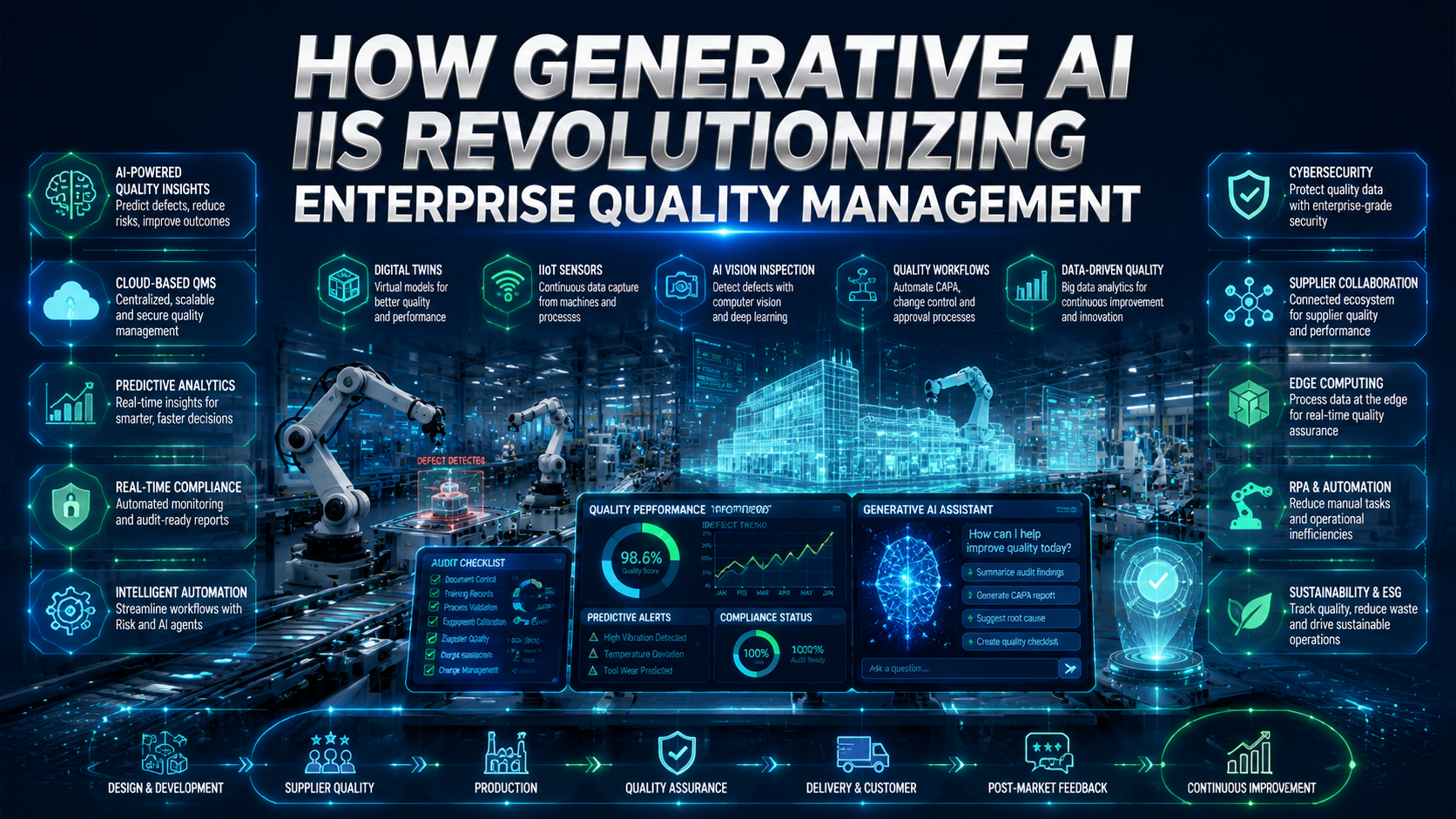
Enterprise quality management is undergoing a fundamental transformation as Artificial Intelligence (AI), cloud computing, automation, and data-driven decision-making redefine how organizations maintain product excellence and operational consistency. Traditional quality assurance methods are no longer sufficient to meet the demands of increasingly complex supply chains, accelerated product development cycles, and stricter regulatory requirements. Consequently, enterprises are embracing intelligent quality platforms that predict defects, automate compliance, and optimize performance throughout the product lifecycle.
This shift has elevated the Quality & Lifecycle Management Software Market into a strategic pillar of enterprise digital transformation. Across manufacturing, healthcare, automotive, aerospace, electronics, consumer goods, and life sciences, organizations are investing in AI-enabled quality management solutions to improve efficiency, strengthen compliance, and enhance customer satisfaction. Rather than serving as standalone operational tools, these platforms have become enterprise-wide systems that support continuous improvement and long-term business resilience.
Generative AI is accelerating this evolution by converting enterprise data into actionable intelligence. Modern AI models analyze structured and unstructured information, automate documentation, identify emerging quality risks, and recommend corrective actions in real time. Instead of replacing quality professionals, AI augments human expertise with predictive insights that improve decision-making, reduce manual effort, and deliver greater product consistency. This technological advancement continues to accelerate Quality & Lifecycle Management Software Market growth, creating new opportunities for software vendors, manufacturers, and enterprise technology providers.
Industry research also demonstrates the measurable value of AI-powered quality management. Organizations adopting intelligent quality platforms have reported inspection time reductions of up to 40%, improvements in defect detection exceeding 30%, and lower compliance costs through automated documentation and workflow optimization. These measurable outcomes continue strengthening the Quality & Lifecycle Management Software Market analysis, encouraging enterprises to prioritize intelligent quality management as a competitive business strategy rather than a compliance requirement.
Discover emerging business opportunities Download the PDF supported by extensive market research.
Why Generative AI Is Transforming Enterprise Quality Management
For decades, enterprise quality management relied heavily on manual inspections, scheduled audits, paper-based documentation, and reactive corrective actions. While these practices established strong quality foundations, they often struggle to address today’s dynamic manufacturing environments, global supply networks, and rapidly evolving customer expectations. Generative AI introduces a proactive approach by continuously learning from operational data and identifying potential quality issues before they affect production, compliance, or customer experience.
Modern AI-powered quality platforms can automatically generate inspection reports, summarize audit findings, recommend corrective actions, create compliance documentation, and assist engineers in identifying recurring production challenges. By integrating seamlessly with enterprise systems such as Enterprise Resource Planning (ERP), Manufacturing Execution Systems (MES), Product Lifecycle Management (PLM), and Industrial Internet of Things (IIoT) platforms, Generative AI delivers real-time visibility across manufacturing operations and product lifecycle activities. These capabilities continue reshaping Quality & Lifecycle Management Software Market trends, enabling organizations to transition from reactive quality assurance toward predictive quality management.
Another transformative benefit is intelligent knowledge management. Enterprises often possess decades of valuable engineering documents, quality records, standard operating procedures, supplier audits, and customer feedback that remain difficult to access efficiently. Generative AI converts these fragmented knowledge assets into searchable, context-aware repositories, enabling employees to retrieve relevant information instantly. This improves collaboration, accelerates employee onboarding, simplifies troubleshooting, and strengthens regulatory compliance while preserving institutional knowledge.
As a result, organizations increasingly recognize AI-powered quality management as a strategic business investment capable of improving operational excellence, reducing quality-related costs, accelerating innovation, and strengthening competitive advantage. The growing demand for intelligent enterprise platforms continues expanding the Quality & Lifecycle Management Software Market, positioning Generative AI as one of the most influential technologies shaping the future of enterprise quality management.
This Sample Report is designed to fuel your business growth download it today.
Current State of the Quality & Lifecycle Management Software Market
The Quality & Lifecycle Management Software Market is experiencing sustained expansion as enterprises prioritize digital transformation, operational excellence, and product innovation. Cloud-native quality platforms, predictive analytics, AI-powered automation, and intelligent workflow management are rapidly becoming core capabilities across enterprise software ecosystems. These technologies help organizations reduce operational risk, improve product consistency, accelerate time-to-market, and maintain regulatory compliance in increasingly competitive global markets.
The continued adoption of Industry 4.0, smart manufacturing, digital twins, Industrial IoT, and connected production environments is further strengthening the Quality & Lifecycle Management Software Market size. Enterprises now require integrated platforms that unify quality management, supplier collaboration, document control, product lifecycle management, compliance monitoring, risk assessment, and advanced analytics within a single intelligent environment. This integrated approach provides greater operational visibility while supporting faster and more informed business decisions.
Leading Quality & Lifecycle Management Software Market companies are responding by expanding their AI capabilities through strategic acquisitions, cloud partnerships, and industry-specific innovation. Vendors increasingly differentiate themselves by delivering predictive analytics, low-code automation, intelligent compliance management, and Generative AI-powered quality assistants that simplify enterprise operations. These continuous innovations are expected to reinforce the long-term Quality &Lifecycle Management Software Market outlook, enabling organizations worldwide to build more resilient, efficient, and data-driven quality management strategies.
AI-Powered Quality Control and Predictive Analytics
Generative AI is reshaping enterprise quality management by shifting organizations from reactive quality assurance to predictive, intelligence-driven operations. Conventional inspection processes often detect defects only after production, leading to expensive rework, production delays, and higher operational costs. AI-powered quality platforms eliminate many of these limitations by continuously analyzing production data, Industrial IoT sensor inputs, supplier performance metrics, and customer feedback to identify anomalies before they develop into significant quality issues.
Machine learning algorithms uncover hidden quality patterns that traditional inspection methods frequently overlook. When combined with computer vision, natural language processing, and predictive analytics, Generative AI enables automated defect detection, intelligent root cause analysis, and real-time quality recommendations. These capabilities improve manufacturing precision, reduce waste, and increase operational efficiency while reinforcing long-term Quality & Lifecycle Management Software Market growth across both discrete and process manufacturing industries.
Another major advantage is the automation of quality documentation. AI can generate inspection reports, audit summaries, compliance records, and corrective action plans with minimal human intervention. This not only reduces administrative effort but also improves regulatory traceability, accelerates reporting cycles, and enhances enterprise decision-making. As organizations increasingly adopt intelligent quality platforms, AI continues to strengthen the Quality & Lifecycle Management Software Market analysis, positioning predictive quality management as a core element of digital transformation.
Enterprise Use Cases Across Industries
The adoption of AI-powered quality management continues to expand across multiple industries, with each sector leveraging Generative AI to improve product quality, operational efficiency, and regulatory compliance.
Manufacturing
Manufacturers are integrating Artificial Intelligence with smart factories, Industrial IoT, robotics, and digital twins to monitor production lines in real time. AI continuously evaluates machine performance, predicts equipment failures, detects process deviations, and recommends corrective actions before defects occur. This proactive approach minimizes downtime, improves production efficiency, and strengthens overall product quality.
Automotive
Automotive manufacturers utilize Generative AI to enhance supplier quality management, warranty analytics, component inspection, and product lifecycle monitoring. AI-powered computer vision systems inspect thousands of components with remarkable speed and consistency, helping organizations reduce recalls, improve vehicle reliability, and optimize production processes.
Healthcare and Life Sciences
Medical device manufacturers and pharmaceutical companies depend on AI-driven quality platforms to automate compliance documentation, validate manufacturing processes, and support adherence to FDA, ISO, and GMP regulations. Intelligent document generation, automated risk assessments, and continuous quality monitoring simplify regulatory compliance while improving patient safety and operational efficiency.
Aerospace and Defense
Quality assurance remains mission-critical within aerospace and defense manufacturing. AI supports predictive maintenance, intelligent inspection workflows, engineering knowledge management, and supplier quality analytics, enabling organizations to enhance safety, reduce operational risk, and maintain strict regulatory standards throughout complex production environments.
Consumer Goods and Electronics
Consumer product manufacturers leverage Generative AI to accelerate product testing, evaluate customer feedback, monitor supplier performance, and improve quality across the entire product lifecycle. Faster quality validation and improved production consistency enable organizations to strengthen customer satisfaction while protecting brand reputation in highly competitive markets.
Market Statistics and Emerging Trends
Enterprise investment in AI-powered quality technologies continues to accelerate as organizations increasingly recognize quality management as a strategic driver of innovation rather than simply a compliance requirement.
Several transformative trends continue shaping the Quality & Lifecycle Management Software Market:
- Rapid adoption of cloud-native Quality Management Systems (QMS)
- Expansion of AI-powered predictive quality analytics
- Growth of Industry 4.0 and smart manufacturing initiatives
- Integration of digital twins with enterprise quality platforms
- Rising demand for low-code and no-code quality applications
- Automated compliance management and intelligent document generation
- Expansion of supplier quality collaboration ecosystems
- Increased investment in ESG reporting and sustainable manufacturing initiatives
Collectively, these innovations continue strengthening Quality & Lifecycle Management Software Market share by enabling organizations to modernize quality operations through intelligent automation, cloud collaboration, and data-driven decision-making.
Strategic Investment Opportunities
The rapid advancement of enterprise AI is creating substantial opportunities for investors, software developers, manufacturers, and technology providers participating in the Quality & Lifecycle Management Software Market.
AI-Powered Quality Platforms
Organizations increasingly seek intelligent platforms capable of automating inspections, predicting quality risks, generating compliance documentation, and improving enterprise decision-making. This sustained demand continues driving investment in AI-enabled quality management technologies.
Cloud-Based Quality Management
Cloud adoption remains one of the strongest catalysts for market expansion. Enterprises are migrating to Software-as-a-Service (SaaS) quality platforms to improve scalability, cybersecurity, remote collaboration, and operational flexibility while reducing infrastructure costs. This transition continues supporting long-term Quality & Lifecycle Management Software Market size expansion.
Digital Manufacturing and Smart Factories
The convergence of Artificial Intelligence, Industrial IoT, robotics, edge computing, and digital twins is accelerating demand for fully integrated quality management ecosystems. Organizations investing in connected manufacturing environments are expected to realize significant operational improvements and long-term business value.
Advanced Analytics and Business Intelligence
Enterprise data has become a strategic business asset. AI-powered analytics, predictive dashboards, supplier performance intelligence, and automated reporting solutions continue strengthening the Quality & Lifecycle Management Software Market report, enabling executives to make faster, data-driven decisions that improve operational resilience and competitive performance.
As digital transformation accelerates across global industries, continued investment in intelligent quality technologies will create new opportunities for enterprise software vendors, manufacturing organizations, and technology investors while further strengthening the Quality & Lifecycle Management Software Market.
Challenges Slowing Enterprise Adoption
While Generative AI is transforming enterprise quality management, successful implementation requires organizations to overcome several operational and technological challenges. Many enterprises continue to depend on fragmented legacy systems that restrict data visibility and complicate integration with modern cloud platforms. Migrating decades of quality records, engineering documentation, and compliance data into AI-enabled environments demands careful planning, investment, and executive commitment.
Data quality remains another critical factor. AI models are only as effective as the information they process, making strong data governance essential for generating reliable insights. Organizations must establish standardized data management practices, strengthen cybersecurity, and ensure compliance with evolving industry regulations to maximize the value of AI-driven quality management.
The shortage of professionals with expertise in Artificial Intelligence, cloud technologies, quality engineering, and advanced analytics also presents a significant barrier. Enterprises are increasingly addressing this challenge through workforce upskilling, strategic partnerships, and managed AI services. These factors continue shaping the Quality & Lifecycle Management Software Market analysis, encouraging software providers to deliver intuitive, low-code, and AI-assisted platforms that simplify enterprise adoption.
Future Outlook and Market Forecast
The long-term Quality & Lifecycle Management Software Market outlook remains highly positive as organizations accelerate digital transformation and modernize quality operations. Enterprises are shifting from reactive quality control to predictive, intelligence-driven quality ecosystems that improve efficiency, compliance, and business resilience.
Several structural trends are expected to influence the Quality & Lifecycle Management Software Market forecast over the coming years:
- Rapid adoption of Generative AI and machine learning across enterprise operations.
- Continued expansion of cloud-native Quality Management Systems (QMS).
- Greater integration of Digital Twins, Industrial IoT, and connected manufacturing.
- Increased deployment of predictive analytics and intelligent automation.
- Rising demand for ESG reporting and sustainable manufacturing initiatives.
- Stronger investment in cybersecurity, regulatory compliance, and supplier collaboration.
These developments are expected to sustain Quality & Lifecycle Management Software Market growth across manufacturing, automotive, healthcare, aerospace, electronics, consumer goods, and life sciences. As AI becomes embedded within enterprise quality strategies, organizations will achieve greater operational agility, faster innovation cycles, and improved customer satisfaction.
Leading Companies Driving Innovation
Competition within the Quality & Lifecycle Management Software Market is intensifying as software providers expand AI capabilities, cloud services, and industry-specific solutions. Leading Quality & Lifecycle Management Software Market companies are investing heavily in Generative AI, predictive analytics, workflow automation, and cloud-native architectures to help enterprises accelerate digital quality transformation.
Strategic acquisitions, technology partnerships, and product innovation continue reshaping the competitive landscape. Vendors that combine AI-powered analytics, scalable cloud infrastructure, cybersecurity, and intelligent automation into integrated enterprise platforms will be best positioned to increase Quality & Lifecycle Management Software Market share while delivering measurable business value.
Strategic Recommendations for Enterprise Leaders
Enterprise leaders should approach quality management as a strategic growth initiative rather than a compliance requirement. Organizations that integrate AI into quality operations will be better positioned to improve productivity, reduce operational risk, and accelerate innovation.
Key priorities include:
- Develop an AI-first quality management roadmap aligned with business objectives.
- Modernize legacy systems using cloud-native quality management platforms.
- Integrate ERP, PLM, MES, Industrial IoT, and analytics into a unified digital ecosystem.
- Expand predictive analytics and intelligent automation across quality workflows.
- Strengthen cybersecurity, governance, and regulatory compliance frameworks.
- Invest in employee training for AI, digital engineering, and advanced analytics.
- Establish continuous improvement programs supported by real-time performance intelligence.
These initiatives enable organizations to reduce costs, improve product quality, enhance customer trust, and create sustainable competitive advantage.
Generative AI is redefining enterprise quality management by transforming manual, reactive processes into intelligent, predictive, and data-driven operations. From automated documentation and defect prediction to real-time analytics and compliance management, AI empowers organizations to improve operational efficiency while consistently delivering higher-quality products and services.
The continued evolution of the Quality & Lifecycle Management Software Market highlights the growing importance of intelligent technologies within enterprise digital transformation. As Artificial Intelligence, cloud computing, Industry 4.0, Digital Twins, predictive analytics, and intelligent automation converge, enterprises will increasingly rely on advanced quality platforms to strengthen resilience, accelerate innovation, and improve business performance.
The latest Quality & Lifecycle Management Software Market report indicates that organizations investing in AI-powered quality management will be better equipped to optimize manufacturing processes, strengthen regulatory compliance, reduce operational risks, and support long-term growth. As innovation continues to reshape the industry, the Quality & Lifecycle Management Software Market size, Quality & Lifecycle Management Software Market forecast, and investment potential are expected to expand steadily, creating significant opportunities for technology providers, enterprise customers, and investors. Enterprises that embrace AI-driven quality management today will be better positioned to lead tomorrow’s intelligent, data-centric manufacturing economy.