
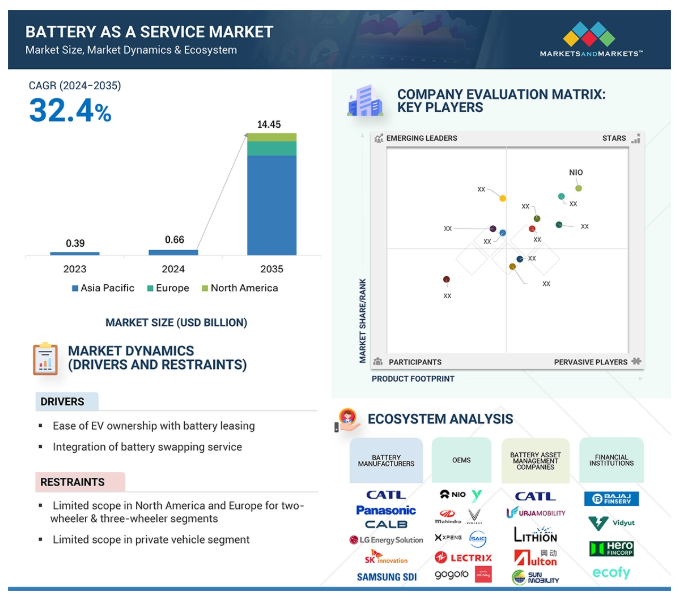
The battery as a service market size is projected to grow from USD 0.66 billion in 2024 to USD 14.45 billion by 2035, registering a robust CAGR of 32.4% during the forecast period. Growing electric vehicle adoption, expanding battery swapping infrastructure, government incentives, and advancements in battery lifecycle management are expected to drive long-term battery as a service market growth.
The global battery as a service market is witnessing remarkable growth as the automotive industry shifts toward flexible ownership models that reduce the upfront cost of electric vehicles. Battery as a Service (BaaS) separates battery ownership from vehicle ownership, enabling consumers and fleet operators to lease batteries through subscription or pay-per-use models. This innovative approach improves EV affordability while addressing concerns surrounding battery degradation, replacement costs, and residual value.
Battery as a Service Industry Overview
Battery as a Service is an innovative business model that allows EV owners to subscribe to or lease batteries instead of purchasing them as part of the vehicle. The model significantly lowers the initial purchase price of electric vehicles while giving users access to battery upgrades, maintenance, and replacement services throughout the battery’s lifecycle.
Battery as a Service also enables efficient battery utilization by supporting battery swapping, predictive maintenance, second-life applications, and battery recycling. As EV adoption accelerates globally, manufacturers, mobility providers, and energy companies are increasingly investing in BaaS platforms to improve affordability and enhance customer convenience.
The growing focus on sustainable transportation and circular battery management is expected to strengthen the Battery as a Service industry over the coming decade.
Rising EV Adoption Driving Battery as a Service Market Growth
The rapid adoption of electric vehicles is the primary growth driver of the battery as a service market. Consumers increasingly seek affordable EV ownership options, while fleet operators aim to reduce capital expenditure and improve vehicle utilization.
Battery leasing eliminates one of the largest cost components of an electric vehicle, making EVs more accessible to a broader customer base. Governments across several countries are also supporting battery leasing and battery swapping through subsidies, incentives, and EV infrastructure investments.
As global EV sales continue expanding, Battery as a Service is expected to become a key enabler of mass electric mobility adoption.
Battery Leasing Reducing Electric Vehicle Ownership Costs
Battery leasing has become one of the most attractive trends within the Battery as a Service market. By separating battery ownership from vehicle ownership, consumers can significantly reduce the purchase price of an electric vehicle while paying a predictable monthly subscription fee.
This model also transfers battery maintenance, performance monitoring, replacement, and end-of-life management to the service provider. Consumers benefit from lower financial risk, while service providers maximize battery utilization through asset management and second-life applications.
As EV affordability becomes increasingly important, battery leasing is expected to remain a major contributor to market growth.
Download PDF Brochure @ https://www.marketsandmarkets.com/pdfdownloadNew.asp?id=164666806
Battery Swapping Infrastructure Accelerating Market Expansion
Battery swapping is emerging as one of the most important developments within the Battery as a Service market. Instead of waiting for batteries to recharge, drivers can exchange depleted batteries for fully charged units within minutes, significantly reducing vehicle downtime.
Battery swapping is particularly attractive for commercial fleets, ride-hailing services, logistics operators, and two- and three-wheelers that require continuous vehicle availability. Expanding battery swap station networks are improving operational efficiency while accelerating electric vehicle adoption across urban markets.
Growing investments in standardized battery technologies and swapping infrastructure are expected to create substantial opportunities throughout the forecast period.
Passenger Cars Leading Battery as a Service Market Share
Passenger cars are expected to account for the largest share of the Battery as a Service market due to rising global EV adoption and increasing consumer preference for flexible ownership models. Several leading automakers now offer battery subscription options that reduce upfront vehicle costs while providing access to battery upgrades and maintenance services.
Battery leasing has become particularly attractive in markets where consumers prioritize affordability and long-term ownership flexibility. As manufacturers continue expanding their electric passenger vehicle portfolios, battery subscription models are expected to gain broader acceptance.
Private EV Users Fueling Battery as a Service Demand
Private vehicle owners are expected to represent the largest usage segment within the Battery as a Service market. Rising disposable income, expanding EV model availability, and increasing awareness of battery leasing benefits are encouraging individual consumers to adopt subscription-based battery services.
Battery as a Service also helps alleviate concerns regarding battery degradation, resale value, and future technology upgrades. Consumers can benefit from newer battery technologies without replacing their vehicles, making electric mobility more affordable and future-proof.
Growing consumer confidence in battery leasing is expected to support long-term market expansion.
North America Emerging as a High-Growth Battery as a Service Market
North America is expected to witness significant growth in the Battery as a Service market due to rising electric vehicle adoption, expanding charging infrastructure, and supportive government incentives. Fleet electrification initiatives, growing investments in battery technologies, and partnerships between automakers and energy companies are accelerating market development.
Increasing commercial fleet electrification, growing demand for sustainable transportation, and continuous improvements in battery technologies are expected to strengthen North America’s position as one of the fastest-growing regional markets during the forecast period.
Future Outlook for the Battery as a Service Market
The future of the battery as a service market will be shaped by battery leasing, battery swapping infrastructure, advanced battery management systems, circular economy initiatives, and the continued expansion of electric mobility. As automakers increasingly introduce subscription-based ownership models and governments continue supporting EV adoption, Battery as a Service will become an integral part of the global electric vehicle ecosystem.
Growing investments in battery asset management, second-life battery applications, intelligent energy management, battery recycling, and digital mobility services will continue creating significant opportunities for automakers, battery manufacturers, mobility providers, and energy companies. As a result, the Battery as a Service market is expected to witness exceptional innovation, rapid market expansion, and sustained global growth through 2035.
Request Free Sample Report @ https://www.marketsandmarkets.com/requestsampleNew.asp?id=164666806