
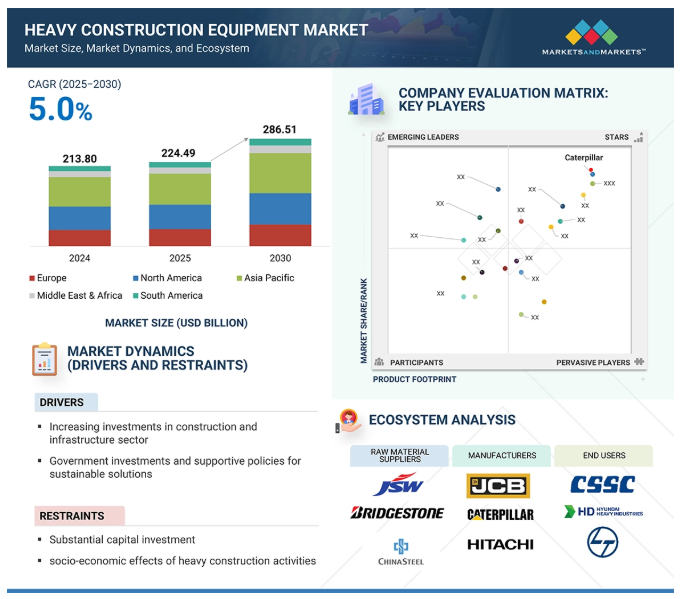
The heavy construction equipment market size is projected to grow from USD 160.11 billion in 2026 to USD 226.91 billion by 2033, registering a CAGR of 5.1% during the forecast period. Increasing investments in smart infrastructure, mining expansion, electrification, and digital construction technologies are expected to drive long-term heavy construction equipment market growth.
The global heavy construction equipment market is expanding steadily as governments and private developers invest in transportation infrastructure, mining operations, renewable energy projects, and urban development. Modern construction projects demand highly productive, fuel-efficient, and technologically advanced equipment capable of improving operational efficiency while reducing project timelines and operating costs.
Heavy Construction Equipment Industry Overview
Heavy construction equipment includes a broad range of machinery such as excavators, wheel loaders, bulldozers, dump trucks, cranes, compactors, graders, and material handling equipment used across construction, mining, quarrying, road development, and infrastructure projects.
Modern construction machinery integrates advanced hydraulics, telematics, GPS guidance, machine control systems, artificial intelligence, and predictive maintenance technologies to improve productivity and reduce equipment downtime. Manufacturers are also focusing on electrification, fuel efficiency, operator safety, and autonomous capabilities to meet evolving customer requirements and environmental regulations.
As infrastructure spending increases worldwide, heavy construction equipment continues to play a critical role in supporting economic development and large-scale engineering projects.
Infrastructure Development Driving Heavy Construction Equipment Market Growth
Infrastructure development remains the primary driver of the heavy construction equipment market. Governments worldwide are investing in highways, railways, airports, ports, bridges, industrial facilities, and smart city projects to stimulate economic growth and improve transportation networks.
Large-scale public infrastructure programs require earthmoving equipment, cranes, loaders, and heavy vehicles capable of handling demanding construction activities efficiently. Rising investments in renewable energy infrastructure, including wind farms, solar parks, and hydroelectric projects, are also creating additional demand for heavy machinery.
As infrastructure modernization accelerates globally, demand for advanced construction equipment is expected to remain strong.
Earthmoving Equipment Leading the Heavy Construction Equipment Market
Earthmoving equipment is expected to account for the largest share of the heavy construction equipment market. Excavators, wheel loaders, bulldozers, motor graders, and dump trucks are extensively used for excavation, grading, material handling, demolition, and site preparation across construction and mining projects.
Manufacturers continue introducing more fuel-efficient machines equipped with intelligent hydraulic systems, advanced operator assistance features, and digital machine control technologies. These innovations improve productivity while lowering fuel consumption and maintenance costs.
The growing demand for earthmoving machinery across infrastructure and mining applications will continue supporting market expansion throughout the forecast period.
Download PDF Brochure @ https://www.marketsandmarkets.com/pdfdownloadNew.asp?id=1211
Electric Heavy Construction Equipment Transforming the Industry
Electrification is emerging as one of the most significant trends within the heavy construction equipment market. Electric excavators, wheel loaders, compactors, and dump trucks are gaining traction as contractors seek lower emissions, reduced operating costs, and quieter equipment for urban construction projects.
Advances in lithium-ion battery technology, electric drivetrains, and fast-charging infrastructure are enabling manufacturers to introduce larger electric construction machines capable of handling demanding workloads. These machines also support sustainability goals by reducing greenhouse gas emissions and improving energy efficiency.
As governments introduce stricter emissions standards, electric heavy construction equipment is expected to become an increasingly important growth segment.
Smart Construction Technologies and Telematics Improving Productivity
Digital transformation is reshaping the heavy construction equipment industry through the adoption of telematics, IoT connectivity, GPS machine guidance, predictive maintenance, and autonomous operation.
Connected equipment enables fleet managers to monitor machine health, fuel consumption, location, productivity, and maintenance schedules in real time. Intelligent machine control systems improve grading accuracy, excavation precision, and overall project efficiency while reducing operator fatigue.
The integration of construction equipment telematics, AI-powered analytics, and automation is expected to remain one of the most important trends influencing the heavy construction equipment market.
Mining and Infrastructure Projects Fueling Equipment Demand
Mining continues to be one of the fastest-growing application areas for heavy construction equipment. Surface mining, quarrying, mineral extraction, and large-scale earthmoving operations require durable, high-capacity equipment capable of operating in harsh environments.
At the same time, infrastructure investments in highways, railways, airports, industrial parks, and energy facilities continue supporting demand for excavators, dump trucks, cranes, and loaders. Increasing project complexity is encouraging contractors to adopt technologically advanced machinery that improves productivity while minimizing project delays.
Growing investments in mining and infrastructure are expected to create long-term opportunities for equipment manufacturers worldwide.
Asia Pacific Leading the Heavy Construction Equipment Market Share
Asia Pacific is expected to account for the largest heavy construction equipment market share, driven by rapid urbanization, infrastructure development, mining expansion, and strong manufacturing capabilities. China, India, Japan, South Korea, and Southeast Asian countries continue investing heavily in transportation infrastructure, renewable energy, industrial development, and smart city projects.
The presence of major OEMs, expanding equipment manufacturing facilities, and increasing adoption of advanced construction technologies further strengthens the region’s leadership position. Rising demand for electric construction equipment and connected machinery is also accelerating regional market growth.
Future Outlook for the Heavy Construction Equipment Market
The future of the heavy construction equipment market will be shaped by electrification, autonomous construction machinery, intelligent fleet management, telematics, artificial intelligence, and sustainable construction practices. As governments continue investing in infrastructure modernization and contractors adopt digital technologies to improve productivity, demand for advanced heavy equipment will continue to rise.
Growing investments in electric construction equipment, smart machine control, autonomous operation, predictive maintenance, and connected construction ecosystems will create significant opportunities for OEMs, component suppliers, and technology providers. As a result, the heavy construction equipment market is expected to witness sustained innovation, expanding market share, and steady global growth through 2033.
Request Free Sample Report @ https://www.marketsandmarkets.com/requestsampleNew.asp?id=1211