
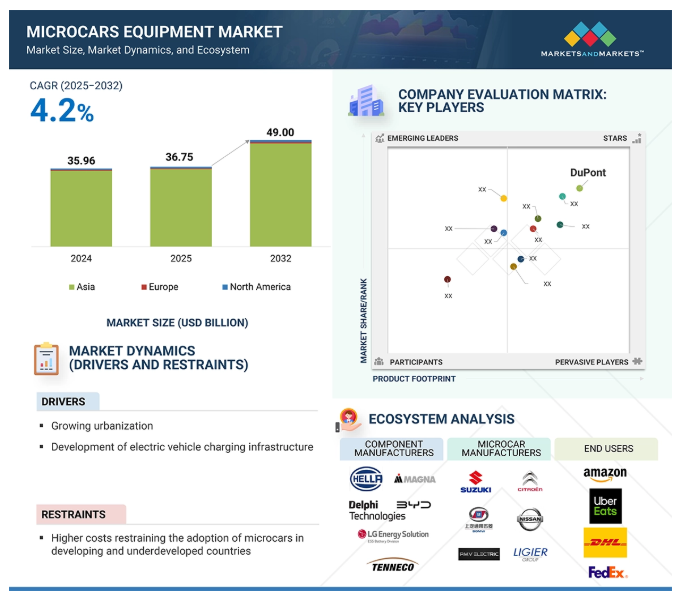
The microcars market size is projected to grow from USD 36.75 billion in 2025 to USD 49.00 billion by 2032, registering a CAGR of 4.2% during the forecast period. Rising urbanization, increasing demand for electric mobility, and growing investments in smart transportation infrastructure are expected to drive sustained microcars market growth worldwide.
The global microcars market is gaining momentum as cities become more congested, environmental regulations become stricter, and consumers increasingly seek affordable, compact, and energy-efficient mobility solutions. Microcars are emerging as an ideal transportation option for urban environments due to their small footprint, lower operating costs, and ease of maneuverability. Advancements in electric propulsion, connected technologies, and lightweight vehicle design are further accelerating the adoption of microcars across developed and emerging markets.
Microcars Industry Overview
Microcars are compact passenger vehicles designed primarily for short-distance urban transportation. This category includes Kei cars, A00 vehicles, neighborhood electric vehicles (NEVs), and quadricycles, offering consumers an economical alternative to conventional passenger cars. Their compact dimensions, lower maintenance costs, and improved energy efficiency make them well suited for densely populated cities where parking availability and traffic congestion remain major challenges.
Modern microcars increasingly feature electric powertrains, connected infotainment systems, advanced safety technologies, and digital connectivity. Manufacturers are continuously introducing innovative models that combine affordability with enhanced comfort and intelligent mobility features, making microcars an attractive solution for personal transportation and shared mobility services.
Urbanization Driving Microcars Market Growth
Rapid urbanization is one of the strongest drivers of the microcars market. As cities continue to expand, traffic congestion, limited parking spaces, and increasing transportation costs are encouraging consumers to adopt smaller, more efficient vehicles.
Microcars offer practical solutions for daily commuting by reducing fuel consumption, simplifying parking, and improving maneuverability in crowded urban environments. Governments are also encouraging compact vehicle adoption through smart city initiatives, urban mobility programs, and low-emission transportation policies.
The continued growth of urban populations is expected to remain a major factor supporting microcars market growth during the forecast period.
Download PDF Brochure @ https://www.marketsandmarkets.com/pdfdownloadNew.asp?id=117059235
Electric Microcars Accelerating Sustainable Mobility
Electric microcars are emerging as one of the fastest-growing segments within the microcars market. Battery-electric powertrains provide zero tailpipe emissions, lower operating costs, and quiet operation, making them ideal for urban transportation.
Continuous improvements in battery technology, charging infrastructure, and vehicle efficiency are enabling electric microcars to deliver sufficient driving range for everyday city commuting. Many governments are also offering incentives to promote electric vehicle adoption, further strengthening demand for compact electric mobility solutions.
As global efforts to reduce carbon emissions intensify, electric microcars are expected to play an increasingly important role in sustainable transportation systems.
Kei Cars and Quadricycles Creating New Market Opportunities
Kei cars in Japan and quadricycles in Europe are among the fastest-growing categories within the microcars market. Kei cars continue to gain popularity because of their affordability, tax advantages, fuel efficiency, and suitability for urban environments.
Similarly, quadricycles, particularly electric L7 models, are experiencing growing demand due to regulatory support, improved performance, and increasing adoption among young urban consumers. These lightweight vehicles offer an effective balance between compact size, practicality, and environmental sustainability.
The growing popularity of both vehicle categories is expected to create significant opportunities for automotive manufacturers and mobility providers.
Connected Technologies Transforming the Microcars Industry
Connected vehicle technologies are transforming the microcars industry by improving convenience, safety, and user experience. Modern microcars increasingly integrate smartphone connectivity, navigation systems, remote vehicle monitoring, digital instrument clusters, and intelligent driver assistance features.
Automakers are also exploring width-adjustment technologies, over-the-air software updates, and connected mobility platforms to enhance vehicle functionality while maintaining compact vehicle dimensions. These innovations are helping microcars compete more effectively with larger passenger vehicles in urban transportation markets.
The integration of digital technologies is expected to become a major trend shaping the future of the microcars market.
Personal Mobility Driving Market Demand
Personal transportation accounts for the largest share of the microcars market as consumers increasingly prefer compact vehicles for daily commuting and short-distance travel. Microcars are particularly attractive to urban residents due to their affordability, low maintenance costs, and ease of parking.
Growing interest in second household vehicles, sustainable commuting, and low-cost mobility solutions is further supporting demand. Additionally, younger drivers and senior citizens are increasingly adopting microcars because of their convenience and accessibility.
As urban lifestyles continue evolving, personal mobility applications are expected to remain the dominant end-use segment.
Asia Pacific Leading the Microcars Market Share
Asia Pacific is expected to account for the largest microcars market share, driven by high demand for Chinese A00 vehicles and Japanese Kei cars. China and Japan together dominate regional sales, supported by strong automotive manufacturing capabilities, growing urban populations, expanding charging infrastructure, and increasing adoption of electric mobility.
India is also witnessing growing interest in quadricycles and compact electric vehicles as urban transportation requirements evolve. Rising disposable incomes, government support for electric mobility, and investments in smart cities are expected to further strengthen regional market growth.
Asia Pacific is expected to maintain its leadership position throughout the forecast period due to continued innovation and large-scale vehicle production.
Future Outlook for the Microcars Market
The future of the microcars market will be driven by urbanization, electric mobility, connected vehicle technologies, smart city initiatives, and sustainable transportation policies. As consumers increasingly prioritize affordability, efficiency, and environmentally friendly mobility, microcars will become an integral part of future urban transportation ecosystems.
Growing investments in battery technology, intelligent connectivity, shared mobility platforms, and lightweight vehicle engineering will continue creating opportunities for automakers and technology providers. As a result, the microcars market is expected to witness sustained innovation, expanding market share, and steady global growth through 2032.
Request Free Sample Report @ https://www.marketsandmarkets.com/requestsampleNew.asp?id=117059235