
The global biofertilizers market is witnessing remarkable growth as the agricultural sector shifts toward sustainable and environmentally friendly farming practices. Growing concerns over soil degradation, excessive chemical fertilizer use, and the need to improve crop productivity have accelerated the adoption of microbial-based crop nutrition solutions. Biofertilizers not only enhance nutrient availability but also improve soil health, making them an essential component of modern agriculture.
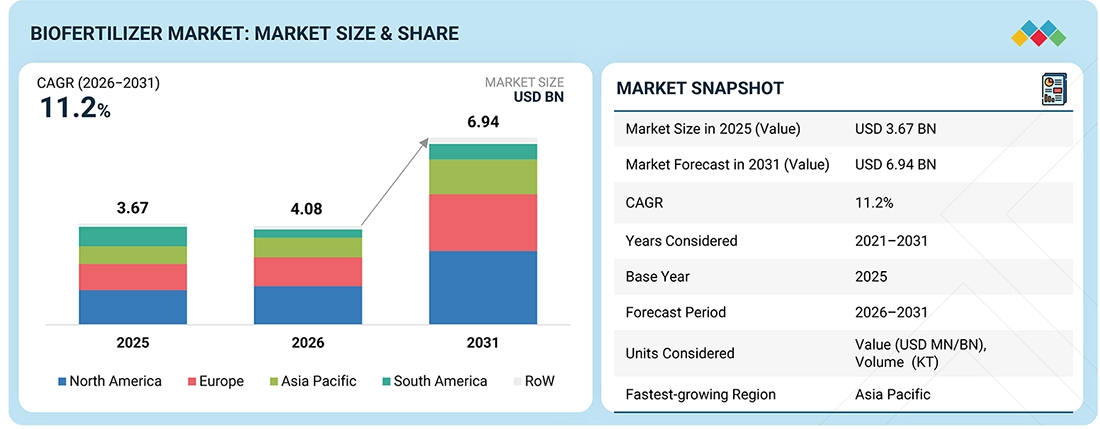
According to industry estimates, the biofertilizers market is projected to grow from USD 4.08 billion in 2026 to USD 6.94 billion by 2031, registering a CAGR of 11.2% during the forecast period.
What is Driving the Growth of the Biofertilizers Market?
The increasing demand for sustainable agricultural inputs is one of the primary factors fueling market expansion. Farmers worldwide are looking for alternatives that reduce dependence on synthetic fertilizers while maintaining high crop yields and improving soil fertility.
Biofertilizers contain beneficial microorganisms that naturally improve nutrient availability by fixing atmospheric nitrogen, solubilizing phosphorus, mobilizing potassium, and enhancing root growth. These biological solutions contribute to long-term soil health while minimizing environmental impacts associated with chemical fertilizers.
Several factors are supporting market growth, including:
- Growing adoption of sustainable and regenerative agriculture
- Rising demand for organic food production
- Increasing awareness of soil health restoration
- Expansion of integrated nutrient management programs
- Government initiatives promoting eco-friendly farming practices
- Greater focus on reducing carbon emissions in agriculture
As agricultural producers continue adopting environmentally responsible farming techniques, biofertilizers are becoming an important component of crop nutrition strategies across both developed and emerging economies.
Download PDF Brochure: https://www.marketsandmarkets.com/pdfdownloadNew.asp?id=856
Why Biofertilizers are Becoming Essential in Modern Agriculture
Modern agriculture faces the challenge of increasing food production while preserving natural resources. Continuous use of chemical fertilizers has led to declining soil fertility, reduced microbial diversity, and environmental concerns.
Biofertilizers address these challenges by:
- Improving nitrogen fixation naturally
- Increasing phosphorus and potassium availability
- Enhancing root development
- Improving nutrient uptake efficiency
- Restoring beneficial soil microorganisms
- Supporting long-term soil fertility
- Reducing dependency on synthetic fertilizers
Their ability to improve crop productivity while maintaining ecological balance has positioned biofertilizers as one of the fastest-growing segments within agricultural biologicals.
Biofertilizers Market by Type
Based on type, the market is segmented into:
- Nitrogen-Fixing Biofertilizers: Nitrogen-fixing biofertilizers represent one of the largest market segments. These microorganisms convert atmospheric nitrogen into forms that plants can readily absorb, significantly reducing the need for synthetic nitrogen fertilizers while improving crop growth.
- Phosphate Solubilizing & Mobilizing Biofertilizers: These products improve phosphorus availability by converting insoluble phosphorus present in the soil into plant-accessible forms. Enhanced phosphorus uptake supports stronger root systems and improved crop productivity.
- Potassium Solubilizing & Mobilizing Biofertilizers: Potassium plays a critical role in plant growth, disease resistance, and water regulation. Potassium-mobilizing microorganisms improve nutrient absorption and contribute to healthier soils and higher agricultural yields.
- Other Biofertilizer Types: Additional microbial formulations are increasingly being developed to improve micronutrient availability, stimulate plant growth, and enhance soil microbial diversity.
Request Sample Pages: https://www.marketsandmarkets.com/requestsampleNew.asp?id=856
Biofertilizers Market by Crop Type
Biofertilizers are widely used across multiple crop categories, including:
- Cereals & Grains: This segment accounts for a significant market share due to extensive cultivation areas and high nutrient requirements. Farmers are increasingly integrating biofertilizers into cereal production to improve nutrient efficiency while lowering fertilizer costs.
- Pulses & Oilseeds: The cultivation of pulses and oilseeds benefits significantly from nitrogen-fixing microorganisms, resulting in improved plant growth and enhanced soil fertility.
- Fruits & Vegetables: Demand for chemical-free produce and organic farming is encouraging growers to adopt biofertilizers that improve fruit quality, yield, and nutrient absorption while maintaining healthy soils.
- Other Crop Types: Biofertilizers are also gaining popularity in horticultural crops, plantation crops, floriculture, and specialty agriculture as sustainable farming practices continue expanding globally.
Biofertilizers Market by Mode of Application
The market is segmented into three primary application methods.
Soil Treatment: Soil treatment remains the leading application method because it directly enhances soil microbial activity, nutrient availability, and long-term fertility. This approach supports sustainable nutrient management and healthier crop production.
Seed Treatment: Seed treatment is witnessing rapid growth as beneficial microorganisms coat seeds before planting, promoting faster germination, stronger root development, and healthier early plant growth.
Other Application Methods: Additional application techniques continue to emerge as precision agriculture and biological crop management systems gain wider acceptance.
Make an Inquiry: https://www.marketsandmarkets.com/Enquiry_Before_BuyingNew.asp?id=856
North America Leads the Global Biofertilizers Market
North America is expected to hold the largest share of the global biofertilizers market throughout the forecast period.
The region’s leadership is driven by:
- Strong adoption of sustainable farming practices
- Growing consumer demand for organic food
- Increased awareness regarding soil conservation
- Expansion of regenerative agriculture
- Adoption of precision farming technologies
- Government support for environmentally sustainable agriculture
- Rising investments in biological crop nutrition
Farmers across the United States and Canada are increasingly incorporating microbial-based fertilizers into crop nutrition programs to improve nutrient efficiency, reduce chemical fertilizer use, and enhance long-term agricultural productivity.
Leading biofertilizers Companies:
The global biofertilizers market is highly competitive, with leading companies investing in research, product innovation, microbial technologies, and strategic partnerships to strengthen their market position.
Major players operating in the market include:
- Novonesis (Denmark)
- UPL Limited (India)
- Syngenta AG (Switzerland)
- Stanes & Company (India)
- Lallemand Inc. (Canada)
- Rizobacter (Argentina)
- Gujarat State Fertilizers and Chemicals Ltd. (GSFC) (India)
- Madras Fertilizers Limited (India)
- IPL Biologicals (India)
- Koppert Biological Systems (Netherlands)
- Corteva Agriscience (United States)
- Kan Biosys (India)
- Mapleton Agri Biotech Pvt. Ltd. (India)
- Seipasa S.A. (Spain)
- AgriLife (India)
These companies continue expanding their product portfolios through innovations in microbial formulations designed to improve nutrient use efficiency, soil fertility, and sustainable crop production.
Future Outlook
The future of the biofertilizers market remains highly promising as agriculture increasingly embraces biological and sustainable crop nutrition solutions. Rising environmental awareness, supportive government policies, technological advancements in microbial research, and growing demand for organic food are expected to drive widespread adoption over the coming years.
As farmers continue seeking effective alternatives to conventional fertilizers, biofertilizers will play a vital role in improving crop productivity, restoring soil health, and supporting global food security. With strong investments in agricultural biologicals and increasing emphasis on regenerative farming, the biofertilizers market is well-positioned for sustained long-term growth through 2031.