
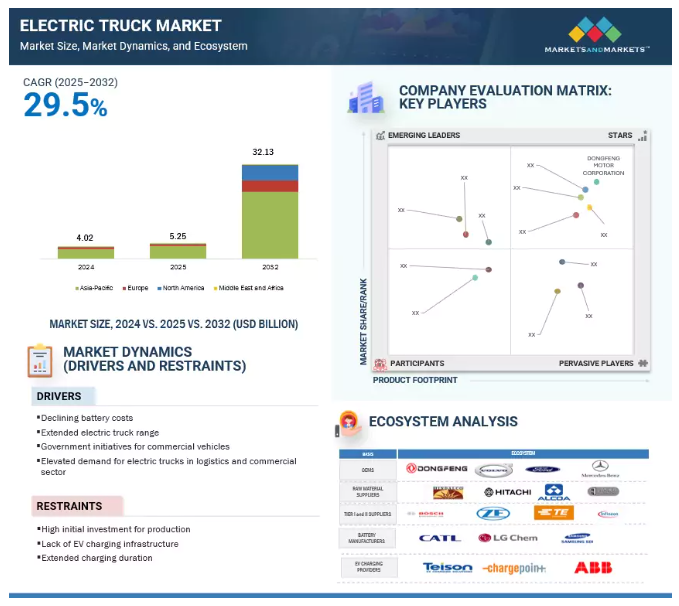
The electric truck industry size is projected to grow from 101,499 units in 2022 to 1,067,985 units by 2030, registering a robust CAGR of 34.2% during the forecast period. Rising investments in fleet electrification, battery electric trucks, and intelligent transportation solutions are expected to continue fueling electric truck market growth.
The global electric truck market is experiencing exceptional growth as governments, logistics companies, and fleet operators accelerate the transition toward zero-emission transportation. Increasing environmental regulations, advancements in battery technology, expanding charging infrastructure, and growing demand for sustainable freight transportation are driving the rapid adoption of electric commercial vehicles across the world.
Electric Truck Industry Overview
Electric trucks are commercial vehicles powered by battery-electric or fuel-cell electric propulsion systems instead of conventional internal combustion engines. These vehicles significantly reduce greenhouse gas emissions, operating costs, and noise pollution while supporting global decarbonization initiatives.
Electric trucks are increasingly deployed across logistics, e-commerce, municipal services, construction, and industrial transportation. Modern electric trucks integrate advanced battery management systems, regenerative braking, connected telematics, and intelligent fleet management software to maximize efficiency and vehicle uptime.
As commercial transportation becomes increasingly sustainable and connected, electric trucks are emerging as a key component of the future mobility ecosystem.
Fleet Electrification Driving Electric Truck Market Growth
Fleet electrification is one of the strongest drivers of the electric truck market. Logistics companies, retailers, and transportation providers are replacing diesel fleets with electric trucks to reduce carbon emissions, lower operating expenses, and meet corporate sustainability goals.
Government incentives, emission reduction mandates, and total cost of ownership advantages are encouraging fleet operators to accelerate electric truck adoption. Large fleet operators are increasingly investing in charging infrastructure and energy management systems to support large-scale electrification initiatives.
As companies pursue net-zero transportation strategies, fleet electrification is expected to remain a major contributor to electric truck market growth.
Battery Electric Trucks Dominating the Electric Truck Market
Battery Electric Trucks (BETs) are expected to account for the largest share of the electric truck market due to continuous improvements in battery technology, charging efficiency, and driving range. Advances in lithium-ion battery chemistry, energy density, and thermal management have made battery electric trucks increasingly suitable for urban deliveries, regional freight, and commercial transportation.
Manufacturers are introducing electric trucks with larger battery capacities, faster charging capabilities, and improved payload performance to meet the evolving needs of logistics operators. Falling battery costs are further improving the economic viability of battery electric trucks across multiple commercial applications.
The continued expansion of battery technology is expected to strengthen the electric truck market throughout the forecast period.
Download PDF Brochure @ https://www.marketsandmarkets.com/pdfdownloadNew.asp?id=221011937
Last-Mile Delivery Accelerating Electric Truck Adoption
The rapid growth of e-commerce and urban logistics is significantly increasing demand for electric trucks in last-mile delivery applications. Delivery companies are adopting electric commercial vehicles to reduce operating costs, comply with low-emission zones, and improve sustainability performance.
Electric trucks are particularly well suited for urban distribution due to their quiet operation, zero tailpipe emissions, and lower maintenance requirements. Fleet operators are increasingly utilizing connected telematics and route optimization software to maximize vehicle utilization and charging efficiency.
The expansion of last-mile delivery services is expected to create substantial opportunities for electric truck manufacturers and fleet operators.
Heavy-Duty Electric Trucks Transforming Freight Transportation
Heavy-duty electric trucks are becoming increasingly important as battery performance and charging infrastructure continue to improve. Advances in high-capacity battery systems, megawatt charging technologies, and electric powertrains are enabling electric trucks to support long-haul freight operations.
Governments and transportation companies are investing in charging corridors and commercial charging networks to facilitate heavy-duty electric truck deployment. The growing availability of high-performance electric trucks is expected to accelerate the decarbonization of freight transportation worldwide.
As infrastructure investments continue expanding, heavy-duty electric trucks are expected to play an increasingly important role in sustainable logistics.
Advanced Battery Technologies Improving Truck Performance
Battery innovation remains central to the future of the electric truck market. High-energy-density lithium-ion batteries, nickel manganese cobalt (NMC) battery chemistries, improved battery management systems, and advanced thermal management technologies are significantly improving vehicle range, charging speed, and operational efficiency.
Manufacturers are also investing in next-generation battery technologies, including solid-state batteries and fast-charging solutions, to further enhance commercial vehicle performance. These innovations are helping reduce total cost of ownership while improving fleet productivity.
Continued advancements in battery technology will remain one of the key trends shaping the electric truck market.
Asia Pacific Leading Electric Truck Market Share
Asia Pacific is expected to account for the largest electric truck market share due to rapid industrialization, strong government support for electric mobility, expanding commercial vehicle production, and growing investments in charging infrastructure. China, Japan, South Korea, and India are leading the adoption of electric commercial vehicles through supportive policies and large-scale electrification programs.
The region’s growing logistics sector, increasing e-commerce activity, and strong manufacturing capabilities continue to create favorable conditions for electric truck market expansion. Government incentives and emission regulations are further encouraging fleet operators to transition toward zero-emission transportation solutions.
Future Outlook for the Electric Truck Market
The future of the electric truck market will be driven by fleet electrification, battery innovation, intelligent fleet management, connected vehicle technologies, and zero-emission transportation initiatives. As battery costs continue declining and charging infrastructure expands globally, electric trucks will become increasingly competitive across light-, medium-, and heavy-duty commercial vehicle segments.
Growing investments in battery electric trucks, autonomous freight technologies, smart logistics platforms, and sustainable transportation infrastructure will continue creating significant opportunities for vehicle manufacturers, fleet operators, charging providers, and technology companies. As a result, the electric truck market is expected to witness sustained innovation, strong market growth, and widespread commercial adoption through 2030.
Request Free Sample Report @ https://www.marketsandmarkets.com/requestsampleNew.asp?id=221011937