
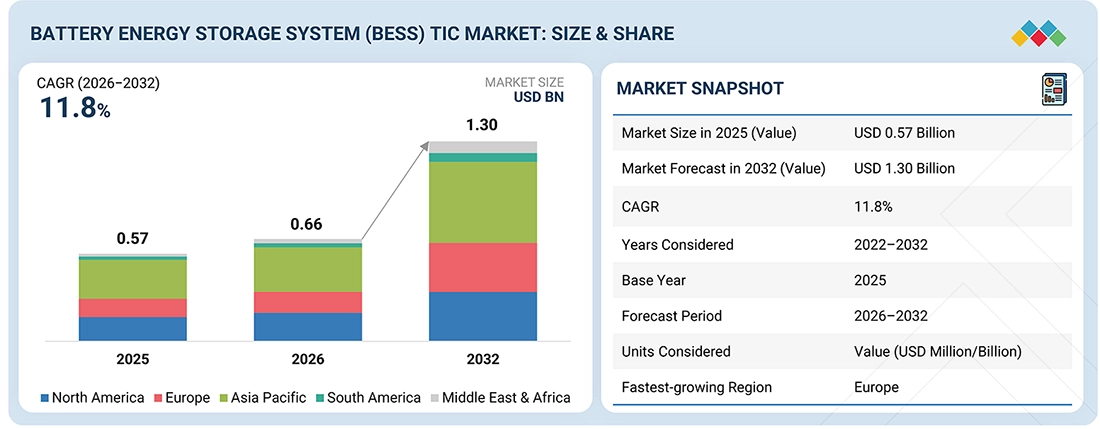
The Battery Energy Storage System Testing, Inspection, and Certification (BESS TIC) Market is becoming an essential component of the global energy transition as countries accelerate the shift toward cleaner, more resilient, and decentralized energy systems. Battery energy storage systems are no longer viewed as complementary technologies but as critical infrastructure that enables renewable energy integration, stabilizes electricity grids, supports electrification, and improves overall energy efficiency. As investments in battery storage continue to increase worldwide, the need for comprehensive testing, inspection, certification, and technical validation services is growing at an equally rapid pace. BESS TIC providers ensure that battery systems meet strict safety, quality, performance, and regulatory requirements, making them indispensable partners in supporting the worldwide transition to sustainable energy.
One of the strongest drivers supporting the BESS TIC market is the rapid expansion of renewable energy generation. Governments across the world are investing heavily in solar and wind power to reduce greenhouse gas emissions and decrease dependence on fossil fuels. However, renewable energy sources generate electricity intermittently, making reliable energy storage essential for balancing electricity supply and demand. Battery energy storage systems store excess renewable electricity during periods of high generation and deliver power when renewable output declines. Before these storage systems can be connected to electricity grids, they must undergo extensive testing and certification to verify safety, efficiency, and operational reliability. This growing deployment of renewable energy projects directly increases demand for TIC services.
Global decarbonization policies are also driving sustained growth in the BESS TIC market. Countries have established ambitious carbon neutrality targets that require significant reductions in greenhouse gas emissions over the coming decades. Achieving these goals depends heavily on replacing conventional power generation with renewable energy supported by large-scale battery storage. Regulatory agencies increasingly require battery systems to comply with rigorous technical standards before they are approved for commercial operation. Independent testing, inspection, and certification ensure compliance with these regulations while supporting the safe expansion of clean energy infrastructure.
Grid modernization represents another major driver influencing market expansion. Traditional electricity grids were designed around centralized power generation, whereas modern grids increasingly incorporate distributed renewable energy, battery storage, electric vehicles, and smart energy management systems. Battery energy storage improves frequency regulation, voltage control, peak demand management, load balancing, and backup power capabilities within these evolving power networks. As utilities modernize electricity infrastructure, independent validation of battery performance becomes increasingly important. TIC organizations verify that energy storage systems meet operational requirements while ensuring compatibility with advanced grid technologies.
Download PDF Brochure @ https://www.marketsandmarkets.com/pdfdownloadNew.asp?id=177783585
The rapid growth of utility-scale battery energy storage installations is creating substantial opportunities for the BESS TIC market. Modern battery projects often involve hundreds of megawatt-hours of storage capacity and highly sophisticated battery management systems, power conversion equipment, thermal management technologies, and fire protection systems. These complex installations require extensive laboratory testing, manufacturing inspections, commissioning assessments, and operational certification before entering commercial service. As utility-scale battery deployment continues accelerating globally, demand for comprehensive TIC solutions is expected to grow significantly.
Electrification across transportation, industrial operations, and commercial facilities further supports market expansion. Electric vehicle charging infrastructure, industrial microgrids, commercial energy management systems, and distributed energy resources increasingly rely on battery energy storage for reliable operation. These applications require battery systems that demonstrate high levels of safety, durability, and performance under diverse operating conditions. Independent testing and certification help ensure that batteries satisfy technical standards while minimizing operational risks for businesses and consumers.
Battery technology innovation is another important growth driver for the BESS TIC market. While lithium-ion batteries remain the dominant energy storage technology, manufacturers continue introducing new battery chemistries such as lithium iron phosphate, sodium-ion, flow batteries, and solid-state batteries. Each technology requires specialized testing procedures to evaluate electrical performance, thermal stability, environmental durability, lifecycle characteristics, and safety behavior. As battery technologies diversify, TIC organizations continue expanding laboratory capabilities and technical expertise to support the commercialization of emerging energy storage solutions.
Safety remains one of the most significant factors driving demand for testing and certification services. Battery energy storage systems operate with high energy densities and must perform safely under varying environmental and operational conditions. Thermal runaway, electrical faults, mechanical damage, and fire risks require comprehensive safety validation before battery systems are deployed at utility, commercial, or industrial sites. TIC organizations conduct thermal testing, fire resistance evaluation, abuse testing, environmental assessments, and system-level safety verification to ensure batteries meet evolving international safety standards. Increasing regulatory attention to battery safety continues strengthening long-term demand for independent certification services.
Inquiry Before Buying @ https://www.marketsandmarkets.com/Enquiry_Before_BuyingNew.asp?id=177783585
Growing investment in energy resilience is also contributing to market growth. Extreme weather events, aging electrical infrastructure, cyber threats, and increasing electricity demand have highlighted the importance of resilient power systems. Battery energy storage provides reliable backup power during outages while supporting critical infrastructure such as hospitals, data centers, telecommunications networks, transportation systems, and emergency services. Organizations deploying battery systems for resilience require independent performance verification to ensure dependable operation during critical situations, increasing demand for inspection and certification services.
Digital transformation across the energy sector is reshaping the BESS TIC market. Artificial intelligence, Industrial Internet of Things technologies, cloud computing, digital twins, and predictive analytics enable continuous monitoring of battery health and operational performance. TIC providers increasingly incorporate these digital tools into testing and inspection procedures, allowing real-time diagnostics, predictive maintenance, and lifecycle performance validation. Digital innovation improves testing efficiency while enabling more comprehensive evaluation of battery systems throughout their operational lifespan.
Financial institutions and insurance providers also contribute to market expansion by requiring independent technical validation before supporting battery projects. Utility-scale battery installations represent significant infrastructure investments, and investors seek assurance regarding technology reliability, operational safety, and long-term financial performance. Technical due diligence, certification, and engineering assessments reduce investment risk while improving confidence among project developers, lenders, insurers, and regulatory authorities. As energy storage projects continue increasing in financial scale, demand for professional TIC services will remain strong.
International standardization efforts are further strengthening market growth. Organizations responsible for developing global battery safety and performance standards continue updating technical requirements to reflect evolving technologies and operational experience. Manufacturers seeking access to international markets rely on independent certification demonstrating compliance with these globally recognized standards. Harmonized certification processes facilitate international trade while improving product quality and safety across the battery industry.
View detailed Table of Content here – https://www.marketsandmarkets.com/Market-Reports/bess-tic-market-177783585.html
Regional market development continues supporting long-term expansion. Asia Pacific remains the largest battery manufacturing and deployment region, creating sustained demand for advanced testing laboratories and certification infrastructure. North America continues investing heavily in renewable energy, battery storage, and grid modernization initiatives that require comprehensive TIC services. Europe emphasizes sustainability, battery safety, environmental compliance, and circular economy principles, encouraging extensive testing and lifecycle assessment. Emerging economies across Latin America, the Middle East, and Africa are also expanding battery deployment to strengthen electricity access and renewable energy integration, creating additional opportunities for TIC providers.
Sustainability objectives throughout the battery lifecycle are becoming increasingly important. Governments and industries are focusing on responsible battery manufacturing, recycling, material traceability, and environmental impact reduction. TIC organizations are expanding services related to lifecycle assessment, recycling validation, environmental compliance, and sustainable manufacturing certification. These capabilities support broader energy transition goals while helping manufacturers satisfy evolving environmental regulations.
Looking toward the future, the BESS TIC market will remain closely linked to global energy transition initiatives. Continued renewable energy deployment, expanding battery storage capacity, advancing battery technologies, stricter safety regulations, digital innovation, and increasing investment in resilient power infrastructure will sustain long-term demand for testing, inspection, certification, and technical due diligence services. As battery energy storage becomes a cornerstone of modern electricity systems, BESS TIC providers will continue playing a vital role in ensuring that energy storage technologies operate safely, efficiently, and reliably while supporting the world’s transition toward a cleaner and more sustainable energy future.