
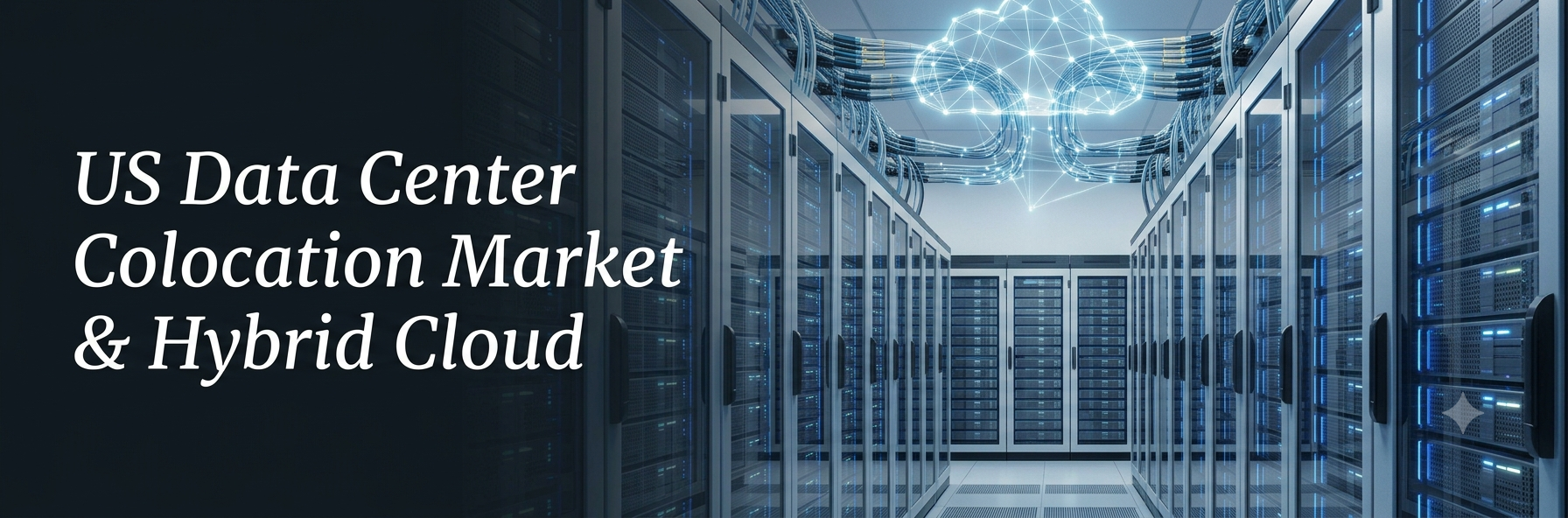
The modern enterprise is fundamentally data-driven, yet the underlying infrastructure hosting these digital assets is undergoing a profound architectural paradigm shift. Optimizing a contemporary corporate footprint requires a sophisticated balance: retaining the robust, uncompromising security of private infrastructure while leveraging the hyper-scalable elasticity of public cloud environments. This structural equilibrium is achieved via high-performance hybrid cloud connectivity—an architectural methodology that transitions infrastructure from isolated silos into a fluid, unified resource pool.
At the absolute epicenter of this transformation sits the US Data Center Colocation Market. Decades ago, traditional colocation was viewed primarily through a real estate lens—a transactional model for leasing reliable power, physical square footage, and cooling. In the current enterprise landscape, that paradigm has been entirely dismantled.
The premier providers capturing US Data Center Colocation Market share have evolved from passive utilities into dynamic interconnection hubs. These facilities serve as the critical physical nexuses where corporate private networks interface directly with public hyperscale on-ramps. By migrating core infrastructure into a multitenant colocation environment, enterprises can construct high-density ecosystems that maintain localized governance over sensitive workloads while seamlessly harnessing the massive processing power of public cloud AI engines. This integration successfully bridges institutional trust with bleeding-edge technology.
Market Context & Growth Narrative
The escalating demand for high-compute infrastructure has triggered an unprecedented expansion across North American digital corridors. Recent data from the US Data Center Colocation Market report indicates that the domestic colocation sector has surpassed a valuation of $24.5 billion, with projections indicating it will climb toward $55.2 billion by 2030. This trajectory represents a steady compound annual growth rate (CAGR) of 14.9%, heavily concentrated in high-density wholesale deployments.
This rapid expansion is fueled by macro-level structural shifts in enterprise technology deployment:
- The Generative AI Mandate: Advanced AI models require immense computational power, pushing rack density requirements well past legacy operational thresholds.
- Thermal Management Evolution: The transition to high-performance computing (HPC) has accelerated the adoption of liquid-to-chip and immersion cooling systems, rendering older corporate real estate obsolete.
- Geographic De-risking: Due to power grid constraints in primary markets like Northern Virginia, capacity is expanding rapidly into secondary and tertiary regional hubs.
Consequently, the competitive landscape is stratifying into a sophisticated, tiered ecosystem. Traditional colocation operators are designing multi-megawatt campuses tailored specifically for hyperscalers and massive enterprise clients, while agile regional operators are deploying specialized edge data centers to provide local processing power and minimal latency for real-time manufacturing and commercial automation applications.
Discover emerging business opportunities Download the PDF supported by extensive market research.
The Enterprise Dilemma: Key Operational and Economic Pain Points
Despite the clear strategic advantages of modern technology, corporate IT leaders face severe operational friction when attempting to scale legacy environments.
Severe Operational Inefficiencies
Many organizations continue to manage a fragmented mix of legacy on-premises hardware and disparate public cloud tools. This fragmented architecture creates isolated data silos, rendering unified management highly inefficient. Moving data between these unlinked environments requires complex, manual workflows, which inherently increases the risk of configuration errors and unplanned operational downtime.
Unchecked Cloud and Capital Expenditures
The initial promise of a completely public cloud strategy—lower up-front capital spending—has run into practical financial realities. Organizations that moved massive data stores entirely to the public cloud frequently face high monthly egress fees. Conversely, building or upgrading an exclusive on-premises data center requires large capital investments that drain corporate budgets.
Regulatory Compliance and Security Hurdles
Highly regulated sectors—such as financial services, healthcare, and defense—operate under strict mandates dictating exactly how sensitive information must be handled. Storing this information entirely in a public cloud environment can introduce compliance risks. However, isolating that data inside an offline warehouse cuts it off from modern analytical engines and artificial intelligence tools.
This Sample Report is designed to fuel your business growth—download it today.
A Solution-Oriented Approach: Architecting the Hybrid Engine
Mitigating these structural vulnerabilities requires a balanced hybrid cloud strategy built within a premium colocation framework. Rather than forcing an artificial choice between on-premises control and cloud agility, hybrid connectivity merges both environments into a single network infrastructure.
- Direct Cloud On-Ramps and Software-Defined Networking (SDN): Instead of routing corporate traffic over the public internet, companies place their physical servers in a colocation facility that houses direct cloud on-ramps. By running physical fiber optic patch cables directly to cloud gateways within the same building, businesses bypass the public internet entirely. This creates reliable, private connections with sub-millisecond latency.
- High-Density Layouts Tailored for AI Workloads: Modern colocation facilities allow companies to consolidate old server racks into smaller, high-density equipment configurations. These specialized environments handle advanced power distributions exceeding 30 to 40 kilowatts per rack, providing the specific infrastructure needed to safely run advanced analytics and machine learning tools right alongside protected data stores.
- Strategic Partnerships and Shared Responsibility Models: By working directly with top-tier colocation providers, enterprises can offload the daily complexities of physical security, backup power testing, and environmental monitoring. This shift allows internal IT teams to step away from facility maintenance and focus entirely on high-value digital transformation initiatives.
Data-Driven Insights: Metrics Shaping the Infrastructure Landscape
A macro-level US Data Center Colocation Market analysis reveals a direct correlation between strategic infrastructure deployment and corporate financial health. Enterprise data indicates that organizations adopting hybrid colocation environments experience significant operational advantages over peers relying solely on legacy setups.
A comprehensive US Data Center Colocation Market outlook shows that the overall US Data Center Colocation Market size is on track to hit record levels of investment by 2031, heavily driven by the integration of AI-ready wholesale footprints. This massive injection of capital highlights a major enterprise trend: corporations are aggressively shifting away from building private data center facilities in favor of flexible, scalable third-party ecosystems.
Real-World Case Study: Overhauling Core Enterprise Architecture
To understand the practical impact of these infrastructure strategies, consider the real-world operational overhaul of a major North American logistics and supply chain corporation.
The Baseline Environment
The organization managed a complex network of regional fulfillment centers, with operations coordinated across three aging, company-owned data repositories. As the company rolled out automated tracking systems and real-time route optimization software, their data processing needs grew exponentially. Their legacy storage centers lacked the necessary power capacity to run modern analytics tools, and their network pathways suffered from significant latency delays. This bottleneck slowed down processing across their automated fulfillment systems, resulting in costly delivery delays and rising operational friction.
The Hybrid Colocation Implementation
Rather than attempting a multi-million dollar upgrade on their old buildings, the company chose to migrate their core data engines into a high-density wholesale colocation facility located in a major network hub. They placed their core private records on dedicated, high-security server racks inside the colocation facility. From there, they established direct, private fiber connections to the cloud-based AI engines handling their route planning algorithms. This setup kept sensitive customer data highly secure on their own hardware, while allowing large datasets to stream directly into the public cloud for real-time processing without security risks or high latency.
The Measurable Outcomes
The strategic migration yielded immediate, systemic optimization across the enterprise operating model:
- Latency Minimization: Network lag plummeted from 65ms to sub-2ms thresholds, enabling real-time synchronization across automated fulfillment nodes.
- OpEx Rationalization: Decommissioning legacy facilities and consolidating data footprints generated a 34% reduction in overall real estate and power utility overhead.
- Agile Scalability: Time-to-market for deploying new regional distribution nodes dropped from months to days via pre-provisioned, software-defined network profiles.
Financial and Strategic Impact: Measuring Return on Investment
Transitioning to a hybrid infrastructure model delivers clear, quantifiable financial returns across multiple areas of corporate operations.
Direct Cost Reductions
By moving into shared colocation spaces, enterprises benefit from the facility’s overall purchasing power. The massive scale of modern colocation setups allows them to secure lower utility rates and achieve optimized power utilization metrics that are impossible to duplicate in a private corporate data center. Furthermore, using private direct connections to the cloud slashes monthly network data transit costs, eliminating expensive public cloud data extraction fees.
Optimized Capital Allocation
Shifting infrastructure spending from an unpredictable upfront capital expense (CapEx) to a predictable, monthly operating expense (OpEx) frees up substantial cash flow. Corporate finance teams can redirect capital away from depreciating physical assets like real estate, commercial cooling units, and backup generators, and invest it instead into core product development and market expansion.
Clear Competitive Advantage
In digital-first industries, infrastructure speed directly translates to business performance. Organizations that build out high-performance hybrid networks can bring new software features to market faster, integrate strategic corporate acquisitions smoothly, and adapt to changing market conditions far more fluidly than competitors anchored to rigid, legacy IT structures.
Challenges, Risk Management, and Future Outlook
While the strategic advantages of hybrid cloud models are undeniable, navigating this infrastructure shift requires careful planning and proactive risk management.
Navigating Energy Limits and Supply Pressures
The breakneck growth of the data center sector has put immense pressure on local power grids. In several key markets, operators face extended timelines to secure the electrical utility hookups needed for new facilities. Concurrently, global supply chains for critical electrical components—such as large industrial transformers and custom distribution switchgear—remain highly constrained. Forward-looking companies are managing these risks by reserving power capacity years in advance and choosing colocation partners that utilize independent on-site power generation and alternative energy sources.
Proactive Data Governance
Operating a hybrid environment means managing data across multiple physical locations and cloud environments. Without strict oversight, this complexity can create visibility gaps, leaving data exposed or leading to compliance oversights. Enterprises must implement unified security tools that provide continuous visibility and consistent policy enforcement across every private rack and public cloud instance.
The Long-Term Outlook
Looking ahead, the evolution of the US Data Center Colocation Market trends will be defined by deep integration and automation. Enterprise infrastructure is shifting toward software-defined models, where compute power, storage, and network pathways across the country can be adjusted automatically via software commands.
As emerging technologies like edge computing, 5G enterprise networks, and early quantum processing continue to mature, the colocation facility will cement its role as the essential physical anchor of the modern digital economy. Organizations that invest in building resilient, highly connected hybrid cloud networks today will find themselves well-positioned to lead the next wave of corporate innovation.