
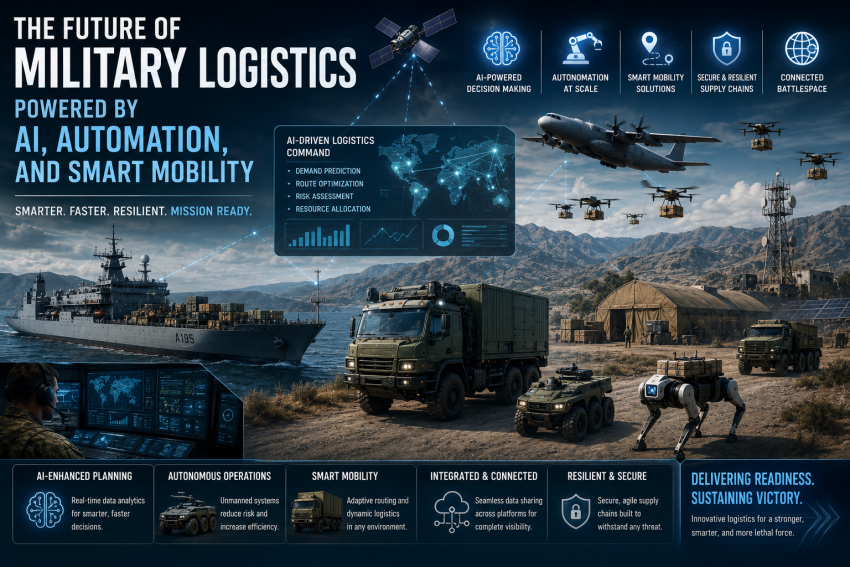
Military logistics is undergoing a profound transformation as armed forces worldwide adopt artificial intelligence, automation, and smart mobility technologies to build faster, more resilient, and data-driven sustainment networks. Modern military operations extend across vast geographical regions and increasingly contested environments, making efficient logistics as critical to mission success as combat capability itself. To maintain operational readiness and support multi-domain operations, defense organizations are investing in intelligent logistics ecosystems that improve supply chain visibility, accelerate decision-making, and enhance the movement of personnel, equipment, fuel, ammunition, and critical supplies.
As digital transformation accelerates, the future of military logistics will be defined by interconnected technologies that enable autonomous resupply, predictive maintenance, real-time asset tracking, and adaptive supply chain management.
Artificial Intelligence Is Transforming Military Supply Chains
Artificial intelligence is becoming the backbone of next-generation military logistics by enabling defense organizations to analyze vast amounts of operational and logistical data in real time. AI-powered platforms can forecast supply requirements, optimize inventory levels, prioritize resource allocation, and recommend the most efficient transportation routes based on mission conditions.
Machine learning algorithms continuously evaluate battlefield information, weather conditions, equipment availability, and transportation status to improve logistics planning. These intelligent systems reduce delays, minimize waste, and ensure that frontline units receive critical supplies when and where they are needed. As military operations become increasingly dynamic, AI-driven logistics will provide commanders with greater agility and faster decision-making capabilities.
Download Free PDF Brochure : https://www.marketsandmarkets.com/pdfdownloadNew.asp?id=155479010
Automation Is Increasing Operational Efficiency
Automation is reshaping military logistics by reducing manual processes and accelerating supply chain operations. Automated warehousing systems, robotic inventory management, and intelligent material-handling equipment are improving the speed and accuracy of logistics activities while reducing dependence on labor-intensive operations.
Within military depots and distribution centers, automated systems can rapidly identify, sort, package, and dispatch supplies with greater precision than traditional methods. These capabilities help improve inventory accuracy, reduce operational costs, and increase the responsiveness of logistics networks during high-tempo military operations.
Automation also enables logistics personnel to focus on strategic planning and mission support rather than repetitive administrative tasks.
Smart Mobility Is Revolutionizing Battlefield Sustainment
Smart mobility technologies are redefining how military resources move across operational environments. Autonomous ground vehicles, unmanned cargo aircraft, robotic transport platforms, and intelligent convoy systems are enabling safer and more efficient transportation of supplies through contested and high-risk areas.
These systems leverage advanced navigation technologies, artificial intelligence, and real-time communications to optimize movement while reducing risks to personnel. Autonomous logistics platforms can deliver ammunition, fuel, medical equipment, and humanitarian assistance directly to frontline units without exposing soldiers to unnecessary danger.
As smart mobility technologies continue to mature, they will become essential components of military sustainment strategies across land, air, and maritime domains.
Predictive Maintenance Is Enhancing Equipment Readiness
Maintaining mission-critical equipment is a fundamental aspect of military logistics. Artificial intelligence and advanced sensor technologies are enabling predictive maintenance approaches that improve equipment availability while reducing maintenance costs.
Connected sensors continuously monitor the health of military vehicles, aircraft, naval platforms, and support equipment, generating real-time data that AI systems analyze to detect potential failures before they occur. Maintenance teams can schedule repairs proactively, minimizing unexpected breakdowns and extending the operational life of valuable defense assets.
This predictive approach enhances fleet readiness, optimizes spare parts inventory, and ensures greater operational continuity during sustained military missions.
Real-Time Visibility Is Strengthening Supply Chain Resilience
Modern military logistics increasingly depends on real-time situational awareness across the supply chain. Integrated digital platforms combine information from satellite communications, Internet of Military Things (IoMT) devices, RFID technologies, GPS tracking, and battlefield sensors to provide complete visibility into logistics operations.
Commanders can monitor the location, condition, and status of critical assets throughout transportation and distribution networks. This transparency enables rapid responses to disruptions, supports more accurate resource planning, and improves coordination across military units operating in dispersed environments.
Enhanced supply chain visibility also strengthens resilience against emerging operational and geopolitical challenges.
Multi-Domain Operations Are Driving Logistics Innovation
Future military operations will involve seamless coordination across land, air, maritime, cyber, and space domains. Supporting these missions requires logistics systems capable of synchronizing resources across multiple operational theaters while adapting to rapidly changing battlefield conditions.
AI-enabled logistics platforms facilitate real-time collaboration between transportation assets, maintenance units, supply depots, and operational commanders. This integrated approach ensures that sustainment activities remain aligned with mission objectives and evolving operational priorities.
As multi-domain warfare becomes the standard framework for defense operations, intelligent logistics will become increasingly essential to mission success.
Digital Twins and Advanced Analytics Are Optimizing Logistics Planning
Digital twin technology is emerging as a valuable tool for military logistics planning and operational optimization. By creating virtual replicas of supply chains, transportation networks, and maintenance systems, defense organizations can simulate operational scenarios before implementing real-world decisions.
Combined with advanced analytics, digital twins enable logistics planners to evaluate multiple supply strategies, identify vulnerabilities, optimize resource allocation, and improve contingency planning. These capabilities reduce operational risk while enhancing overall logistics performance.
The integration of digital twins with AI-powered decision support systems is expected to significantly improve military logistics efficiency in the coming years.
Cybersecurity Is Becoming Integral to Smart Logistics
As military logistics becomes increasingly digital, protecting logistics infrastructure from cyber threats has become a strategic priority. AI-powered cybersecurity platforms, encrypted communications, zero-trust architectures, and resilient cloud infrastructures are helping safeguard sensitive logistics data and operational networks.
Secure digital ecosystems ensure uninterrupted logistics operations while protecting critical military supply chains from cyberattacks, electronic warfare, and information disruptions. Strong cybersecurity measures are essential for maintaining operational readiness in future digitally connected battlefields.
Defense Modernization Is Accelerating Adoption
Governments worldwide are incorporating intelligent logistics technologies into broader defense modernization initiatives. Investments in artificial intelligence, autonomous vehicles, robotics, cloud computing, and advanced communications are enabling military organizations to build agile and resilient logistics ecosystems capable of supporting future operational requirements.
Strategic partnerships between defense agencies, technology companies, and logistics providers are accelerating innovation while facilitating the deployment of next-generation sustainment solutions. These modernization efforts are positioning intelligent logistics as a key pillar of future military capability.
The Road Ahead
The future of military logistics will be characterized by highly connected, autonomous, and data-driven sustainment networks capable of adapting to complex operational environments in real time. Artificial intelligence will continuously optimize logistics planning, automation will improve operational efficiency, and smart mobility solutions will transform battlefield transportation and resupply.
As defense organizations continue embracing digital transformation, military logistics will evolve from a traditional support function into a strategic force multiplier that enhances readiness, resilience, and operational effectiveness across every domain of modern warfare.
Get More Information: https://www.marketsandmarkets.com/Market-Reports/military-vehicle-sustainment-market-155479010.html
Conclusion
Artificial intelligence, automation, and smart mobility are redefining the future of military logistics by creating faster, more intelligent, and highly resilient supply chain ecosystems. These technologies are enabling predictive maintenance, autonomous resupply, real-time asset visibility, and data-driven decision-making that improve operational readiness and sustain military forces in increasingly complex environments. As defense modernization programs continue to accelerate, intelligent logistics will become an indispensable element of future military operations, ensuring that armed forces remain agile, efficient, and prepared to meet the evolving challenges of modern warfare.