
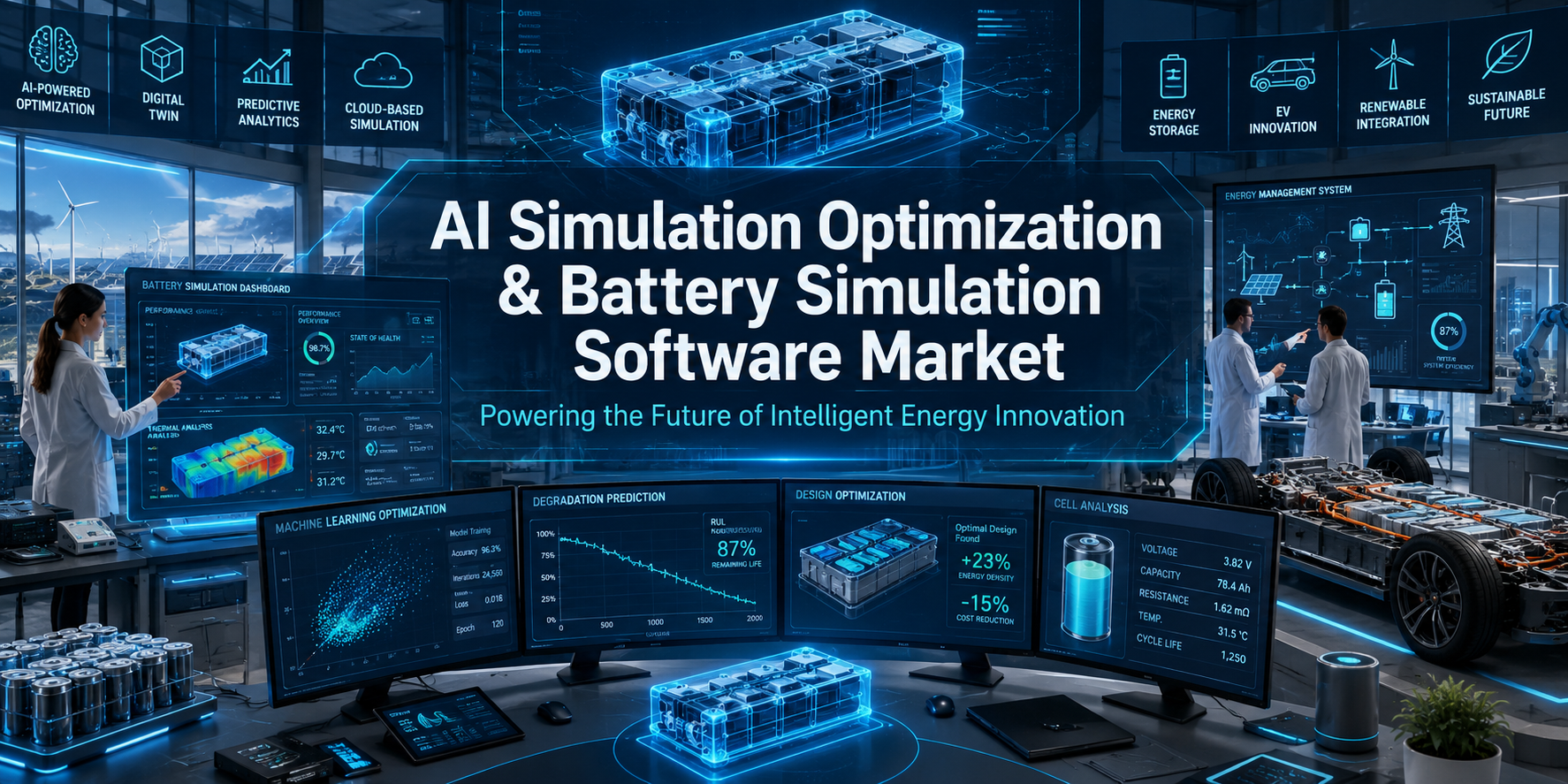
The Battery Simulation Software Market is emerging as a critical technology domain as enterprises strive to accelerate battery development cycles, enhance product performance, and achieve ambitious sustainability objectives. At the same time, AI Simulation Optimization has become one of the most influential technology trends globally, empowering organizations to model, predict, and optimize battery performance with exceptional precision and efficiency.
As industries increasingly embrace electrification, renewable energy integration, intelligent mobility solutions, and digital manufacturing initiatives, AI-enabled simulation platforms are becoming indispensable tools for reducing research and development costs, mitigating engineering risks, and accelerating innovation. The integration of advanced analytics, digital twin technologies, machine learning algorithms, and battery simulation capabilities is unlocking transformative opportunities for enterprises across multiple sectors.
Why AI Simulation Optimization Is Gaining Global Momentum
Organizations worldwide are significantly increasing investments in AI-powered simulation technologies to streamline product development processes and improve innovation outcomes. Traditional testing methodologies often require extensive physical prototyping, prolonged experimentation cycles, and substantial capital expenditures.
AI Simulation Optimization enables enterprises to:
- Accelerate product development timelines
- Enhance engineering and design accuracy
- Predict performance outcomes with greater confidence
- Reduce manufacturing defects and quality issues
- Support continuous innovation initiatives
- Advance corporate sustainability objectives
The rapid growth of electric vehicles, energy storage systems, and smart manufacturing environments continues to drive demand for advanced simulation technologies.
According to market research, the time is now Download the PDF to seize upcoming business opportunities.
Understanding the Battery Simulation Software Market
The Battery Simulation Software Market encompasses a rapidly evolving ecosystem of software platforms designed to simulate battery chemistry, thermal dynamics, charging behavior, degradation mechanisms, and overall lifecycle performance.
Modern simulation solutions provide organizations with the ability to:
- Evaluate battery architecture and design configurations
- Optimize cell-level performance
- Improve thermal management systems
- Enhance charging efficiency and reliability
- Forecast battery degradation patterns
- Strengthen operational safety and product quality
As battery technologies become increasingly sophisticated, simulation software has evolved into a strategic component of enterprise research and development programs.
The Evolution of Battery Engineering
Over the past decade, battery engineering has undergone a significant transformation. Rising market expectations and technological complexity have made traditional testing approaches increasingly inadequate.
Key industry challenges include:
- Accelerating innovation requirements
- Increasing energy density expectations
- Compliance with evolving safety regulations
- Meeting sustainability mandates
- Achieving cost-efficiency targets
AI-powered simulation environments enable engineering teams to evaluate thousands of design alternatives virtually before committing resources to physical prototype development.
Want to grow faster? Our Sample Report is your starting point—download it now.
How AI Simulation Optimization Delivers Value
AI Simulation Optimization combines several advanced technologies to create highly accurate predictive environments.
Machine Learning
Machine learning algorithms analyze historical battery performance data to identify patterns, generate insights, and forecast future outcomes.
Physics-Based Modeling
Advanced simulation engines replicate real-world battery operating conditions, providing accurate performance predictions under various scenarios.
Digital Twin Technology
Digital twins create virtual representations of battery systems, enabling continuous monitoring, testing, and optimization throughout the product lifecycle.
Predictive Analytics
Organizations gain actionable intelligence regarding battery performance, degradation trends, maintenance requirements, and operational risks.
Collectively, these technologies empower enterprises to optimize battery systems across a broad range of operating conditions.
Enterprise Benefits of Battery Simulation Software
Accelerated Product Development
Simulation-driven engineering significantly reduces testing cycles and minimizes dependence on costly physical prototypes.
Reduced Research and Development Costs
Organizations can identify design inefficiencies and performance limitations early in the development process, reducing overall project expenses.
Enhanced Product Quality
AI-powered modeling improves battery reliability, consistency, and long-term performance.
Improved Risk Management
Simulation platforms enable early detection of safety concerns and performance vulnerabilities before commercialization.
Stronger Competitive Positioning
Enterprises can accelerate innovation and reduce time-to-market, strengthening their market leadership capabilities.
These advantages continue to support robust Battery Simulation Software Market growth across global industries.
Applications Across Key Industries
Electric Vehicles
Automotive manufacturers utilize battery simulation software to improve driving range, charging efficiency, thermal management, and safety performance.
Renewable Energy
Energy providers leverage simulation platforms to optimize battery storage systems supporting solar, wind, and hybrid energy projects.
Consumer Electronics
Manufacturers enhance battery performance, lifespan, and reliability for smartphones, laptops, wearables, and connected devices.
Aerospace and Defense
Mission-critical applications require highly reliable battery technologies that can perform under demanding operational conditions.
Industrial Manufacturing
Manufacturing organizations deploy battery simulation tools to improve automation systems, operational efficiency, and equipment reliability.
These expanding use cases continue to increase the global Battery Simulation Software Market size.
Digital Twins and Virtual Battery Testing
Digital twin technology is transforming the battery innovation landscape by enabling organizations to simulate real-world operating environments with unprecedented accuracy.
Virtual battery models can evaluate:
- Temperature variations
- Charging and discharging cycles
- Environmental influences
- Mechanical stress conditions
- Long-term degradation behavior
This capability enables data-driven decision-making while significantly reducing development risks and operational uncertainty.
As digital transformation initiatives continue to expand, digital twins are becoming a major contributor to evolving Battery Simulation Software Market trends.
AI-Driven Predictive Battery Analytics
Predictive analytics allows enterprises to anticipate battery performance issues before operational failures occur.
Key advantages include:
Predictive Maintenance
Identify potential failures before they impact operations.
Lifecycle Optimization
Extend battery lifespan through intelligent performance management.
Cost Efficiency
Reduce maintenance expenditures and replacement costs.
Operational Excellence
Improve productivity and performance across battery-powered environments.
These capabilities are increasingly influencing industry-wide Battery Simulation Software Market analysis and investment strategies.
Sustainability and Energy Efficiency Advantages
Sustainability remains a strategic priority for organizations worldwide. Battery simulation software contributes to environmental and operational goals by enabling:
- Reduced material consumption and waste
- Lower carbon emissions
- Enhanced battery recycling initiatives
- Improved energy efficiency
- Sustainable product development practices
As environmental regulations continue to evolve, organizations increasingly recognize simulation technologies as critical enablers of long-term sustainability strategies.
Innovation Trends Shaping the Market
Several emerging technologies are redefining the future of battery simulation.
Generative AI for Battery Design
AI-powered systems automatically generate optimized battery architectures and performance models.
Cloud-Based Simulation Platforms
Cloud environments provide scalable, cost-effective simulation capabilities for enterprises of all sizes.
Real-Time Analytics
Continuous monitoring improves visibility into battery performance and operational conditions.
Autonomous Engineering Systems
AI-driven optimization reduces manual engineering effort while improving development efficiency.
Advanced Material Modeling
Simulation accelerates the discovery and evaluation of next-generation battery materials.
Together, these innovations are shaping the future Battery Simulation Software Market outlook.
Battery Simulation Software Market Share Analysis
The global Battery Simulation Software Market share continues to expand as demand increases across transportation, manufacturing, energy storage, aerospace, and consumer electronics industries.
Leading market participants are prioritizing:
- Artificial intelligence integration
- Digital twin deployment
- Cloud-native architectures
- Predictive analytics capabilities
- Enterprise-scale implementation
Growing investments in electrification and sustainable energy initiatives are expected to further accelerate market adoption worldwide.
Key Drivers Influencing Market Expansion
Several factors are contributing to the increasing Battery Simulation Software Market size.
Expansion of Electric Vehicles
Global electric vehicle production continues to accelerate, increasing demand for advanced battery development solutions.
Growth of Renewable Energy Infrastructure
The rising need for large-scale energy storage systems is creating new opportunities for battery simulation technologies.
Advancements in Artificial Intelligence
More sophisticated AI models continue to improve simulation accuracy and predictive capabilities.
Sustainability Regulations
Governments and regulatory bodies are promoting cleaner and more energy-efficient technologies.
Industrial Digital Transformation
Organizations are increasingly adopting intelligent engineering platforms to improve operational performance and innovation outcomes.
Collectively, these drivers support sustained Battery Simulation Software Market growth.
Emerging Market Trends
Current Battery Simulation Software Market trends include:
- AI-driven battery engineering
- Cloud-native simulation platforms
- Edge computing integration
- Autonomous optimization systems
- Real-time digital twin environments
- Multi-physics simulation frameworks
- Sustainable battery innovation strategies
Organizations adopting these technologies are strengthening their competitive differentiation and long-term growth potential.
Battery Simulation Software Market Forecast Through 2035
Industry projections indicate a highly favorable Battery Simulation Software Market forecast, supported by continued investments in electrification, renewable energy infrastructure, intelligent transportation systems, and advanced manufacturing technologies.
Key developments expected over the coming decade include:
- More advanced AI-driven simulation models
- Faster simulation processing capabilities
- Expanded cloud-based deployment
- Broader enterprise adoption
- Enhanced predictive intelligence
- More sophisticated digital twin ecosystems
These advancements are expected to drive sustained market expansion through 2035 and beyond.
Future Outlook and Strategic Recommendations
The future of AI Simulation Optimization is intrinsically linked to the continued evolution of the Battery Simulation Software Market. Enterprises investing in intelligent simulation platforms today will be better positioned to accelerate innovation, reduce operational costs, enhance sustainability performance, and strengthen competitive advantage.
As batteries become increasingly central to global economic development and energy transformation initiatives, simulation software will evolve from a specialized engineering application into a strategic enterprise platform that supports innovation, resilience, operational excellence, and business transformation.
Organizations pursuing long-term growth opportunities should closely monitor developments highlighted in leading Battery Simulation Software Market reports, evaluate emerging technologies, and build digital engineering capabilities that support next-generation energy ecosystems.