
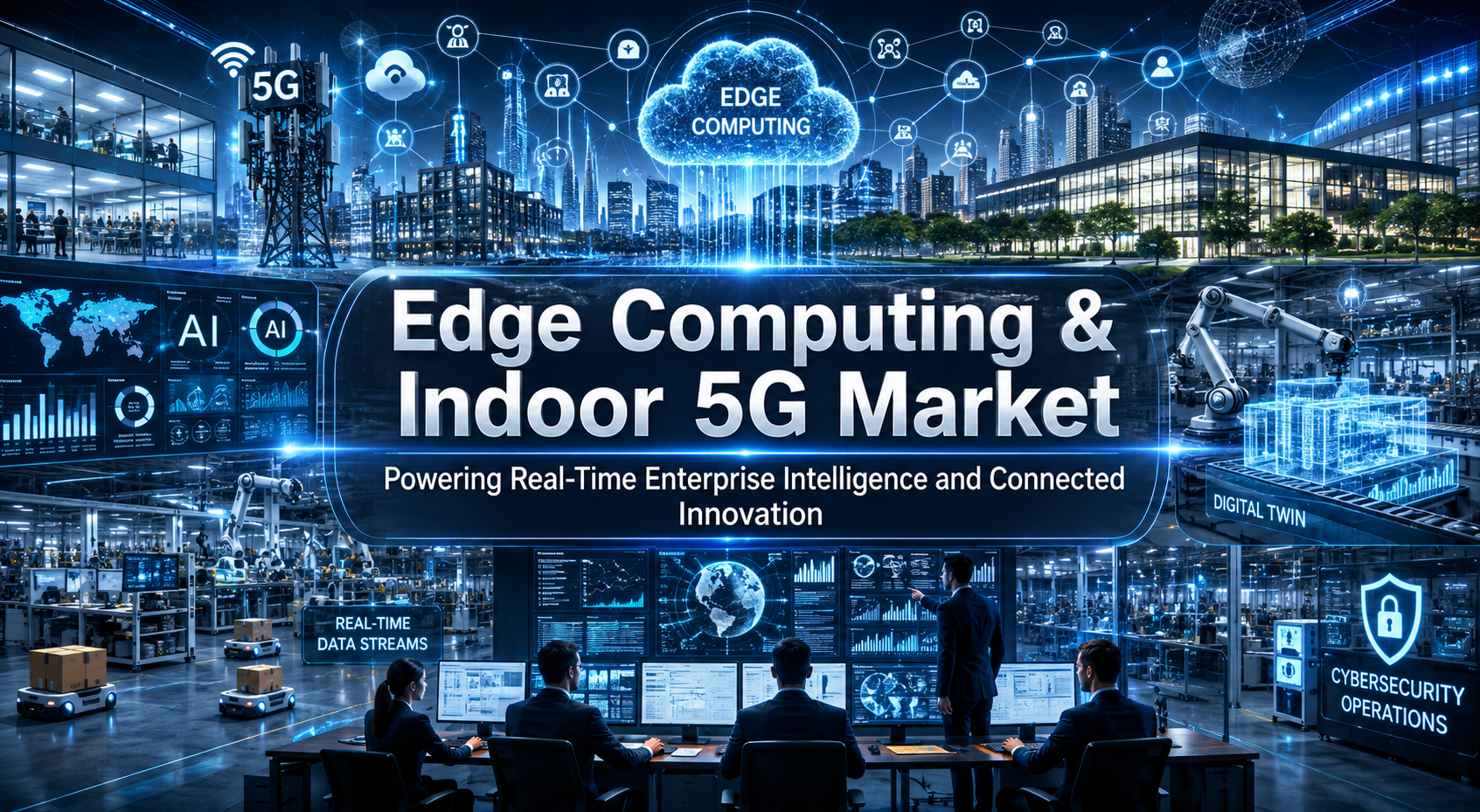
Why Enterprises Are Shifting Intelligence to the Edge
The global digital economy is entering a transformative phase where operational agility, automation, and real-time decision-making have become essential strategic priorities. As organizations accelerate their digital transformation initiatives, the Indoor 5G Market is emerging as a foundational enabler of next-generation enterprise connectivity, while Edge Computing is evolving into the intelligence layer that processes and analyzes data closer to its source.
Recent trends observed across leading technology search platforms, including Google, Bing, Yahoo, Baidu, and enterprise innovation communities, indicate growing interest in technologies such as Edge AI, real-time analytics, private 5G networks, Industrial IoT, smart manufacturing, digital twins, autonomous operations, edge cybersecurity, and intelligent automation.
Together, Edge Computing and Indoor 5G are redefining enterprise operating models, enabling organizations to enhance efficiency, accelerate innovation, and strengthen competitiveness in increasingly connected digital ecosystems.
What Is Driving Global Interest in Edge Computing?
Over the past decade, cloud computing has fundamentally transformed enterprise IT environments. However, the rapid proliferation of connected devices, sensors, cameras, and intelligent applications is generating unprecedented volumes of data that require immediate processing and analysis.
Organizations are increasingly focused on addressing key business challenges:
- How can critical data be processed in real time?
- How can latency be minimized for mission-critical operations?
- How can enterprises maintain business continuity across distributed environments?
- How can security be strengthened while supporting large-scale digital ecosystems?
Edge Computing addresses these challenges by processing data closer to where it is generated rather than relying solely on centralized cloud infrastructures.
This decentralized approach delivers several strategic benefits, including:
- Accelerated decision-making capabilities
- Reduced network congestion and bandwidth dependency
- Enhanced cybersecurity and data governance
- Improved application responsiveness
- Greater operational resilience and reliability
As a result, Edge Computing is widely recognized as one of the most impactful enterprise technologies driving the future of digital transformation.
Discover emerging business opportunities Download the PDF supported by extensive market research.
Global Technology Trends Reshaping the Edge Ecosystem
Several emerging technology trends are accelerating enterprise adoption of Edge Computing.
Edge AI and Autonomous Decision-Making
Artificial Intelligence deployed at the edge enables systems to analyze data locally and execute actions instantly without relying on centralized cloud processing.
Key applications include:
- Smart manufacturing facilities
- Predictive maintenance systems
- Autonomous robotics
- Intelligent video analytics
- Advanced logistics operations
By enabling real-time intelligence, Edge AI allows organizations to achieve faster operational responses and improved business outcomes.
Digital Twins and Real-Time Simulation
Organizations are increasingly utilizing digital twins to create virtual representations of facilities, assets, and industrial operations.
Edge Computing provides the processing power necessary to support:
- Manufacturing optimization
- Infrastructure monitoring
- Asset performance management
- Intelligent building automation
This capability enables enterprises to improve operational visibility, efficiency, and predictive decision-making.
Expansion of Industrial IoT
Industrial IoT continues to be one of the fastest-growing enterprise technology segments.
With millions of connected devices continuously generating operational data, organizations require immediate analysis to optimize performance and productivity.
Edge platforms support:
- Equipment monitoring
- Production optimization
- Energy efficiency management
- Regulatory and safety compliance
Cybersecurity at the Edge
As enterprise environments become increasingly distributed, organizations are prioritizing advanced security architectures.
Modern edge environments support:
- Real-time threat detection
- Zero-trust security frameworks
- Identity and access management
- Secure device authentication
These capabilities are becoming increasingly critical as organizations expand connected ecosystems across global operations.
Don’t miss out on this opportunity for business growth—grab your Sample Report today.
Why the Indoor 5G Market Is Becoming Strategically Important
While Edge Computing provides the intelligence layer, the Indoor 5G Market serves as the connectivity foundation required to support modern enterprise applications.
Many organizations continue to face challenges related to:
- Network congestion
- Connectivity limitations
- Latency-sensitive workloads
- High-density device environments
Indoor 5G addresses these challenges by delivering:
- Ultra-high-speed connectivity
- Low-latency communications
- High-capacity device support
- Reliable indoor network coverage
- Enhanced mobility and flexibility
As a result, the Indoor 5G Market size, Indoor 5G Market growth, and Indoor 5G Market forecast continue to attract significant attention from enterprise technology leaders and infrastructure investors worldwide.
How Indoor 5G Applications Deliver Enterprise Value
Smart Manufacturing
Manufacturing organizations are increasingly deploying advanced technologies such as:
- Connected industrial equipment
- Autonomous robotic systems
- Intelligent quality control platforms
- Predictive maintenance solutions
Indoor 5G enables seamless communication between these systems, while Edge Computing processes operational data in real time.
Key business benefits include:
- Reduced operational downtime
- Improved production efficiency
- Enhanced product quality
- Lower maintenance expenditures
Intelligent Warehousing and Logistics
Modern distribution centers and logistics facilities increasingly depend on:
- Automated guided vehicles (AGVs)
- Robotics systems
- Real-time inventory tracking
- Intelligent fulfillment platforms
Indoor 5G facilitates uninterrupted connectivity throughout warehouse environments, while edge platforms enable immediate data analysis and operational optimization.
Organizations benefit from:
- Faster order fulfillment
- Improved inventory accuracy
- Reduced operational costs
- Enhanced supply chain visibility
Smart Buildings and Intelligent Facilities
Commercial buildings are rapidly adopting technologies such as:
- Smart HVAC systems
- Energy management solutions
- Occupancy analytics
- Integrated security platforms
By combining Indoor 5G connectivity with Edge Computing intelligence, organizations can improve facility performance, energy efficiency, and occupant experiences.
Healthcare Innovation
Healthcare environments require highly reliable and secure connectivity to support mission-critical operations.
Indoor 5G enables:
- Connected medical devices
- Remote diagnostic capabilities
- Real-time patient monitoring
- AI-powered healthcare applications
These capabilities help healthcare providers improve patient outcomes while enhancing operational efficiency.
Strategic Benefits of Combining Edge Computing and Indoor 5G
Organizations that integrate Edge Computing and Indoor 5G gain significant competitive advantages.
Accelerated Business Decision-Making
Real-time analytics empower organizations to respond instantly to operational events and emerging business opportunities.
Enhanced Customer Experiences
Low-latency applications enable seamless digital interactions and personalized customer engagement.
Strengthened Cybersecurity Posture
Distributed architectures improve security visibility and enable faster threat detection and response.
Improved Operational Efficiency
Automation, intelligent analytics, and real-time monitoring streamline enterprise workflows and resource utilization.
Optimized Infrastructure Costs
Processing data closer to its source reduces bandwidth requirements and cloud infrastructure expenses.
Indoor 5G Market Trends Transforming Enterprise Networks
Several industry developments continue to shape the evolution of enterprise connectivity.
Private 5G Network Adoption
Organizations are increasingly deploying dedicated private 5G networks to enhance security, control, and performance.
AI-Driven Network Management
Artificial Intelligence is being integrated into network operations to automate optimization, improve resource allocation, and enhance service quality.
Multi-Access Edge Computing (MEC)
MEC combines edge processing capabilities with network infrastructure to support advanced enterprise applications and low-latency services.
Smart Campus Initiatives
Universities, healthcare institutions, airports, and industrial parks are investing heavily in intelligent connected environments powered by Indoor 5G and edge technologies.
These developments continue to influence Indoor 5G Market trends and enterprise infrastructure strategies worldwide.
Indoor 5G Market Analysis: Emerging Business Opportunities
Current Indoor 5G Market analysis highlights significant growth opportunities across a broad range of industries, including:
- Manufacturing
- Healthcare
- Retail
- Transportation
- Logistics
- Energy and Utilities
- Financial Services
- Telecommunications
Organizations across these sectors increasingly require secure, scalable, and low-latency connectivity environments to support digital transformation initiatives.
This growing demand is expected to strengthen overall Indoor 5G Market share across major global regions.
The Future Outlook for Enterprise Edge Infrastructure
Industry leaders increasingly recognize that traditional centralized cloud architectures alone cannot support future enterprise requirements.
The next generation of enterprise infrastructure will likely integrate:
- Cloud Computing
- Edge Computing
- Indoor 5G Networks
- Artificial Intelligence Platforms
- Digital Twin Technologies
- IoT Ecosystems
Together, these technologies will create highly intelligent, autonomous, and data-driven enterprise environments capable of supporting advanced business operations and continuous innovation.
Consequently, the Indoor 5G Market outlook remains highly favorable among technology strategists, infrastructure providers, and enterprise decision-makers.
The convergence of Edge Computing and Indoor 5G is establishing a new foundation for enterprise digital transformation. Organizations can now process data closer to operational environments, enable real-time decision-making, strengthen cybersecurity, and unlock new levels of automation and efficiency.
As digital transformation investments continue to accelerate, Edge Computing will increasingly function as the enterprise intelligence engine, while Indoor 5G will provide the high-performance connectivity infrastructure necessary to support next-generation business operations.
For organizations seeking sustainable competitive advantage, operational excellence, and long-term digital resilience, understanding the latest Indoor 5G Market report, Indoor 5G Market analysis, Indoor 5G Market growth, and Indoor 5G Market forecast will be essential for guiding future technology investment and innovation strategies.