
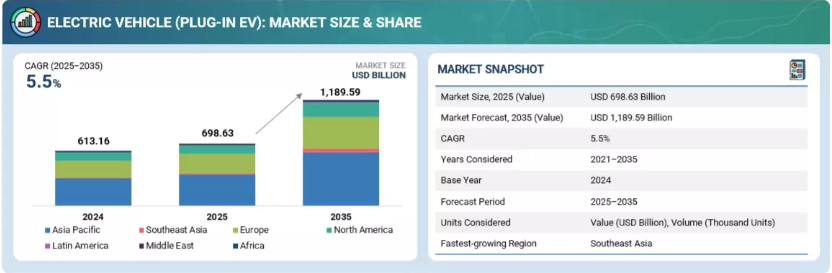
The global electric vehicle market size is undergoing a transformational shift as governments, automakers, technology providers, and consumers increasingly embrace sustainable transportation solutions. Advancements in battery technology, expansion of charging infrastructure, supportive government policies, and rising environmental awareness are accelerating electric vehicle adoption across passenger and commercial transportation segments worldwide.
The electric vehicle market size is projected to grow from USD 1,145.51 billion in 2024 to USD 1,857.33 billion by 2035. Increasing investments in battery electric vehicles, charging infrastructure, connected mobility solutions, and next-generation EV architectures are expected to drive strong electric vehicle market growth throughout the forecast period.
Electric Vehicle Industry Overview
Electric vehicles are redefining the future of mobility by offering cleaner, more efficient alternatives to conventional internal combustion engine vehicles. The industry includes Battery Electric Vehicles (BEVs), Plug-in Hybrid Electric Vehicles (PHEVs), Hybrid Electric Vehicles (HEVs), Mild Hybrid Electric Vehicles (MHEVs), and Fuel Cell Electric Vehicles (FCEVs).
Automakers are rapidly expanding their EV portfolios through dedicated electric platforms, advanced battery technologies, intelligent software systems, and connected vehicle capabilities. As sustainability becomes a global priority, electric vehicles are emerging as a cornerstone of future transportation ecosystems.
Battery Electric Vehicles Driving Electric Vehicle Market Growth
Battery Electric Vehicles continue to represent the largest and most influential segment within the electric vehicle market. Growing consumer confidence, improved battery performance, longer driving ranges, and declining battery costs are making BEVs increasingly attractive across global markets.
Governments worldwide are supporting BEV adoption through incentives, emissions regulations, and infrastructure investments. Automakers are also introducing new models across multiple price segments, enabling broader consumer access to electric mobility solutions.
As battery technology continues to advance, BEVs are expected to remain the primary growth engine for the electric vehicle market.
Download PDF Brochure @ https://www.marketsandmarkets.com/pdfdownloadNew.asp?id=209371461
Electric SUVs Accelerating Global EV Adoption
Electric SUVs are emerging as one of the fastest-growing segments within the electric vehicle market. Consumers increasingly prefer SUVs because of their spacious interiors, advanced safety features, versatile performance, and premium driving experience.
Automakers are responding by launching a growing number of electric SUV models across entry-level, mid-range, and luxury categories. Improvements in battery efficiency and vehicle architectures are enabling electric SUVs to deliver longer ranges and enhanced performance while maintaining practicality.
The growing popularity of electric SUVs is expected to significantly contribute to electric vehicle market share growth over the coming decade.
EV Charging Infrastructure Supporting Market Expansion
The expansion of EV charging infrastructure remains critical to the continued growth of the electric vehicle market. Governments and private-sector companies are investing heavily in public charging networks, fast-charging stations, and ultra-fast charging technologies to support increasing EV adoption.
Advancements in charging technologies are reducing charging times while improving user convenience and vehicle utilization. Smart charging systems and grid integration solutions are further enhancing the efficiency of charging ecosystems.
As charging infrastructure becomes more accessible and reliable, adoption barriers are expected to decline significantly.
800V Architecture Transforming Electric Vehicle Performance
The transition toward 800V electric vehicle architectures is reshaping the performance capabilities of next-generation EVs. Compared with conventional 400V systems, 800V platforms offer faster charging speeds, improved energy efficiency, reduced heat generation, and enhanced power delivery.
Automakers are increasingly adopting 800V architectures for premium and high-performance electric vehicles to deliver superior charging experiences and operational efficiency. These advancements are expected to play a key role in future EV market trends.
The increasing deployment of advanced EV architectures will continue driving innovation across the electric vehicle industry.
Fleet Electrification Creating New Growth Opportunities
Fleet electrification is becoming a major contributor to electric vehicle market growth as logistics providers, ride-hailing companies, public transportation operators, and corporate fleets seek sustainable transportation solutions.
Electric fleets provide lower operating costs, reduced maintenance requirements, and improved environmental performance compared to conventional vehicles. Growing focus on ESG initiatives and carbon reduction goals is further accelerating commercial EV adoption globally.
The continued expansion of fleet electrification programs is expected to create substantial opportunities for EV manufacturers and charging infrastructure providers.
Asia Pacific Leading Electric Vehicle Market Share
Asia Pacific is expected to remain the largest regional market for electric vehicles due to strong manufacturing capabilities, favorable government policies, extensive charging infrastructure development, and high consumer adoption rates.
China continues to dominate global EV production and sales, supported by large-scale investments in battery manufacturing and vehicle electrification. Japan and South Korea are also playing critical roles in advancing EV technologies, battery innovation, and supply chain development.
The region’s leadership in EV manufacturing and technology development is expected to support continued electric vehicle market growth through 2035.
Future Outlook for the Electric Vehicle Market
The future of the electric vehicle market will be shaped by battery innovation, charging infrastructure expansion, software-defined vehicles, connected mobility solutions, fleet electrification, and advanced vehicle architectures. As governments and industries continue pursuing sustainability goals, electric vehicles will become increasingly central to global transportation systems.
Growing investments in electric mobility ecosystems, renewable energy integration, smart charging networks, and vehicle connectivity technologies will continue creating significant opportunities across the electric vehicle industry. As a result, the electric vehicle market is expected to experience sustained growth, innovation, and adoption throughout the forecast period.
Request Free Sample Report @ https://www.marketsandmarkets.com/requestsampleNew.asp?id=209371461