
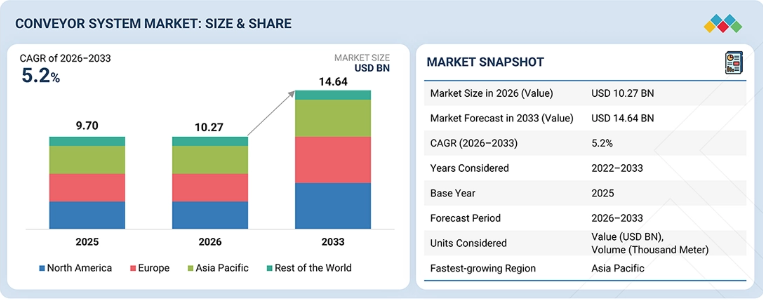
The global conveyor system market size is witnessing strong growth due to increasing warehouse automation, rapid expansion of e-commerce logistics, rising adoption of smart manufacturing technologies, and growing demand for efficient material handling systems across industrial sectors worldwide. Industries increasingly deploy advanced conveyor systems to improve operational efficiency, optimize material movement, reduce labor dependency, and enhance productivity across warehouses, manufacturing facilities, airports, mining sites, and distribution centers.
The conveyor system market size is also expanding due to increasing investments in automated logistics infrastructure, Industry 4.0 technologies, AI-powered material handling systems, and smart warehousing ecosystems.
Conveyor System Industry Overview
Conveyor systems are automated material handling solutions used for transporting products, goods, raw materials, and industrial components across manufacturing facilities, warehouses, airports, logistics hubs, mining operations, and distribution centers. These systems include belt conveyors, roller conveyors, overhead conveyors, pallet conveyors, bucket conveyors, and floor conveyors designed to improve industrial productivity and operational efficiency.
Modern conveyor systems increasingly integrate automation technologies, AI-powered monitoring platforms, IoT-enabled sensors, predictive maintenance software, and intelligent control systems to improve material flow efficiency and reduce operational downtime. Manufacturers are also focusing on modular conveyor designs, energy-efficient drive systems, and digitally connected automation platforms to support evolving industrial automation requirements.
The increasing demand for smart logistics and warehouse automation is expected to continue driving conveyor system market growth globally.
Warehouse Automation Driving Conveyor System Market Growth
Warehouse automation is becoming one of the strongest growth drivers within the conveyor system market. Logistics operators and warehouse providers increasingly deploy automated storage systems, intelligent fulfillment platforms, and connected material handling technologies to improve inventory movement and supply chain efficiency.
Conveyor systems play a critical role in warehouse automation by supporting high-speed product transportation, automated sorting, package handling, and inventory distribution operations. Automated conveyor systems also help warehouse operators reduce manual handling complexity, optimize warehouse throughput, and improve operational accuracy across large-scale fulfillment centers.
The rapid expansion of smart warehouses and digitally connected logistics ecosystems is expected to significantly strengthen conveyor system market demand during the forecast period.
Download PDF Brochure @ https://www.marketsandmarkets.com/pdfdownloadNew.asp?id=31314058
Smart Conveyor Technologies Transforming Industrial Material Handling
Smart conveyor technologies are transforming industrial material handling and manufacturing automation worldwide. Conveyor manufacturers increasingly integrate advanced sensors, AI-powered monitoring systems, cloud-based analytics, and intelligent control platforms to improve operational visibility and predictive maintenance capabilities.
AI-enabled conveyor systems help operators monitor equipment performance, detect operational abnormalities, optimize energy consumption, and reduce unexpected downtime. Smart conveyor technologies also support real-time inventory tracking, automated routing, and synchronized production workflows within highly automated industrial environments.
The increasing adoption of smart factories and connected industrial automation systems is expected to remain a major trend within the conveyor system market globally.
E-Commerce Expansion Increasing Demand for Conveyor Systems
The rapid expansion of e-commerce and omnichannel retail logistics is significantly increasing demand for conveyor systems worldwide. Fulfillment centers and distribution hubs require highly efficient material handling systems capable of supporting high-volume package sorting, inventory transportation, and rapid order processing operations.
Conveyor systems help logistics operators improve warehouse productivity, reduce package handling times, optimize inventory movement, and increase supply chain responsiveness across modern retail logistics ecosystems. Growing investments in automated fulfillment centers and large-scale warehouse infrastructure are further strengthening conveyor system market demand globally.
The continued growth of e-commerce ecosystems and digital retail infrastructure is expected to create major growth opportunities within the conveyor system market during the forecast period.
Industry 4.0 and AI-Powered Automation Supporting Smart Conveyor Deployment
Industry 4.0 technologies and AI-powered automation are becoming increasingly important within modern conveyor system deployments. Industrial operators increasingly deploy IoT-enabled conveyors, AI-driven maintenance systems, digital twins, and cloud-connected automation platforms to improve industrial productivity and operational intelligence.
Connected conveyor systems integrate predictive analytics, machine learning algorithms, real-time diagnostics, and automated control systems to improve reliability and reduce maintenance costs. AI-powered conveyor technologies also help optimize production scheduling, warehouse coordination, and inventory management within smart manufacturing environments.
The increasing integration of AI, IoT, robotics, and connected industrial technologies is expected to remain a major trend within the conveyor system market globally.
Asia Pacific Leading Conveyor System Market Share
Asia Pacific accounts for the largest conveyor system market share due to rapid industrialization, increasing manufacturing activities, expansion of warehouse infrastructure, and growing adoption of industrial automation technologies across China, India, Japan, and Southeast Asia.
China remains a major manufacturing and logistics hub globally, while India is witnessing rapid growth in warehousing infrastructure, industrial corridors, and e-commerce logistics expansion. Increasing investments in smart factories, automated logistics facilities, and intelligent manufacturing technologies are also accelerating conveyor system adoption throughout the region.
The growing expansion of industrial automation ecosystems and logistics infrastructure development is expected to continue driving conveyor system market growth across Asia Pacific during the forecast period.
Request Free Sample Report @ https://www.marketsandmarkets.com/requestsampleNew.asp?id=31314058