
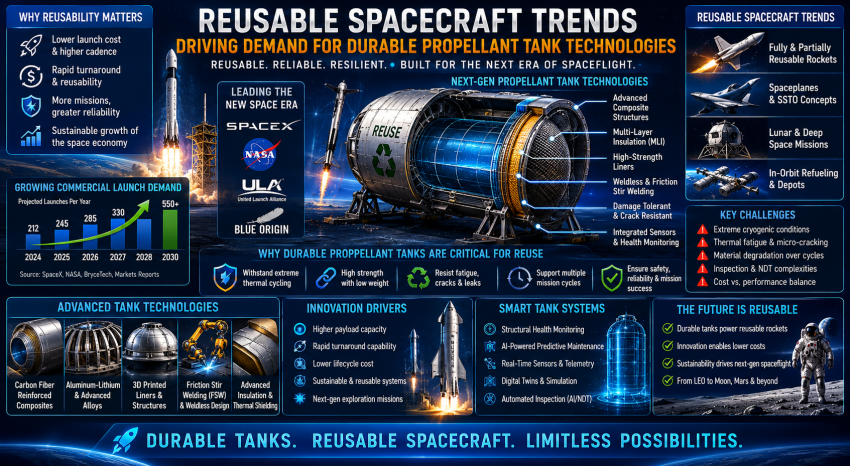
The rapid evolution of reusable launch vehicles and spacecraft is fundamentally reshaping the economics and engineering priorities of the global space industry. As organizations such as SpaceX, NASA, Blue Origin, and Rocket Lab continue advancing reusable launch architectures, the demand for durable, lightweight, and high-performance propellant tank technologies is accelerating at an unprecedented pace. Reusability is no longer viewed as an experimental concept but as the foundation of next-generation orbital transportation systems, lunar exploration missions, and deep-space logistics. This transformation is driving significant innovation in spacecraft propellant storage systems designed to withstand repeated launch, reentry, refueling, and operational cycles.
Traditional expendable launch vehicles prioritized single-use efficiency, often sacrificing long-term structural resilience in favor of immediate mission performance. However, reusable spacecraft require propellant tanks capable of enduring multiple thermal and mechanical stress cycles without compromising safety or operational integrity. This shift has elevated durable tank technologies into a strategic area of aerospace engineering, influencing material science, cryogenic insulation systems, structural design, and intelligent monitoring technologies.
One of the most significant trends fueling demand for advanced propellant tanks is the rise of rapid launch cadence operations. Commercial satellite constellations, national security missions, and expanding global broadband infrastructure are increasing the frequency of launches worldwide. Reusable rockets dramatically reduce mission costs and turnaround times, but achieving operational efficiency depends heavily on robust fuel storage systems capable of repeated use. Propellant tanks must now tolerate continuous exposure to cryogenic temperatures, vibration, pressurization cycles, and atmospheric reentry conditions while maintaining minimal structural degradation.
Get Detailed Market Size & Forecast Data: https://www.marketsandmarkets.com/pdfdownloadNew.asp?id=195002624
Cryogenic propellants such as liquid hydrogen and liquid oxygen remain central to high-efficiency propulsion systems. However, storing these propellants presents substantial engineering challenges because of their extremely low temperatures and volatile behavior. Reusable spacecraft place even greater demands on cryogenic tanks, as thermal fatigue and material stress accumulate over successive missions. To address these challenges, aerospace manufacturers are increasingly adopting advanced composite materials and hybrid metallic-composite tank architectures that offer superior fatigue resistance and lower mass compared to conventional aluminum alloys.
Carbon-fiber-reinforced polymer composites are becoming particularly important in reusable spacecraft programs. These materials provide exceptional strength-to-weight ratios, corrosion resistance, and improved thermal performance. Composite cryogenic tanks help reduce vehicle mass while improving payload capacity and fuel efficiency. Their ability to resist structural fatigue over repeated launch cycles makes them highly attractive for reusable orbital systems. Advanced manufacturing techniques such as automated fiber placement and additive manufacturing are also enabling more precise tank geometries and stronger structural integration.
The emergence of fully reusable heavy-lift systems is further accelerating innovation in propellant containment technologies. Vehicles designed for interplanetary missions and long-duration orbital operations require tanks that can maintain cryogenic stability for extended periods while enduring multiple docking, transfer, and refueling operations. Long-duration storage introduces additional concerns including boil-off mitigation, pressure stability, and insulation efficiency. As lunar and Mars exploration programs gain momentum, durable storage systems capable of supporting in-space refueling operations are becoming increasingly essential.
Another major trend influencing propellant tank development is the growing use of methane-based propulsion systems. Liquid methane has gained popularity because of its relatively high performance, cleaner combustion characteristics, and suitability for long-term storage. Methane-fueled reusable engines are increasingly integrated into next-generation launch systems designed for repeated missions. However, methane storage still requires highly reliable cryogenic containment solutions with advanced thermal insulation and structural resilience. This is driving investment in next-generation tank materials capable of balancing lightweight performance with long operational lifespans.
Artificial intelligence and digital monitoring systems are also transforming reusable spacecraft tank management. Modern spacecraft increasingly integrate smart sensors and predictive maintenance technologies directly into propellant storage systems. Embedded sensors monitor temperature gradients, structural stress, pressure fluctuations, and microfracture formation in real time. AI-powered diagnostic systems analyze operational data to predict maintenance requirements and identify early signs of structural degradation before failures occur. These technologies improve mission reliability while reducing maintenance costs and inspection times between launches.
Thermal management is another critical area of innovation in reusable spacecraft tank technologies. Repeated exposure to extreme thermal conditions during launch and atmospheric reentry can weaken tank structures over time. To combat this issue, aerospace engineers are developing advanced insulation systems, multilayer thermal barriers, and active cooling mechanisms that improve cryogenic stability and reduce heat transfer. Vacuum-insulated tank systems and integrated thermal protection structures are increasingly being adopted to improve operational durability and mission longevity.
The defense sector is also contributing to the expansion of reusable spacecraft tank technologies. Military space programs increasingly prioritize rapid deployment capabilities, resilient orbital infrastructure, and responsive launch systems. Reusable military spacecraft and hypersonic platforms require durable fuel containment systems capable of supporting extreme operational conditions and rapid mission turnaround cycles. These defense-driven investments often accelerate broader aerospace innovation, benefiting both government and commercial launch providers.
Supply chain modernization is further supporting advancements in reusable propellant tank manufacturing. Aerospace manufacturers are leveraging digital engineering platforms, automated production systems, and precision quality-control technologies to improve scalability and reliability. Additive manufacturing allows the production of highly complex tank components with fewer joints and welds, reducing structural vulnerabilities and improving long-term durability. Digital twin technologies are also enabling engineers to simulate lifecycle stress conditions and optimize tank performance before physical deployment.
Sustainability considerations are increasingly influencing reusable spacecraft development as well. Reusable launch systems significantly reduce material waste associated with expendable rockets, aligning with broader industry goals focused on environmental responsibility and cost efficiency. Durable propellant tanks play a vital role in maximizing the operational lifespan of reusable vehicles, minimizing replacement requirements, and reducing manufacturing resource consumption over time.
Discover Growth Opportunities & Trends @ https://www.marketsandmarkets.com/Market-Reports/satellite-propellant-tanks-market-195002624.html
International competition in commercial spaceflight is expected to intensify demand for advanced tank technologies throughout the coming decade. Emerging space economies and private aerospace startups are investing heavily in reusable launch infrastructure to support satellite deployment, scientific exploration, tourism, and future lunar logistics networks. This growing market environment is creating opportunities for specialized manufacturers focused on cryogenic systems, composite materials, thermal protection technologies, and intelligent spacecraft infrastructure.
As reusable spacecraft become central to the future of orbital transportation and deep-space exploration, durable propellant tank technologies will remain a foundational enabling capability. The convergence of advanced materials, AI-enabled monitoring, lightweight composite engineering, and next-generation cryogenic management systems is redefining how spacecraft are designed, operated, and maintained. In the years ahead, innovation in reusable propellant storage systems will play a decisive role in reducing launch costs, improving mission reliability, and supporting humanity’s expanding presence beyond Earth.