
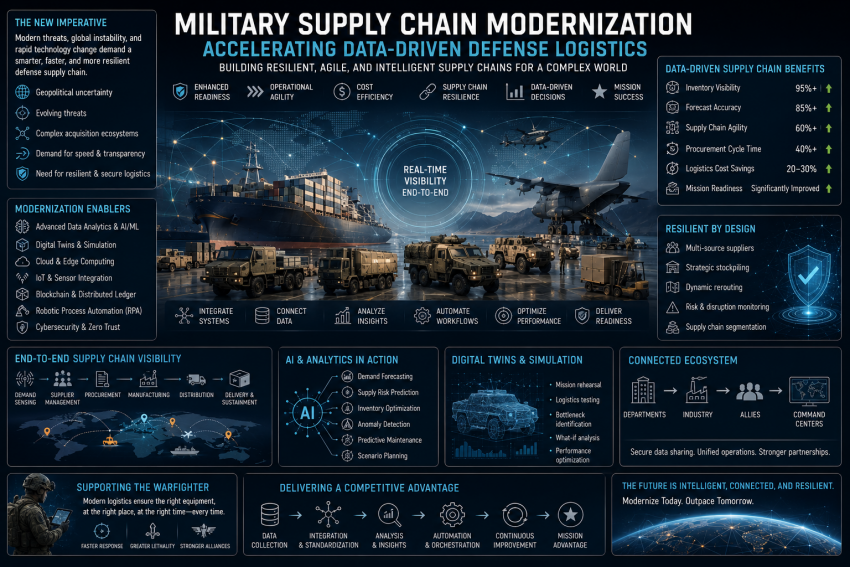
The global defense sector is undergoing a major transformation as military organizations modernize supply chain operations to support faster, smarter, and more resilient battlefield logistics. Traditional military logistics systems, once dependent on manual coordination and fragmented procurement structures, are rapidly evolving into digitally connected ecosystems powered by artificial intelligence, predictive analytics, automation, and real-time data visibility. This modernization wave is significantly accelerating the growth of the military supply chain management market as defense agencies worldwide prioritize operational readiness, sustainment efficiency, and mission agility.
Modern warfare increasingly depends on the rapid movement of equipment, fuel, spare parts, ammunition, medical supplies, and autonomous systems across highly dynamic operational environments. As geopolitical tensions rise and multi-domain warfare becomes more complex, military organizations are investing heavily in intelligent logistics infrastructure capable of supporting distributed operations, high-tempo deployments, and contested supply environments. According to recent industry estimates, the global defense logistics and supply chain market is expected to witness strong growth through 2035, driven by increasing defense budgets, digital transformation programs, and advanced military modernization initiatives.
One of the primary drivers behind this transformation is the adoption of data-driven logistics management systems. Defense agencies are increasingly integrating AI-enabled analytics platforms capable of predicting maintenance needs, optimizing inventory levels, and improving transportation efficiency. Predictive logistics technologies allow commanders to anticipate equipment failures before they occur, reducing downtime and improving mission readiness. These systems leverage massive volumes of operational data gathered from connected vehicles, aircraft, naval systems, and battlefield sensors to improve sustainment decision-making in real time.
Download PDF Brochure : https://www.marketsandmarkets.com/pdfdownloadNew.asp?id=155479010
Artificial intelligence is becoming especially critical in military supply chain modernization. AI-powered logistics platforms can analyze weather conditions, battlefield threats, transportation routes, and fuel consumption patterns simultaneously to optimize resource allocation and mission planning. Machine learning algorithms also help military planners forecast demand fluctuations and identify vulnerabilities within complex defense supply networks. The integration of AI into military sustainment operations is increasingly viewed as essential for maintaining operational superiority in future conflict environments.
The growing deployment of autonomous and unmanned systems is also reshaping defense logistics requirements. Modern military operations now rely heavily on unmanned aerial vehicles, autonomous ground vehicles, robotic resupply systems, and loitering munitions, all of which require highly responsive and digitally coordinated supply chains. Advanced logistics systems must support rapid replenishment cycles, distributed maintenance hubs, and real-time inventory tracking for these next-generation combat assets.
Cloud computing and digital twin technologies are further accelerating logistics modernization across defense organizations. Digital twins enable military planners to create virtual replicas of supply chain networks, warehouses, transportation systems, and battlefield logistics operations. These simulations allow defense agencies to test operational scenarios, identify bottlenecks, and improve contingency planning before real-world deployment. Cloud-enabled logistics systems also improve interoperability among allied forces by enabling secure data sharing and coordinated multinational sustainment operations.
The increasing complexity of modern military equipment is another major factor driving advanced supply chain investments. Next-generation fighter aircraft, hypersonic weapons, missile defense systems, and naval combat platforms require sophisticated maintenance ecosystems supported by predictive analytics and automated inventory systems. As defense systems become more technologically advanced, supply chain efficiency becomes directly tied to combat readiness and force availability.
Military organizations are also focusing heavily on supply chain resilience following recent global disruptions caused by geopolitical tensions, semiconductor shortages, and transportation instability. Defense planners increasingly recognize the risks associated with overreliance on single-source suppliers and geographically concentrated manufacturing hubs. As a result, governments are implementing supply chain diversification strategies, reshoring critical production capabilities, and investing in domestic defense manufacturing infrastructure.
Additive manufacturing is emerging as a particularly important capability within military logistics modernization. Defense forces are increasingly exploring 3D printing technologies for on-demand production of spare parts, tools, and battlefield components. This capability reduces dependency on lengthy supply routes and enables rapid equipment repair in remote or contested environments. Additive manufacturing also improves operational flexibility by allowing deployed units to produce mission-critical parts closer to the point of need.
Blockchain technology is gaining attention as a tool for improving transparency and traceability within defense supply chains. Secure blockchain-based systems can help military agencies track sensitive components, authenticate suppliers, and reduce risks associated with counterfeit parts. Enhanced traceability is particularly important for aerospace systems, missile technologies, and secure communications infrastructure where component integrity is mission-critical.
The expansion of military logistics automation is transforming warehouse and distribution operations as well. Autonomous forklifts, robotic inventory systems, AI-enabled routing software, and smart warehouses are helping defense agencies improve storage efficiency and accelerate supply distribution. Automated logistics hubs can operate with reduced manpower while maintaining high operational tempo during crisis situations.
Cybersecurity has become a central priority in defense supply chain modernization efforts. As logistics systems become increasingly digital and interconnected, military organizations face growing risks from cyberattacks targeting supply networks, transportation infrastructure, and inventory management systems. Governments are investing heavily in secure logistics architectures, encrypted communications, and cyber-resilient command systems to protect defense sustainment operations from emerging digital threats.
The Indo-Pacific region is expected to become one of the fastest-growing markets for military logistics modernization due to rising regional tensions, naval expansion programs, and increasing investments in defense readiness. Countries including India, China, Japan, South Korea, and Australia are accelerating military digitization programs and strengthening supply chain resilience to support long-term strategic objectives. India, in particular, is investing in indigenous defense manufacturing and advanced logistics systems under its broader military modernization initiatives.
North America continues to dominate the military supply chain modernization market due to substantial U.S. defense spending, advanced technology adoption, and extensive global deployment requirements. The U.S. Department of Defense is actively pursuing Joint All-Domain Command and Control (JADC2) initiatives that rely heavily on integrated logistics data, AI-enabled sustainment, and connected battlefield networks. (defense.gov)
Defense contractors and technology companies are increasingly collaborating to develop intelligent logistics ecosystems capable of supporting future autonomous warfare environments. Major industry participants are focusing on AI-based supply optimization, predictive maintenance software, robotics integration, smart warehousing, and secure defense cloud infrastructure to strengthen their market position.
Explore In-Depth Industry Analysis: https://www.marketsandmarkets.com/Market-Reports/military-vehicle-sustainment-market-155479010.html
The evolution of modern warfare toward highly connected, data-centric operations is fundamentally redefining the role of military logistics. Future defense success will depend not only on advanced weapon systems but also on the ability to sustain forces efficiently across dispersed and contested operational theaters. As military organizations prioritize agility, resilience, and digital transformation, supply chain modernization is emerging as one of the most strategically important investments shaping the future of global defense operations.
The convergence of AI, automation, cloud computing, predictive analytics, and autonomous logistics systems is accelerating a new era of intelligent military sustainment. With governments worldwide investing aggressively in defense readiness and operational resilience, the military supply chain modernization market is positioned for sustained long-term growth as data-driven logistics becomes central to next-generation defense strategy.