
Directed-Energy Counter-UAS
Directed-Energy Counter-UAS Programs Accelerating Advanced Military Protection Strategies
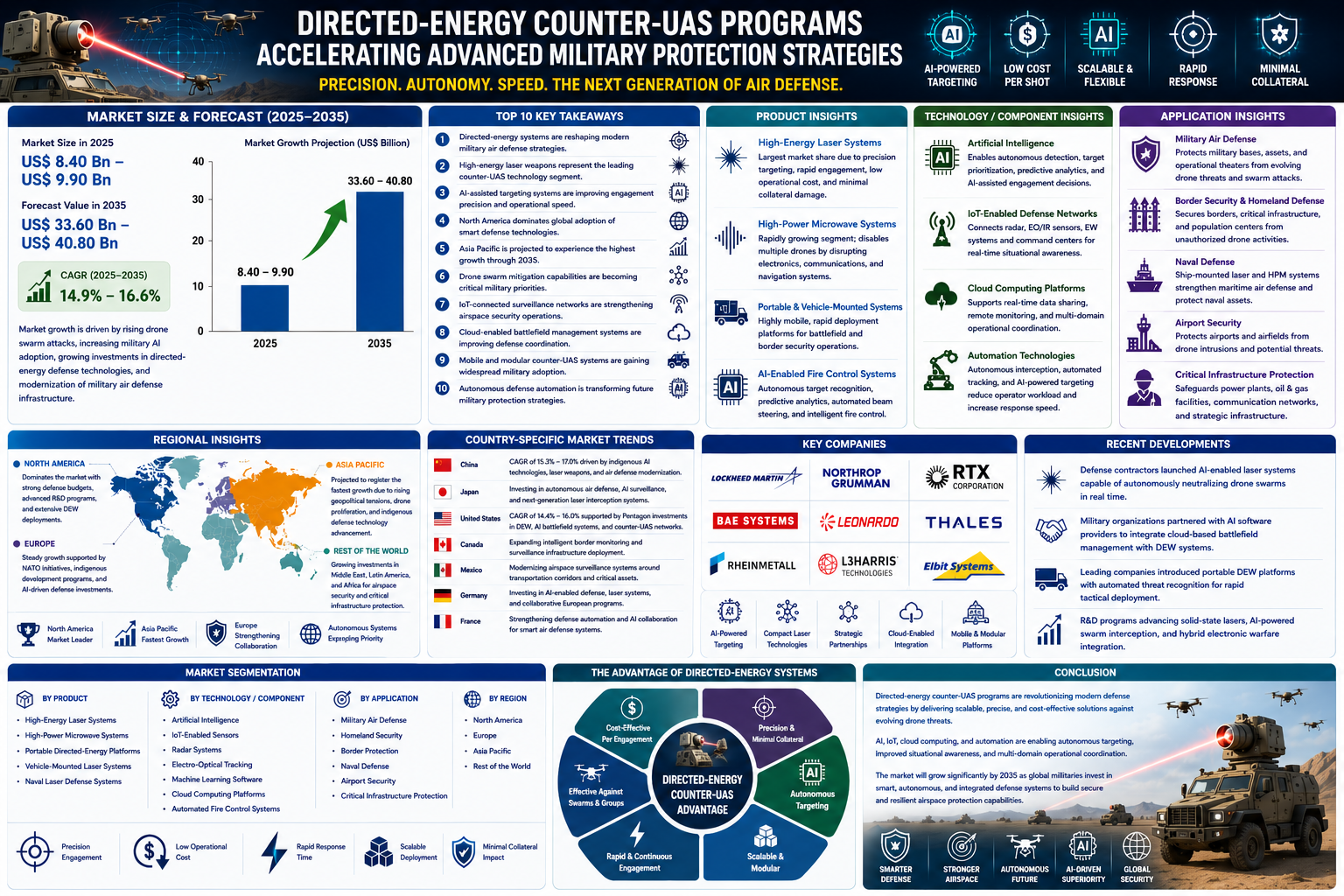
The global market for directed-energy counter-UAS systems is estimated to grow from US$ 8.40 Billion – US$ 9.90 Billion in 2025 to US$ 33.60 Billion – US$ 40.80 Billion by 2035 at a CAGR of 14.9% – 16.6% from 2025 to 2035. The rapid increase in unmanned aerial system threats, rising geopolitical instability, and expanding military modernization programs are accelerating global demand for advanced counter-UAS defense technologies. Directed-energy systems, including high-energy lasers and high-power microwave weapons, are becoming central components of modern military protection strategies due to their precision engagement, scalability, and lower operational costs compared to traditional missile-based interception systems. Artificial intelligence, IoT-enabled defense networks, autonomous targeting systems, and cloud-connected battlefield management platforms are transforming counter-UAS operations by enabling real-time threat detection, predictive engagement, and automated response coordination. Governments worldwide are increasing investments in AI-driven air defense systems, mobile laser weapons, and autonomous military protection platforms to strengthen homeland security and battlefield resilience.
Key Market Trends & Insights
North America leads the market due to extensive defense modernization initiatives and large-scale investments in AI-powered directed-energy programs.
Asia Pacific is projected to witness the fastest growth driven by increasing drone proliferation, geopolitical tensions, and indigenous defense technology development.
High-energy laser systems dominate the market because of their precision targeting capabilities and cost-effective operational performance.
AI-powered autonomous targeting and sensor fusion technologies are transforming modern counter-UAS defense operations.
IoT-enabled radar and surveillance systems are improving real-time battlefield situational awareness and multi-domain defense coordination.
Portable and vehicle-mounted counter-UAS systems are gaining strong demand for tactical battlefield and border security applications.
Download PDF Brochure: https://www.marketsandmarkets.com/pdfdownloadNew.asp?id=4197284
Market Size & Forecast
- Base year market size (2025): US$ 8.40 Billion – US$ 9.90 Billion
- Forecast value by 2035: US$ 33.60 Billion – US$ 40.80 Billion
- CAGR (2025–2035): 14.9% – 16.6%
- Market growth is supported by rising drone swarm attacks, increasing military AI adoption, growing investments in directed-energy defense technologies, and expanding deployment of autonomous battlefield protection systems
Directed-Energy Counter-UAS Programs Accelerating Advanced Military Protection Strategies Top 10 key takeaway
- Directed-energy systems are reshaping modern military air defense strategies
- High-energy laser weapons represent the leading counter-UAS technology segment
- AI-assisted targeting systems are improving engagement precision and operational speed
- North America dominates global smart defense deployment initiatives
- Asia Pacific is projected to experience the highest growth through 2035
- Drone swarm mitigation capabilities are becoming critical military priorities
- IoT-connected surveillance networks are strengthening airspace security operations
- Cloud-enabled battlefield management systems are improving defense coordination
- Mobile and modular counter-UAS systems are gaining widespread military adoption
- Autonomous defense automation is transforming future military protection strategies
Product Insights
High-energy laser systems currently account for the largest market share because they provide highly precise, scalable, and cost-efficient solutions for neutralizing unmanned aerial threats. These systems can rapidly engage drones with minimal collateral damage, making them highly suitable for protecting military installations, naval vessels, airbases, and critical infrastructure facilities. Defense organizations worldwide are increasingly deploying laser-based defense platforms to improve airspace protection and battlefield survivability.
High-power microwave systems are emerging as one of the fastest-growing product categories due to their capability to disable multiple drones simultaneously by disrupting onboard electronics and communications systems. These systems are particularly effective against coordinated drone swarm attacks and electronic warfare threats in modern combat environments.
Vehicle-mounted and portable directed-energy systems are also witnessing strong demand as military forces prioritize highly mobile and rapidly deployable air defense solutions. Compact counter-UAS platforms integrated with tactical vehicles and mobile command units are improving operational flexibility across battlefield environments.
Artificial intelligence is increasingly integrated into next-generation directed-energy platforms through autonomous tracking systems, predictive threat analytics, AI-powered fire control software, and automated beam steering technologies. These capabilities significantly enhance targeting accuracy and response efficiency during dynamic military operations.
Technology / Component Insights
Artificial intelligence is playing a transformative role in the counter-UAS defense market by enabling autonomous threat detection, intelligent target prioritization, and AI-assisted engagement decision-making. Machine learning algorithms analyze radar data, infrared signatures, electro-optical imagery, and sensor inputs in real time to identify and neutralize aerial threats more effectively.
IoT-enabled defense ecosystems are strengthening military situational awareness by connecting radar systems, surveillance drones, command centers, electronic warfare platforms, and battlefield sensors into integrated operational networks. These interconnected systems improve communication, operational coordination, and rapid-response defense capabilities.
Cloud computing technologies are enabling scalable battlefield management platforms capable of supporting real-time intelligence sharing, remote surveillance monitoring, and coordinated multi-domain defense operations. Cloud-based systems also facilitate integration of AI-enabled directed-energy platforms into broader military command architectures.
Automation technologies are significantly reducing operator workload while improving response speed in high-intensity defense scenarios. Autonomous interception systems and AI-powered targeting algorithms enable rapid engagement against complex drone threats, including swarm-based attacks.
Future innovation trends are expected to include quantum-enhanced targeting technologies, compact solid-state laser systems, hybrid electronic warfare integration, AI-powered swarm interception platforms, and fully autonomous battlefield defense ecosystems.
Application Insights
Military air defense applications currently dominate the market due to increasing deployment of directed-energy systems across strategic military bases, operational theaters, and frontline combat environments. Governments worldwide are prioritizing investments in advanced counter-UAS technologies to protect military assets from evolving drone threats.
Border security and homeland defense applications are experiencing substantial growth as countries strengthen surveillance capabilities around national borders, transportation corridors, and critical infrastructure. Directed-energy systems provide highly effective protection against unauthorized drone activities, smuggling operations, and aerial reconnaissance threats.
Naval defense applications are also expanding rapidly as maritime forces integrate ship-mounted laser systems and AI-powered counter-UAS technologies into naval fleets and offshore defense operations. These systems improve maritime situational awareness and strengthen protection against unmanned aerial attacks targeting naval assets.
Future opportunities are expected in airport security, smart military bases, urban defense infrastructure, autonomous battlefield operations, and integrated multi-domain air defense ecosystems powered by artificial intelligence and IoT technologies.
Regional Insights
North America dominates the global market due to extensive investments in advanced defense modernization programs, AI-enabled military technologies, and next-generation directed-energy systems. The United States Department of Defense continues to allocate substantial funding toward autonomous battlefield defense platforms, laser weapon systems, and integrated counter-UAS technologies.
Europe is witnessing steady market growth driven by NATO modernization initiatives, increasing investments in smart defense technologies, and growing concerns over drone-related security threats. Germany, France, and the United Kingdom are strengthening indigenous development programs focused on autonomous defense systems and laser-based military protection platforms.
Asia Pacific is projected to register the fastest growth during the forecast period due to increasing geopolitical tensions, expanding drone manufacturing capabilities, and rising military modernization initiatives across China, Japan, India, and South Korea. Regional governments are investing heavily in AI-powered defense technologies and smart airspace security systems.
The Middle East is also emerging as a promising regional market because of increasing investments in critical infrastructure protection, military modernization, and advanced air defense technologies.
- North America remains the largest regional market for directed-energy defense systems
- Asia Pacific is projected to achieve the fastest growth through 2035
- Europe is strengthening collaborative AI-driven defense initiatives
- Naval counter-UAS applications are expanding across global maritime forces
- Autonomous battlefield defense systems are becoming strategic military priorities
[Country]-Specific Market Trends
China is projected to grow at a CAGR of 15.3% – 17.0% due to expanding investments in indigenous AI-powered military technologies, advanced laser weapon systems, and integrated air defense modernization programs. The country continues to strengthen domestic defense manufacturing capabilities to improve strategic self-reliance.
Japan is accelerating adoption of autonomous defense systems and AI-enabled surveillance technologies to strengthen maritime security and homeland protection capabilities. Government-supported innovation initiatives are advancing development of next-generation directed-energy defense systems.
The United States remains the largest national market with a CAGR of 14.4% – 16.0%, supported by substantial Pentagon investments in AI-assisted battlefield systems, directed-energy weapons, and integrated smart defense networks. Canada is expanding deployment of intelligent border monitoring systems, while Mexico is modernizing critical airspace surveillance infrastructure.
Germany and France are increasing investments in collaborative European defense initiatives focused on AI-enabled military automation, laser weapon integration, and autonomous battlefield protection technologies.
- China is strengthening indigenous AI-enabled military production capabilities
- Japan is prioritizing autonomous maritime and homeland defense modernization
- The United States leads global deployment of advanced counter-UAS technologies
- Germany and France are expanding European military AI collaboration programs
- Government-backed defense AI investments continue driving market expansion worldwide
Key Company Insights
Major companies operating in the market include Lockheed Martin, Northrop Grumman, RTX Corporation, BAE Systems, Thales Group, Leonardo, Rheinmetall, L3Harris Technologies, and Elbit Systems.
These companies are focusing heavily on AI-powered targeting systems, autonomous drone interception platforms, compact solid-state laser technologies, and cloud-connected battlefield management solutions. Strategic defense collaborations with military agencies are accelerating development and deployment of advanced counter-UAS systems.
Industry participants are also investing in modular defense architectures, AI-assisted sensor fusion platforms, and next-generation mobile defense systems designed for rapid-response battlefield operations.
- AI-enabled autonomous targeting remains a major innovation focus
- Defense companies are investing heavily in mobile laser weapon platforms
- Strategic military partnerships are accelerating technology deployment
- Cloud-connected battlefield systems are improving operational coordination
- Modular smart defense architectures are gaining strong military demand
Recent Developments
Several defense contractors recently launched AI-enabled laser defense systems capable of autonomously detecting and neutralizing coordinated drone swarm attacks in real time.
Military organizations announced partnerships with AI software developers to integrate cloud-based battlefield management platforms with next-generation counter-UAS defense networks.
Leading defense companies introduced portable directed-energy systems equipped with automated threat recognition software and intelligent target prioritization capabilities for tactical military operations.
Market Segmentation
The market is segmented by product, technology/component, application, and region. By product, the market includes high-energy laser systems, high-power microwave systems, portable directed-energy platforms, vehicle-mounted laser weapons, and naval laser defense systems. High-energy laser systems currently dominate due to their precision targeting and operational efficiency.
By technology/component, the market includes artificial intelligence, IoT-enabled sensors, radar systems, electro-optical tracking technologies, machine learning software, cloud computing platforms, and automated fire control systems. AI-enabled targeting and automation technologies represent the fastest-growing technology category.
Applications include military air defense, homeland security, border protection, naval defense, airport security, and critical infrastructure protection. Military air defense remains the largest application segment because of rising deployment of autonomous counter-UAS systems across modern battlefield environments.
Regionally, the market is segmented into North America, Europe, Asia Pacific, and the rest of the world. North America leads the market, while Asia Pacific is expected to witness the highest long-term growth.
- High-energy laser systems dominate the product landscape
- AI-assisted targeting technologies are driving smart defense modernization
- Military air defense remains the largest application segment
- IoT-enabled surveillance systems are improving situational awareness
- Asia Pacific is projected to become the fastest-growing regional market
Conclusion
Directed-energy counter-UAS programs are accelerating the evolution of advanced military protection strategies through increasing adoption of AI-powered autonomous defense technologies, laser weapons, and intelligent battlefield management systems. Rising drone swarm threats, growing military modernization initiatives, and expanding investments in smart defense technologies are reshaping the future of global airspace security.
Artificial intelligence, IoT-enabled surveillance infrastructure, cloud-connected command systems, and automation technologies are significantly improving operational efficiency, autonomous threat engagement, and real-time situational awareness across modern military defense ecosystems.
The market is expected to experience robust expansion through 2035 as governments and defense organizations continue investing in scalable, highly precise, and intelligent counter-UAS defense architectures. Companies capable of delivering integrated AI-powered directed-energy systems and autonomous battlefield protection solutions are expected to maintain strong competitive advantages in the rapidly evolving smart defense industry.