
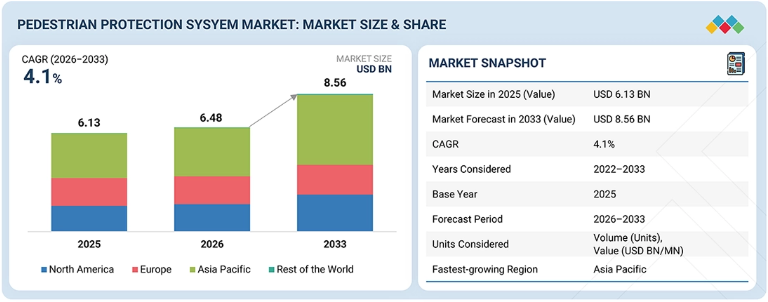
The global pedestrian protection system market is witnessing substantial growth due to increasing focus on road safety, rising adoption of advanced driver assistance systems (ADAS), and growing regulatory pressure to reduce pedestrian fatalities worldwide. Automotive manufacturers are increasingly integrating intelligent pedestrian safety technologies into passenger and commercial vehicles to improve collision prevention, enhance driver awareness, and support next-generation vehicle safety systems.
The pedestrian protection system industry is also benefiting from rapid advancements in artificial intelligence, computer vision, radar sensors, LiDAR technologies, autonomous emergency braking systems, and connected vehicle platforms. Increasing investments in autonomous mobility, smart transportation infrastructure, and AI-enabled automotive safety technologies are expected to accelerate long-term market growth globally. The pedestrian protection system market size is projected to expand steadily as governments and automotive manufacturers continue prioritizing vulnerable road user safety and intelligent transportation solutions.
Pedestrian Protection System Industry Overview
The pedestrian protection system industry includes automotive safety technologies designed to reduce pedestrian injuries and fatalities during vehicle collisions. These systems combine active safety technologies, passive safety mechanisms, intelligent sensing platforms, and collision mitigation systems to improve road safety and strengthen vehicle safety performance.
Modern pedestrian protection systems increasingly integrate technologies such as pedestrian detection sensors, forward-facing cameras, radar systems, LiDAR, automatic emergency braking, hood lift mechanisms, and pedestrian airbags. Automotive manufacturers are deploying these intelligent safety systems across passenger vehicles, electric vehicles, commercial fleets, and autonomous mobility platforms to improve compliance with global vehicle safety standards.
The pedestrian protection system market share is growing rapidly as governments worldwide implement stricter vehicle safety regulations and consumers increasingly prioritize advanced automotive safety features. Rising adoption of connected mobility ecosystems and software-defined vehicles is further supporting integration of intelligent pedestrian safety technologies across the automotive industry.
Key Trends in the Pedestrian Protection System Market
One of the most significant trends shaping the pedestrian protection system market is the rapid integration of artificial intelligence and computer vision technologies. AI-powered pedestrian detection systems can analyze vehicle surroundings in real time, identify pedestrians, monitor movement patterns, and trigger collision prevention mechanisms before accidents occur.
Advanced Driver Assistance Systems (ADAS) are also becoming increasingly important within the pedestrian safety market. Technologies such as automatic emergency braking, forward collision warning, lane departure assistance, and adaptive cruise control are increasingly integrated with pedestrian detection systems to improve overall vehicle safety performance.
Another major pedestrian protection system industry trend is the increasing use of radar and LiDAR sensors. These technologies improve detection accuracy under challenging weather and lighting conditions while supporting higher levels of vehicle automation and autonomous driving functionality. Sensor fusion technologies combining cameras, radar, and LiDAR are becoming critical components of next-generation automotive safety systems.
Connected vehicle technologies and smart transportation infrastructure are further accelerating innovation within the pedestrian protection system market. Real-time vehicle-to-everything (V2X) communication and intelligent traffic management systems are expected to significantly improve pedestrian safety within urban mobility environments.
Download PDF Brochure @ https://www.marketsandmarkets.com/pdfdownloadNew.asp?id=253754061
ADAS and AI Technologies Transforming Pedestrian Protection Systems
Artificial intelligence and ADAS technologies are transforming the future of automotive pedestrian safety systems. AI-enabled computer vision platforms can now recognize pedestrians, cyclists, and vulnerable road users with significantly higher accuracy compared to traditional sensor systems.
Pedestrian detection systems increasingly use deep learning algorithms, object recognition technologies, and predictive analytics to identify potential collision risks and activate automatic emergency braking systems in real time. These intelligent systems improve driver awareness and reduce accident probability, especially in urban traffic environments with high pedestrian density.
Automotive manufacturers are also integrating radar sensors, LiDAR technologies, and high-resolution camera systems to improve environmental perception and support advanced collision mitigation capabilities. The growing convergence of AI, sensor fusion, and connected mobility technologies is expected to significantly accelerate adoption of pedestrian protection systems globally.
Autonomous Vehicles Increasing Demand for Pedestrian Safety Technologies
The rapid development of autonomous vehicles is creating strong demand for advanced pedestrian protection systems. Self-driving vehicles require highly accurate environmental perception technologies capable of detecting pedestrians, cyclists, and other vulnerable road users under complex traffic conditions.
Autonomous mobility platforms increasingly rely on sensor fusion systems combining LiDAR, radar, cameras, and AI-based perception algorithms to improve collision avoidance and decision-making accuracy. Pedestrian protection technologies are becoming critical safety components within autonomous driving ecosystems and smart mobility infrastructure.
As urban mobility systems become increasingly connected and automated, intelligent pedestrian safety technologies are expected to play a central role in reducing traffic accidents and improving transportation safety globally.
Regional Analysis of the Pedestrian Protection System Market
Europe represents one of the largest pedestrian protection system market shares due to strict vehicle safety regulations, strong ADAS adoption, and increasing focus on vulnerable road user protection. Euro NCAP safety requirements are significantly accelerating deployment of pedestrian safety technologies across European automotive markets.
Asia Pacific is emerging as a major growth region due to rapid automotive production, increasing urbanization, expansion of electric vehicle markets, and rising investments in intelligent transportation infrastructure. China, Japan, South Korea, and India are increasingly adopting advanced automotive safety systems and connected mobility technologies.
North America is witnessing growing adoption of ADAS platforms, autonomous driving technologies, and AI-based vehicle safety systems across passenger and commercial vehicle segments.
Future Outlook of the Pedestrian Protection System Market
The future of the pedestrian protection system market will be strongly influenced by artificial intelligence, autonomous driving technologies, connected mobility ecosystems, and smart transportation infrastructure. Automotive safety systems are expected to evolve toward highly intelligent collision prevention platforms capable of real-time environmental perception and predictive risk analysis.
Advancements in computer vision, sensor fusion, LiDAR, radar analytics, and cloud-connected mobility systems are expected to significantly improve pedestrian detection accuracy and collision mitigation performance. Integration with autonomous vehicles, software-defined mobility platforms, and smart city infrastructure will further strengthen the strategic importance of pedestrian safety technologies globally.
As governments, automotive manufacturers, and mobility providers continue prioritizing road safety and intelligent transportation systems, the pedestrian protection system market is expected to remain a critical segment within the future automotive safety ecosystem.
Request Free Sample Report @ https://www.marketsandmarkets.com/requestsampleNew.asp?id=253754061