
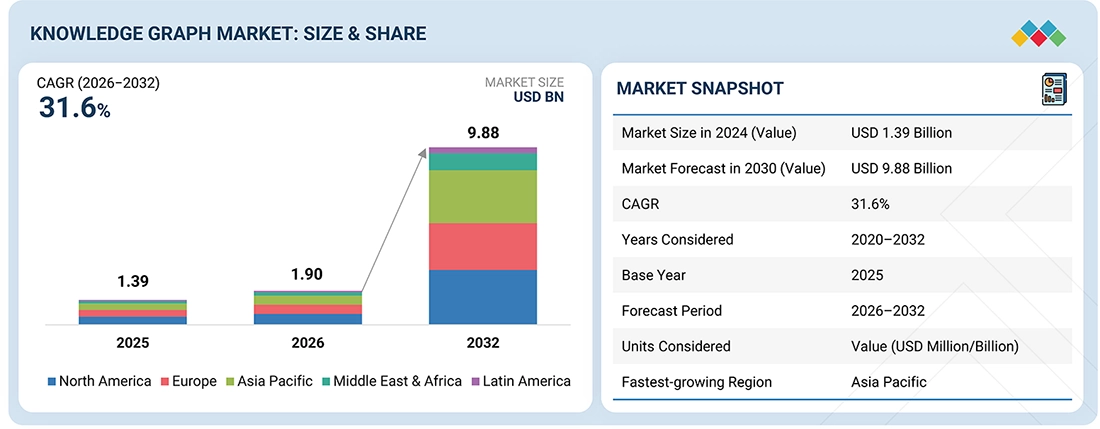
According to report “Knowledge Graph Market by Solution (Enterprise Knowledge Graph Platform, Graph Database Engine, Knowledge Management Toolset), Model Type (Resource Description Framework (RDF) Triple Stores, Labelled Property Graph) – Global Forecast to 2032″ published by MarketsandMarkets, the global Knowledge Graph Market size is projected to reach USD 9.88 billion by 2032 from USD 1.90 billion in 2026, at a compound annual growth rate (CAGR) of 31.6%.
Browse 350 market data Tables and 50 Figures spread through 300 Pages and in-depth TOC on “Knowledge Graph Market”
Download PDF Brochure @ https://www.marketsandmarkets.com/pdfdownloadNew.asp?id=217920811
The increasing need to organize and interpret complex, interconnected datasets is driving the adoption of knowledge graph technologies across enterprises. Knowledge graphs enable organizations to connect data from multiple sources into a unified structure, making it easier to access, analyze, and derive meaningful insights.
By establishing relationships between entities, knowledge graphs improve data discoverability and support advanced search capabilities, including semantic search and contextual recommendations. They also assist organizations in breaking down data silos and creating a more integrated view of enterprise information. As businesses continue to rely on both structured and unstructured data, knowledge graphs are becoming an essential tool for enhancing decision-making, improving operational efficiency, and enabling more collaborative workflows across departments.
By vertical, the BFSI segment is estimated to hold the largest market size during the forecast period.
The BFSI segment is expected to hold the largest market size during the forecast period, driven by the increasing need to manage complex financial data and ensure regulatory compliance. Knowledge graphs enable financial institutions to link customer data, transaction histories, credit information, and risk indicators, providing a comprehensive view of relationships across datasets. These capabilities are widely used in fraud detection, where interconnected data helps identify suspicious patterns and anomalies in real time. Knowledge graphs also support compliance requirements such as anti-money laundering (AML) and know your customer (KYC) by enabling better traceability and transparency of financial activities. In banking, they assist in credit risk assessment and loan evaluation processes, while in insurance, they help connect claims data, policies, and fraud indicators to improve claims management. In addition, the integration of knowledge graphs with AI technologies is enabling applications such as personalized financial services, intelligent assistants, and automated decision-making tools, contributing to improved customer experience and operational efficiency within the BFSI sector.
Virtual assistants, self-service data, and digital asset discovery segment to have the highest growth during the forecast period.
The virtual assistants, self-service data, and digital asset discovery segment is expected to register the highest growth during the forecast period, as organizations focus on improving data accessibility and user experience. Knowledge graphs play a key role in enabling these applications by connecting data across different sources and providing contextual understanding. In virtual assistants, knowledge graphs help interpret user queries more effectively by linking relevant data points and delivering context-aware responses. This improves the accuracy and relevance of interactions, leading to enhanced user engagement. Similarly, self-service data platforms leverage knowledge graphs to allow business users to explore and analyze data independently, without requiring extensive technical expertise.
For digital asset discovery, knowledge graphs enable efficient organization and retrieval of content by linking documents, media, and metadata. This makes it easier to identify relationships between assets and improves searchability across large repositories. As organizations continue to generate large volumes of digital content, the demand for such capabilities is expected to grow significantly.
Request Sample Pages @ https://www.marketsandmarkets.com/requestsampleNew.asp?id=217920811
Asia Pacific is estimated to witness the highest market growth rate during the forecast period.
Asia Pacific, enterprises are increasingly adopting knowledge graph technologies to enhance operational efficiency and support data-driven decision-making. In Japan, manufacturing organizations are integrating enterprise knowledge graphs into production and supply chain systems to improve visibility, optimize workflows, and strengthen resilience under national digital transformation strategies. These implementations enable better coordination across suppliers, production units, and logistics networks. In South Korea, the telecommunications sector is leveraging behavioral knowledge graphs, supported by the 2026 AI Basic Act, to enhance customer analytics and deliver personalized digital services. Telecom providers are using these systems to power AI-driven platforms and improve user engagement. Additionally, enterprises across sectors such as BFSI and e-commerce are exploring knowledge graph applications for fraud detection, recommendation systems, and customer intelligence. These developments indicate a growing emphasis on connected data ecosystems and advanced analytics capabilities across the region.
Market Players
The major vendors covered in the knowledge graph market are IBM Corporation (US), Oracle (US), Microsoft Corporation (US), AWS (US), Neo4j (US), Progress Software (US), TigerGraph (US), Stardog (US), Franz Inc (US), Openlink Software (US), Graphwise (US), Altair (US), ArangoDB (US), Fluree (US), Memgraph UK), GraphBase (Australia), Metaphacts (Germany), Relational AI (US), Wisecube (US), Smabbler (Poland), Onlim (Austria), Graphaware (UK), Diffbot (US), Eccenca (Germany), ESRI (US), Datavid (UK), and SAP (Germany). These players have adopted various growth strategies, such as partnerships, agreements and collaborations, new product launches, enhancements, and acquisitions, to expand their footprint in the knowledge graph market.
About MarketsandMarkets™
MarketsandMarkets™ has been recently recognized as one of America’s best management consulting firms by Forbes, as per their recent report.
Founded in 2009, MarketsandMarkets™ recognized uncharted business potentials within disruptive trends, forecasting a surge of $25 trillion in new B2B revenues by 2030. In our 16-year journey, we’ve collaborated with over 10,000 companies, generating $140+ billion in revenue impact. From a market research publisher, we’ve transformed into a growth-enabling leader, backed by a 1500+ strong team.
Contact:
Mr. Rohan Salgarkar
MarketsandMarkets™ INC.
1615 South Congress Ave.
Suite 103, Delray Beach, FL 33445
USA: 1-888-600-6441
UK +44-800-368-9399